
Cryotherapy for the Nose: Why Freezing Can Help (and Who It’s For)

If you’ve been dealing with constant sneezing, a runny nose that never seems to stop, or nasal blockage that keeps coming back, you may have heard about nasal cryotherapy. The name sounds intense, but the idea is simple: targeted freezing inside the nose to calm overactive nasal nerves.
This procedure is increasingly used for people with chronic rhinitis—especially when sprays and tablets are not enough, or when they cause side effects.
1) Why does cryotherapy work on the nose?
Your nose is not just “a tube for air.” It is a highly active organ with:
- Rich blood supply (this affects congestion)
- Mucus glands (this affects runny nose and postnasal drip)
- Nerve signals that control secretion and swelling
In many people with chronic rhinitis, the problem is not infection. It’s that the nose becomes over-responsive—almost like it’s stuck in “on mode.”
So why would freezing help?
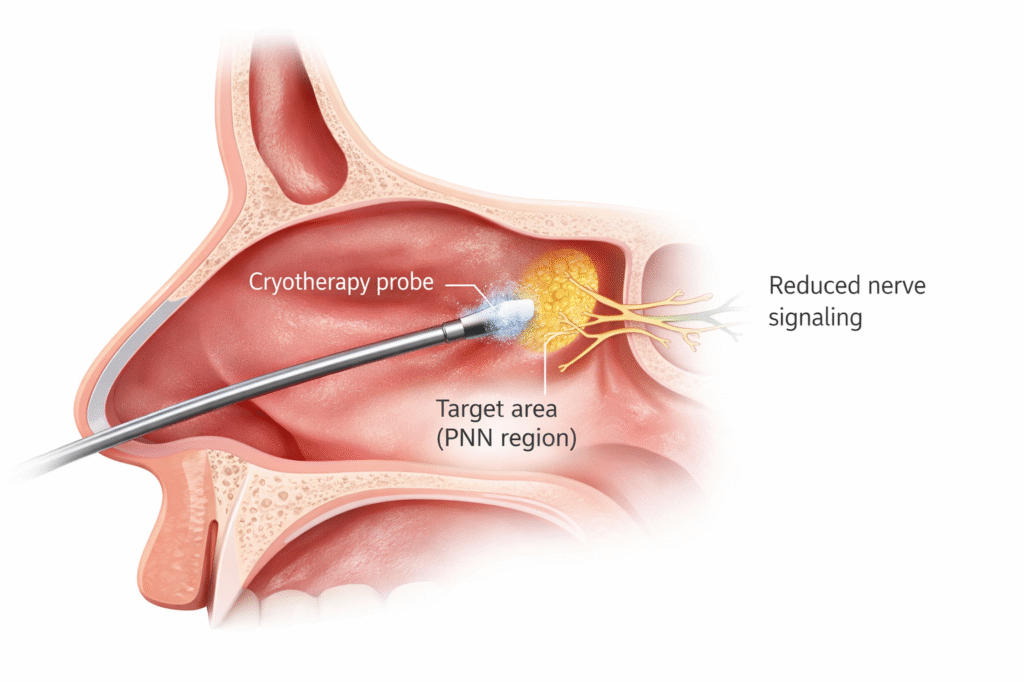
Because freezing can reduce the abnormal nerve signals that drive symptoms.
A major pathway involves a nerve network at the back of the nasal cavity that influences:
- mucus production
- nasal dripping
- sneezing triggers
- congestion patterns
When cryotherapy is applied to the right area, it can dampen the nerve input that keeps telling the nose to overproduce mucus and swell up.
2) Mechanism: how nasal cryotherapy works
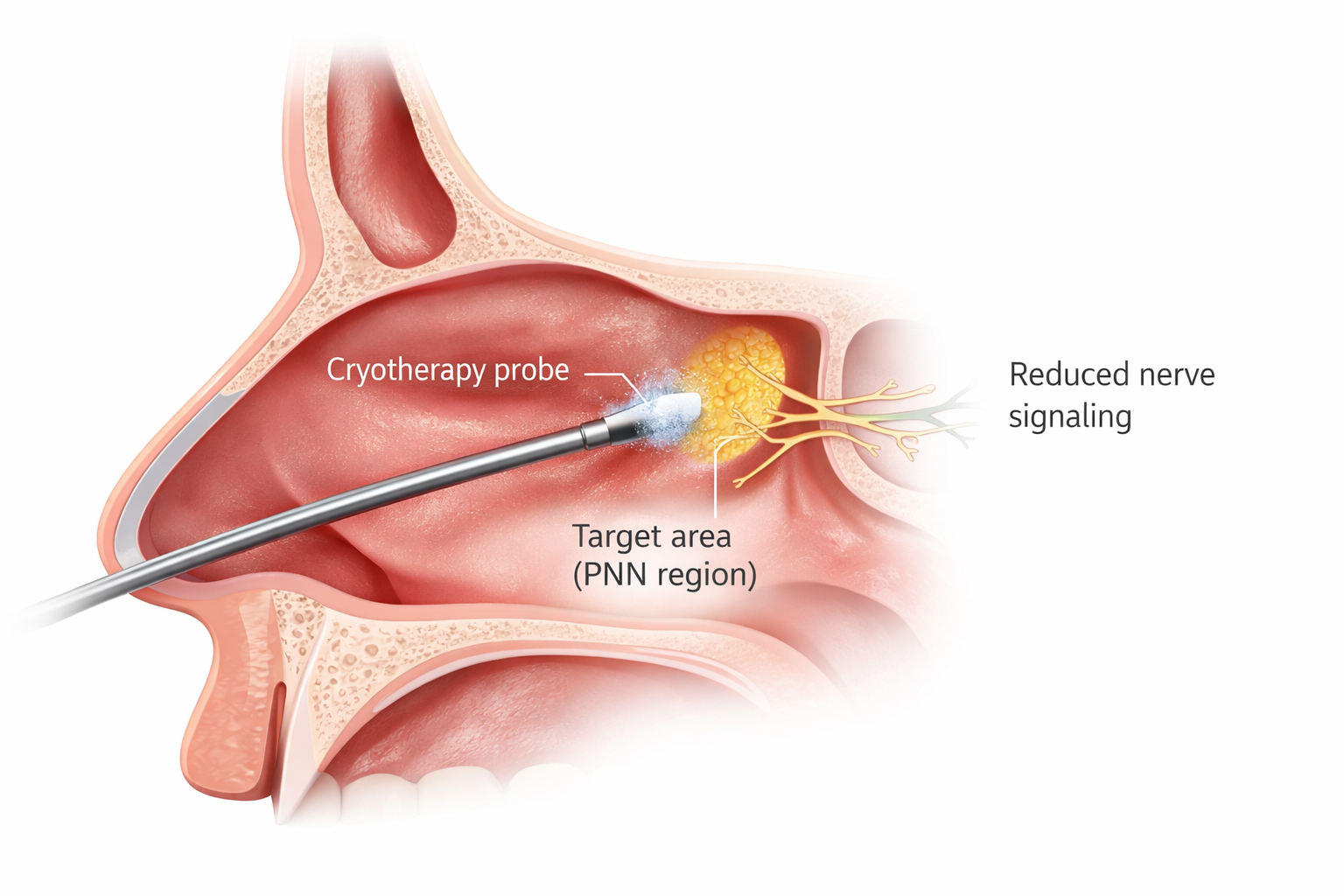
Most modern nasal cryotherapy procedures target the posterior nasal nerve (PNN) region.
Here’s what happens (in practical terms):

Step-by-step effect
- Cold energy is delivered to a specific area inside the nose using a small probe.
- The freezing causes a controlled injury to tiny nerve branches and surrounding tissue.
- Over time, the nerve signalling becomes less hyperactive.
- As the nerve drive reduces, the nose tends to produce less mucus and becomes less reactive to triggers.
What symptoms does this mechanism improve most?
Nasal cryotherapy tends to help the “wet” and “reactive” symptoms more than structural blockage:
- runny nose (rhinorrhea)
- postnasal drip
- sneezing fits
- nasal itch / irritation triggered by food, cold air, smells, dust
If someone’s main issue is a crooked septum or large turbinates causing mechanical obstruction, cryotherapy alone may not be enough. That’s why patient selection matters.
3) Practical indications: who is it for?
Nasal cryotherapy is typically considered for adults with chronic rhinitis, especially when symptoms persist despite good medical therapy.
Common candidates
1) Chronic allergic rhinitis
- Symptoms triggered by dust, pollen, pets, etc.
- Persistent sneezing/runny nose despite sprays
2) Non-allergic (vasomotor) rhinitis
- Symptoms triggered by temperature changes, strong smells, air-conditioning, spicy food, perfumes
- Allergy tests may be negative, but symptoms are real and chronic
3) Medication-limited patients
- People who cannot tolerate antihistamines (sleepiness, dry mouth)
- People who struggle with daily sprays long-term, or have poor response
4) “Drippy nose” and postnasal drip-dominant cases
- Particularly when the dominant complaint is mucus and drip rather than pure blockage
Who may not benefit as much?
- People whose main problem is structural blockage (deviated septum, large polyps)
- Active sinus infection that needs treatment first
- Uncontrolled bleeding tendency or on blood thinners (depends on severity and your doctor’s advice)
- People with unrealistic expectations (this is not a “new nose,” it’s symptom control)
4) Risks and what to do before going for the procedure
Nasal cryotherapy is generally considered a minimally invasive office-based procedure, but it is still a medical intervention. Risks are usually mild, but they matter.
Possible risks and side effects
1) Temporary pain or discomfort
- Some people feel pressure, aching, or sharp discomfort during or after the procedure.
2) Headache
- Often short-lived, can occur in the first day or two.
3) Mild bleeding
- Usually small amounts. Significant bleeding is uncommon but possible.
4) Nasal congestion / swelling
- The nose may feel more blocked for a short period because of local swelling.
5) Crusting and dryness
- Healing tissue may form crusts. Saline irrigation usually helps.
6) Temporary numbness or altered sensation
- Some people describe odd sensations in the nose or upper teeth region. This is usually temporary.
7) Incomplete response
- Not everyone improves. Some improve partially, and some may need additional treatment strategies.
What should you do before going for nasal cryotherapy?
1) Get the diagnosis right
Not every “blocked nose” is rhinitis. A proper ENT assessment can rule out:
- deviated septum
- nasal polyps
- chronic sinusitis
- turbinate hypertrophy as the main driver
2) Optimise medical treatment first
Cryotherapy is often considered after a reasonable trial of:
- intranasal steroid spray
- antihistamine spray or tablet (if allergic)
- saline irrigation
- trigger avoidance strategy
3) Review your medications
Tell your doctor if you are on:
- aspirin
- clopidogrel
- warfarin
- DOACs (apixaban, rivaroxaban, dabigatran)Do not stop anything on your own. The plan depends on your risk profile.
4) Discuss expectations clearly
Good questions to ask:
- Which symptom is most likely to improve for me: drip, sneeze, congestion, postnasal drip?
- How long until I feel the effect?
- What else might I need if blockage is still significant?
5) Plan aftercare
Common aftercare includes:
- saline irrigation
- avoiding vigorous nose blowing for a short period
- follow-up review to assess response and adjust ongoing sprays if needed
Final thoughts
Nasal cryotherapy works because it targets overactive nerve signals that keep the nose in a cycle of dripping, sneezing, and irritation. For the right patient—especially someone with chronic rhinitis dominated by runny nose and postnasal drip—it can be a practical option when standard treatments are not enough.
Comments are closed