
CT scan for sinus: when it’s useful (and when it isn’t)
A sinus CT scan is one of the most useful tests in ENT.
But it is also one of the most over-ordered.
Many people expect a CT for any “sinus” problem.
In real practice, CT is best used selectively.
The goal is simple: get the right diagnosis, and avoid unnecessary radiation and cost.
This guide explains when a sinus CT helps, when it does not, and what to do instead.
What a sinus CT actually shows
A CT scan shows the bony anatomy and the air spaces of the sinuses very clearly.
It can show:
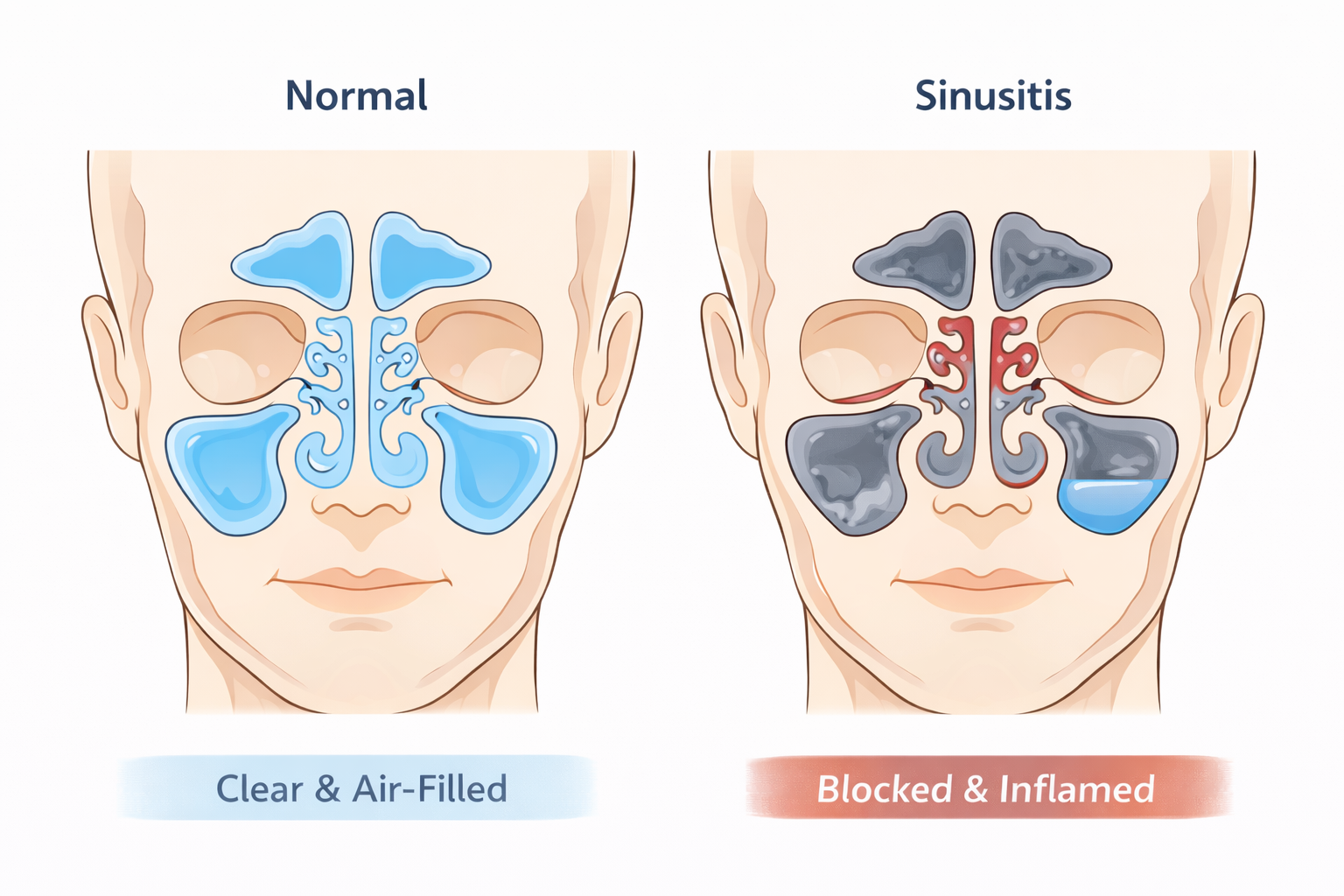
- Mucosal thickening and sinus blockage
- Fluid levels
- Nasal polyps (indirectly, as soft tissue density)
- Deviated septum and turbinate anatomy
- Drainage pathways (important for surgery planning)
- Bone erosion or aggressive disease patterns (red flags)
CT is the main imaging “workhorse” for sinonasal disease.
When a sinus CT is useful
1) Symptoms lasting >12 weeks (possible chronic rhinosinusitis)
If symptoms persist beyond 12 weeks, CT becomes more useful.
It helps confirm disease extent and guide next steps.
Typical symptoms include:
- Nasal blockage
- Nasal discharge / post-nasal drip
- Facial pressure
- Reduced sense of smell
CT should still be interpreted alongside symptoms and exam (often nasal endoscopy).
2) You have “sinus symptoms” but keep relapsing or not responding as expected
If a patient has repeated courses of treatment with persistent symptoms, CT can help answer:
- Is this truly sinus disease?
- Is this mainly allergy/rhinitis instead?
- Is there an anatomical blockage or polyp disease?
This is a common “turning point” where CT becomes reasonable.
3) Before sinus surgery (FESS / polyp surgery)
CT is essential for surgical planning.
It maps the drainage pathways and anatomical variants.
It also helps reduce risk during endoscopic surgery.
4) Suspected complications (this is urgent)
CT is appropriate when there are signs of orbital or intracranial complications.
Red flags include:
- Swollen eyelid, eye pain, reduced eye movement
- Double vision or vision changes
- Severe headache, drowsiness, confusion
- Cranial nerve symptoms
- High fever with worsening facial swelling
5) Suspicion of a mass, invasive fungal sinusitis, or other “non-routine” disease
CT (often combined with MRI) helps evaluate:
- Sinonasal tumours or suspicious unilateral disease
- Bone destruction
- Invasive fungal sinusitis (especially in immunocompromised patients)
This falls under guideline-based imaging scenarios.
6) Suspected CSF leak
If there is suspected cerebrospinal fluid leak (clear watery rhinorrhoea, positional, salty taste), CT (and sometimes MRI) is part of evaluation.
When a sinus CT is usually not useful
1) Simple cold or uncomplicated acute rhinosinusitis
Most acute sinus infections are diagnosed clinically.
Imaging is not recommended for uncomplicated acute rhinosinusitis.
Why? Because CT often shows “sinus changes” during a viral cold.
That does not mean you need antibiotics or surgery.
2) Early symptoms (a few days) without red flags
If symptoms are short-lived and improving, CT rarely changes management.
It adds cost and radiation without clear benefit.
3) To “confirm allergy”
Allergic rhinitis is mainly diagnosed by history and nasal exam.
A CT scan does not diagnose allergy.
If the main problem is sneezing, itch, watery nose, and fluctuating blockage, treat rhinitis first.
CT vs MRI: which one is better?
They answer different questions.
CT is best for:
- Bone anatomy
- Drainage pathways
- Surgical planning
- Many sinus inflammatory patterns
MRI is best for:
- Soft tissue characterisation
- Suspected tumour extension
- Orbital/intracranial complications
Radiation: what should patients know?
A sinus CT has radiation exposure, but it can often be done with low-dose protocols.
One study reported:
- Standard sinus CT effective dose around 0.371 mSv
- Low-dose CT around 0.045 mSv
Dose varies by scanner and protocol.
If CT is needed, ask if a low-dose sinus protocol is available.
For perspective, average natural background radiation is about 3 mSv/year (varies by location).
A practical decision guide (simple)
A sinus CT is more likely to help if any of these apply:
- Symptoms >12 weeks (chronic pattern)
- Not responding as expected to appropriate treatment
- Planning for sinus surgery
- Red flags or suspected complications
- Suspicion of tumour / fungal disease / CSF leak
A sinus CT is usually unnecessary if:
- You have a typical viral cold or uncomplicated acute sinusitis
- Symptoms are mild and improving within days
- The problem is mainly allergy symptoms without chronic sinus features
What I usually do before ordering CT (ENT workflow)
- History: duration, triggers, smell loss, one-sided symptoms
- Nasal exam ± nasal endoscopy
- Treat likely rhinitis first (if the pattern fits)
- If chronic sinusitis is suspected, or surgery is being considered → CT
This approach matches guideline logic: avoid routine imaging for uncomplicated acute sinusitis, and use CT when it will change management.
If you’re stuck in the cycle of “sinus symptoms” and you’re not improving, the fastest way to get clarity is a proper ENT assessment , not an automatic scan. Our ENT doctor will review your symptoms, examine your nose (and do nasal endoscopy if needed), and only recommend a sinus CT when it will genuinely change your treatment plan (for example, chronic symptoms, recurring relapses, polyp disease, surgical planning, or red-flag concerns). If imaging is needed, we’ll also discuss low-dose sinus CT options where appropriate, so you get the right diagnosis with the least unnecessary exposure.
Book an ENT consultation with our sinus specialist today to get a clear diagnosis and a step-by-step plan for your nose and sinus symptoms. If you have urgent red flags like eye swelling, vision changes, severe headache, or high fever, seek urgent medical care immediately.
References
- American Academy of Otolaryngology–Head and Neck Surgery Foundation (AAO-HNSF). Clinical Practice Guideline: Adult Sinusitis (2015). Recommendation against routine imaging for uncomplicated acute rhinosinusitis.
- AAO-HNSF. CT for Acute Sinusitis (Overuse) measure. Uncomplicated acute/subacute sinusitis typically does not require imaging.
- American College of Radiology (ACR). Appropriateness Criteria: Sinonasal Disease. Imaging not required for acute rhinosinusitis alone; CT/MRI used for specific scenarios (complications, chronic, mass, fungal, CSF leak).
- Abul-Kasim K, et al. Low-dose computed tomography of the paranasal sinuses. Reported effective dose differences between standard and low-dose sinus CT.
- RadiologyInfo.org. Radiation Dose from X-Ray and CT Exams. Background radiation estimate for dose perspective.
Comments are closed