
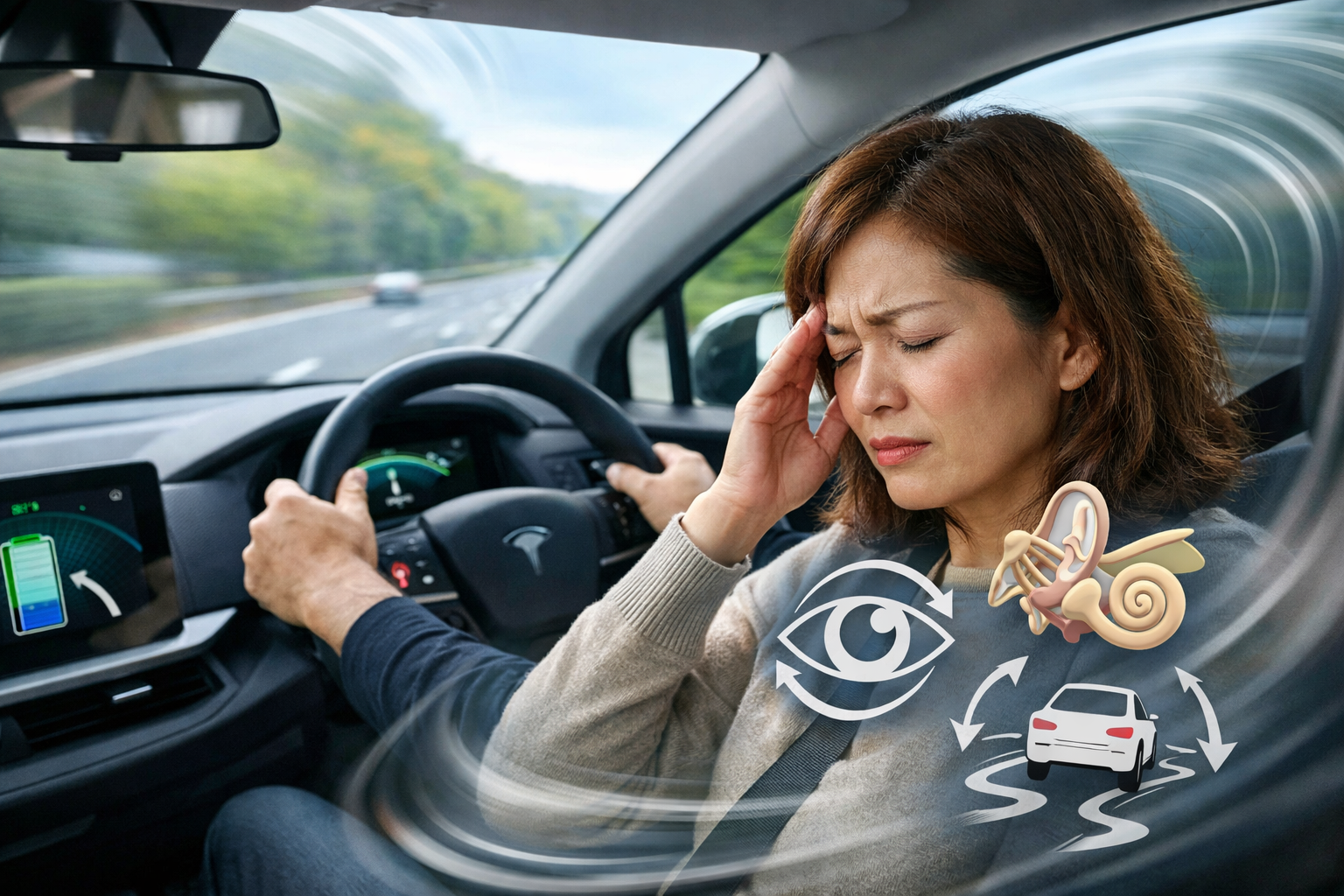
You’re in an EV. The ride is smooth and quiet. Then you feel dizzy, queasy, or like the world is spinning.
Many people call this “vertigo”. But in clinic, we separate two problems:
- Motion sickness / carsickness: nausea, cold sweat, headache, dizziness during movement.
- True vertigo: a spinning sensation that can happen even when you stop moving, often linked to an inner ear (vestibular) disorder.
EVs can make carsickness feel stronger, even in people who rarely get sick in petrol cars. Research on EV ride dynamics points to regenerative braking (deceleration patterns) and reduced sensory cues as likely contributors.
Why EVs can trigger dizziness more easily
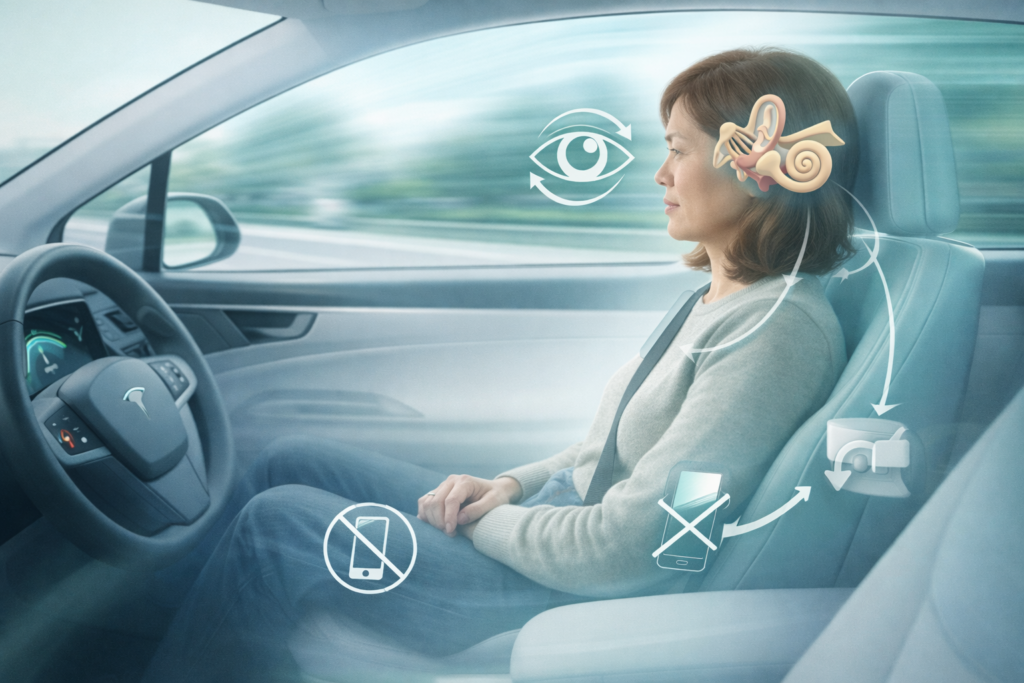
1) Quiet cabin = your brain gets fewer “motion clues”
In a petrol car, your brain gets constant cues: engine sound, vibration, gear changes. These cues help your brain predictmovement.
In an EV, the cabin is quieter and smoother. Your brain may receive less warning that you are accelerating or slowing. That can increase sensory mismatch (eyes vs inner ear vs body cues), which is a core mechanism behind motion sickness.
2) Regenerative braking can create “unfamiliar” deceleration (and jerk)
Many EVs slow down using regenerative braking (especially with one-pedal driving). If the driver’s foot control is not smooth, passengers feel repeated small slow-downs.
Studies looking specifically at EVs report that stronger regenerative braking can increase motion sickness symptoms, and that adding certain cues (like auditory motion cues) may reduce symptoms in some settings.
3) You are more likely to look at screens in an EV
Big touchscreens and quiet cabins encourage reading or scrolling. Looking down at a phone or screen while the body senses movement is a classic trigger for carsickness (again, mismatch of signals). This is also a common finding in broader vehicle motion-sickness research.
4) “New motion patterns” take time to adapt to
If you recently switched from petrol to EV, your brain may simply need time to recalibrate. Some EV-specific survey work suggests differences in symptom severity between EVs and fuel vehicles.
How this relates to ENT (the inner ear)
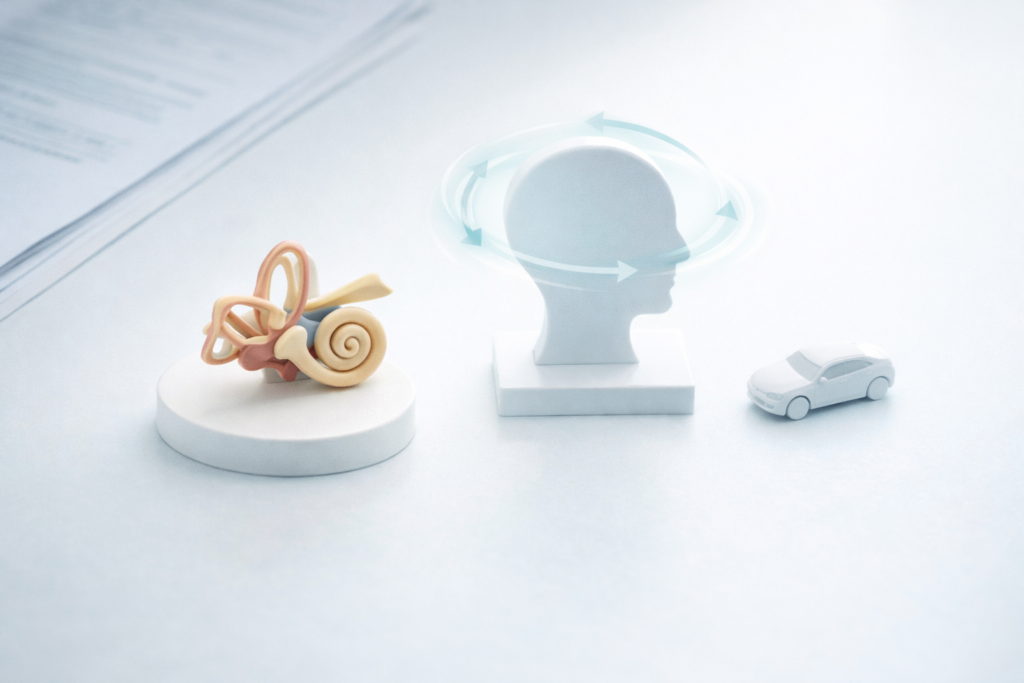
Your inner ear balance organs (vestibular system) detect head movement and acceleration. When the inner ear signals don’t match what your eyes see, your brain can react with dizziness, nausea, and sweating.
But ENT becomes even more relevant if you have a vestibular condition that makes you more sensitive.
Common ENT-related conditions that can be “unmasked” in cars:
- Vestibular migraine (very common): dizziness with motion sensitivity, head pressure, light sensitivity.
- BPPV (benign positional vertigo): brief spinning when you turn in bed or look up/down.
- Ménière’s disease: vertigo episodes with ear fullness, tinnitus, fluctuating hearing.
- Vestibular neuritis (after viral illness): sudden severe vertigo lasting days.
- PPPD (persistent postural-perceptual dizziness): chronic rocking/swaying, worsens in visually busy environments.
Key point: EVs don’t “damage” the ear. They more often trigger motion sickness or expose an underlying vestibular tendency.
What to do if you feel dizzy in an EV (practical checklist)
Step 1: Do this immediately (during the ride)
- Stop looking at your phone.
- Look far ahead at the horizon.
- Sit in the front seat (if you’re a passenger).
- Get fresh air (open a vent/window).
- Keep your head supported (headrest helps reduce head motion).
- If safe: ask the driver to smoothen the ride (gentle acceleration and gentle regen).
Step 2: Reduce EV triggers (settings + driving style)
- If your EV allows it, reduce regenerative braking strength (at least when sensitive passengers are in the car).
- Avoid “on-off” pedal inputs. Aim for steady speed and progressive slowing.
- For frequent sufferers, consider using any comfort/eco settings that smooth throttle response.
(These suggestions align with EV motion-sickness work that highlights braking/ride dynamics and the role of cues. )
Step 3: Simple prevention before travel
- Don’t travel on an empty stomach, but avoid heavy greasy meals.
- Hydrate.
- Sleep well (fatigue worsens symptoms).
- If you know you’re prone to motion sickness, talk to a doctor/pharmacist about motion sickness medication.
- Many can cause drowsiness. Do not drive after taking sedating medication.
Step 4: After you stop the car
If it was carsickness, you usually improve after stopping, with rest and fresh air.
If you have true vertigo, you may still feel spinning even after stopping, and you might have nausea/vomiting.
When it’s not just carsickness: see a doctor/ENT

Consider ENT assessment if you have:
- Spinning vertigo that happens even when you’re not in the car
- Vertigo triggered by turning in bed or looking up/down (possible BPPV)
- Hearing loss, tinnitus, or ear fullness with vertigo
- Symptoms lasting hours to days, not minutes
- Recurrent episodes, especially with migraine features (light sensitivity, head pressure)
Urgent red flags (go to ED)
- New weakness, facial droop, slurred speech
- Severe sudden headache
- Double vision, severe imbalance, fainting
- Chest pain or severe palpitations
Quick FAQ
Is EV dizziness a real thing?
Yes. EV-specific research has explored how regenerative braking and lack of familiar cues can worsen motion sickness in some passengers.
Does it mean my inner ear is damaged?
Usually no. It is often sensory mismatch. But if you get true spinning vertigo or ear symptoms, an ENT review is useful.
What is the single most helpful tip?
Eyes up, horizon view, no screens, plus smoother braking.
Internal Links
- ENT Services (includes dizziness & balance disorders)
- Ear Specialist Clinic (vertigo / dizziness symptoms)
- GP or ENT? When to see an ENT for dizziness / vertigo
- Hearing loss red flags (includes dizziness/vertigo warning signs)
- Ear wax vs ear infection (when dizziness/vertigo needs ENT review)
- Can AirPods replace hearing aids? (red flags incl. vertigo)
- Hearing aids in Malaysia (urgent ENT symptoms incl. recurrent vertigo)
- Contact The ENT Doctor
External Links
- Mayo Clinic: Motion sickness (tips + medications)
- CDC Travelers’ Health: Motion sickness (practical prevention)
- NHS: Vertigo (causes incl. BPPV, vestibular neuritis, Ménière’s)
- NHS: Labyrinthitis & vestibular neuritis
- NIH (NIDCD): Ménière’s disease
- Johns Hopkins: Vestibular migraine
- Cleveland Clinic: PPPD (persistent dizziness)
- Johns Hopkins: Home Epley maneuver (BPPV)
- Cleveland Clinic: Epley / canalith repositioning (BPPV)
- Study PDF: Regenerative braking & motion sickness in EVs (on-road study)
- The Guardian: Why EVs can make passengers carsick (overview)
- The Star (Malaysia): Motion sickness in EVs (local explainer)
Comments are closed