
Treating Your Hearing Loss Today Could Protect Your Brain

When we think about preserving our brain health and preventing dementia as we age, a few common strategies usually come to mind. We focus on eating a balanced, heart-healthy diet, staying physically active, managing our blood pressure, and keeping our minds sharp with crosswords, reading, or puzzles. While all of these habits are undeniably excellent for your overall health, the single most powerful thing you can do to protect your brain might surprise you: getting your hearing checked.
For decades, progressive hearing loss was viewed by both patients and the general medical community as an inevitable, relatively harmless annoyance associated with getting older. It was treated as a lifestyle inconvenience rather than a critical medical condition. If you had to turn the television up a few notches or ask your spouse to repeat themselves at the dinner table, it was simply accepted as a normal part of aging.
However, a monumental paradigm shift is currently transforming the fields of otolaryngology, audiology, and neurology. Groundbreaking, peer-reviewed medical research has definitively established that untreated hearing loss is not just an issue of the ears—it is an issue of the brain. In fact, comprehensive medical reports, including the highly authoritative 2024 update from the Lancet Commission on dementia, have confirmed that untreated hearing loss occurring during mid-life (between the ages of 45 and 65) is the number one modifiable risk factor for developing dementia.
Remarkably, untreated auditory decline outranks other heavily publicized health risks, including clinical obesity, hypertension, severe depression, smoking, physical inactivity, and diabetes, as a predictor of cognitive pathology.
If you or a loved one have been putting off a hearing test, understanding the profound biological connection between your ears and your brain is critical. Here is everything you need to know about why treating hearing loss is one of the most vital investments you can make in your long-term cognitive health.
The Hidden Link: How Hearing Loss Changes the Brain
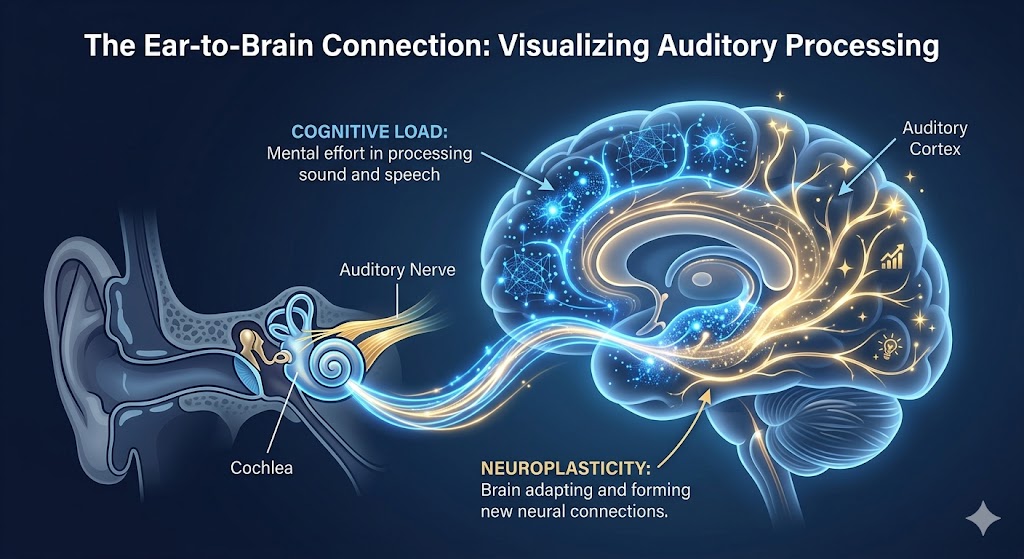
To understand why a loss of hearing leads to a loss of cognitive function, we have to look at how the brain processes sound. Hearing does not actually happen in the ears; the ears simply collect soundwaves and convert them into electrical signals. The actual “hearing”—the interpretation of those signals into meaningful words, music, and environmental awareness—happens deep within the brain.
When your hearing begins to decline, the crisp, clear signals your brain relies on become muffled and distorted. This sets off a cascade of neurological and psychological changes that can severely impact your cognitive longevity. Medical researchers have identified three primary mechanisms that link untreated hearing loss to dementia:
1. The Burden of “Cognitive Load”
Imagine trying to read a book where every third word is blurred out. You could probably figure out what the sentence means by using context clues, but it would require a massive amount of intense concentration. This is exactly what happens in the brain of someone with untreated hearing loss.
When the auditory signals arriving at the brain are degraded, the brain is forced to divert a massive amount of its metabolic energy and processing power away from other critical functions—like working memory, attention, and executive function—simply to decode the incoming sound and guess what is being said. This constant, exhausting neurological strain is known as “cognitive load”. Over years and decades, this chronic overworking leaves the brain with fewer resources to dedicate to memory preservation, inadvertently accelerating cognitive decline.
2. Brain Atrophy (The “Use It or Lose It” Principle)
The human brain is highly efficient. The specific parts of the brain responsible for processing sound, primarily the auditory cortex located in the temporal lobes, require consistent, rich sensory stimulation to remain healthy and robust.
When progressive hearing loss starves these areas of auditory input, the brain begins to reorganize itself. The neural pathways that are no longer being used begin to weaken, and the physical tissue of the brain can actually begin to atrophy, or shrink, over time. MRI studies have shown that individuals with untreated hearing loss experience a faster rate of brain tissue loss compared to those with normal hearing. Treating hearing loss with amplification restores this vital stimulation, helping to preserve the structural integrity of the brain.
3. Social Isolation and Depression
The third mechanism linking hearing loss to dementia is behavioral, but its impact on the brain is profoundly physical. When carrying on a conversation becomes an exhausting, frustrating chore, many individuals with untreated hearing loss begin to subconsciously withdraw from their social lives.
They may stop attending family gatherings, avoid noisy restaurants, or step away from community clubs. This withdrawal leads to social isolation, which drastically reduces the amount of daily intellectual and emotional stimulation the brain receives. The Centers for Disease Control and Prevention (CDC) reports that social isolation is associated with a staggering 50% increased risk of dementia, as well as a heightened risk of severe depression and heart disease.
The Johns Hopkins ACHIEVE Study: A Medical Breakthrough
For years, doctors knew that hearing loss and dementia were correlated, but the medical community lacked definitive proof that treating hearing loss could actually stop or slow down cognitive decline. That changed recently with the publication of the Aging and Cognitive Health Evaluation in Elders (ACHIEVE) study.
Led by researchers at Johns Hopkins University and published in the prestigious medical journal The Lancet, the ACHIEVE study was a massive, randomized controlled trial designed to test this exact theory. The study followed 977 adults between the ages of 70 and 84 who had untreated mild to moderate hearing loss.
The results were nothing short of revolutionary. The researchers found that for older adults who were already at an increased risk for cognitive decline, a comprehensive hearing intervention—which included the fitting of hearing aids and audiological counseling—slowed the loss of thinking and memory abilities by a remarkable 48% over a three-year period compared to a control group.
To put that into perspective: utilizing hearing aids nearly cut the rate of cognitive decline in half for at-risk patients. The study’s co-principal investigator, Dr. Frank Lin, noted that after a decade of epidemiological research identifying hearing loss as the single largest risk factor for dementia, this study finally provided the definitive proof that existing interventions (like hearing aids) can significantly reduce the risk of these adverse outcomes.
Why Mid-Life is the Critical Window for Action
One of the most dangerous misconceptions about hearing loss is that it is exclusively a problem for the elderly. Today, due to the ubiquitous use of personal audio devices, earbuds, and prolonged exposure to loud recreational environments, otolaryngologists are seeing a surge in noise-induced hearing loss in much younger demographics. People in their 30s and 40s are increasingly experiencing the early stages of gradual auditory decline.
The Lancet Commission’s 2024 report emphasizes that mid-life (ages 45 to 65) is the most critical window for intervention. Cognitive decline is a slow, insidious process that begins decades before the first visible symptoms of memory loss appear. If you wait until you are 75 or 80 to address your hearing loss, your brain has already endured decades of cognitive load, atrophy, and sensory deprivation.
By proactively treating hearing loss in your 40s, 50s, and 60s, you are actively preserving your neural pathways and giving your brain the best possible defense against cognitive aging. The Lancet Commission estimates that managing hearing loss proactively could prevent up to 8% of all dementia cases globally—making it a more impactful preventative measure than treating hypertension or quitting smoking in mid-life.
Modern Hearing Aids: A Technological Revolution
Despite the overwhelming medical evidence supporting the use of hearing aids, many patients still hesitate to seek treatment due to outdated stigmas. The average patient waits up to seven years after first noticing a change in their hearing before they consult a doctor. Often, this hesitation is rooted in the memory of the large, whistling, uncomfortable hearing aids worn by previous generations.
However, the audiology landscape in 2025 has been completely revolutionized by technology. Modern hearing aids are essentially microscopic, highly sophisticated wearable computers.
- Invisible Designs: Many of today’s devices sit deep within the ear canal, making them completely invisible to the outside world.
- Artificial Intelligence: The newest generation of AI-powered hearing aids can scan your environment thousands of times per second. They can automatically isolate and prioritize human speech while actively filtering out background noise, drastically easing the brain’s workload in noisy environments like restaurants or theaters.
- Seamless Connectivity: Modern devices feature direct Bluetooth integration, allowing you to stream phone calls, music, and television audio directly into your ears with crystal-clear fidelity.
- Health Tracking: Some advanced hearing aids now feature built-in sensors that track your physical activity, monitor your heart rate, and even detect if you have suffered a fall, automatically alerting your designated emergency contacts.
When to See an Otolaryngologist or Audiologist

Hearing loss is often so gradual that you may not realize what you are missing until it is significantly advanced. If you or a family member experience any of the following signs, it is time to schedule a comprehensive hearing evaluation:
- You frequently ask people to repeat themselves, especially in crowded rooms.
- You feel like people are mumbling rather than speaking clearly.
- You need to turn the television or radio volume up to a level that others find uncomfortable.
- You experience ringing, buzzing, or hissing in your ears (a condition called tinnitus, which is highly correlated with hearing loss).
- You find yourself feeling exhausted, stressed, or drained after attending social events due to the effort required to listen.
Get your appointment here Today
Take Control of Your Cognitive Future
Your hearing health is intricately tied to your brain health, your emotional well-being, and your overall quality of life. The landmark data is clear: addressing your hearing loss is no longer just about improving your ability to hear the television; it is a vital, scientifically proven strategy to preserve your memory, maintain your independence, and slow the onset of dementia.
Do not let untreated hearing loss rob you of your cognitive vitality. If you have concerns about your hearing, or if you simply want to establish a baseline for your auditory health, contact our expert team of otolaryngologists and audiologists today. We utilize the most advanced diagnostic equipment and offer highly personalized, cutting-edge treatment plans tailored to your unique lifestyle.
Schedule your comprehensive hearing evaluation today, and take the first critical step toward protecting your brain for decades to come.
Comments are closed