
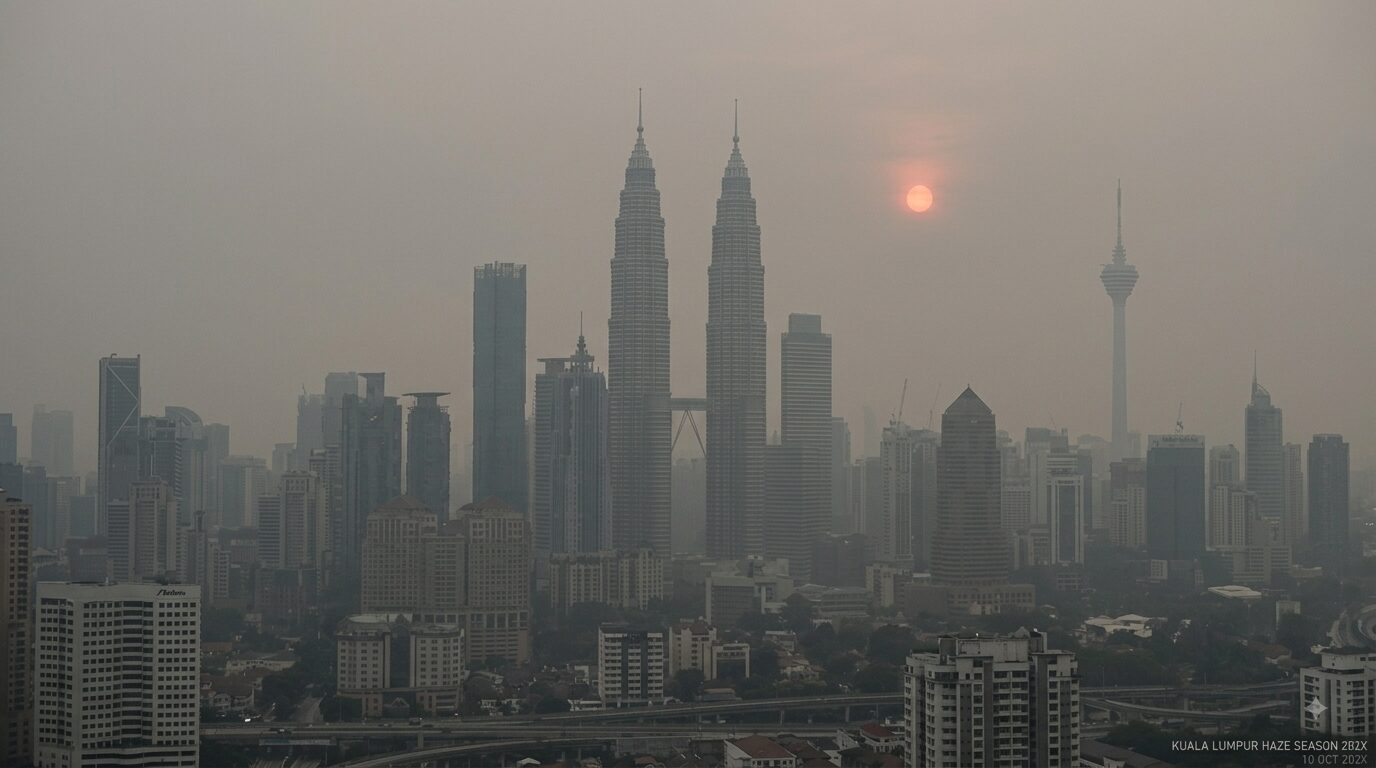
Over the past week, the same pattern has been showing up in my clinic. Patients whose allergies or sinuses were well under control are back, describing the same cluster of complaints: a nose that alternates between blocked and streaming, a scratchy throat that feels sandpapered, and a dull pressure behind the eyes and cheeks that worsens by late afternoon. Almost all of them ask the same question before I do: is it the haze again?
Usually, it is. Malaysia is once again dealing with transboundary haze. As of 9am on 12 August 2026, eight areas nationwide were recording unhealthy Air Pollutant Index (API) readings — six in Sarawak, led by Sarikei at 161, with Bintulu and Sri Aman at 157, Samalaju at 153, Sibu at 151 and Miri at 130, plus two in Peninsular Malaysia, including Putrajaya at 114. Days earlier, Johan Setia in Selangor had already crossed into unhealthy territory at a reading of 153, and in Sarawak’s Serian district, 108 schools closed this week as air quality worsened. Real-time monitoring in the Klang Valley has also shown Petaling Jaya and Kuala Lumpur sitting in the “poor” range, with fine particulate matter (PM2.5) readings around 40 micrograms per cubic metre — roughly triple the World Health Organization’s 24-hour guideline of 15 micrograms per cubic metre.
This isn’t a one-off. Malaysia has recorded haze episodes since the early 1980s, with severe episodes in 1997, 2005 and 2015, and it tends to return most years during the dry season, when land and forest fires in Indonesia send smoke drifting across the region. This year, El Niño conditions have made things harder: drier air means less rain to clear the smoke, and it has reportedly grounded cloud-seeding efforts — usually the government’s go-to tool for inducing rain over affected areas — until at least 18 August.
If your nose, throat or sinuses have felt “off” for the past week, you’re not imagining it. Here’s what’s actually going on, and what is worth doing about it.
Why Haze Goes Straight for Your Nose, Sinuses and Throat
Your nose is designed to be an air filter. The hairs and mucus lining inside your nostrils are built to trap dust, pollen and larger particles before they reach your lungs. Haze defeats this system almost entirely, because its main hazard — PM2.5 — is small enough (2.5 microns or less, about a thirtieth the width of a human hair) to slip past your nose’s natural defences and settle directly into the lining of your nose, sinuses and throat.
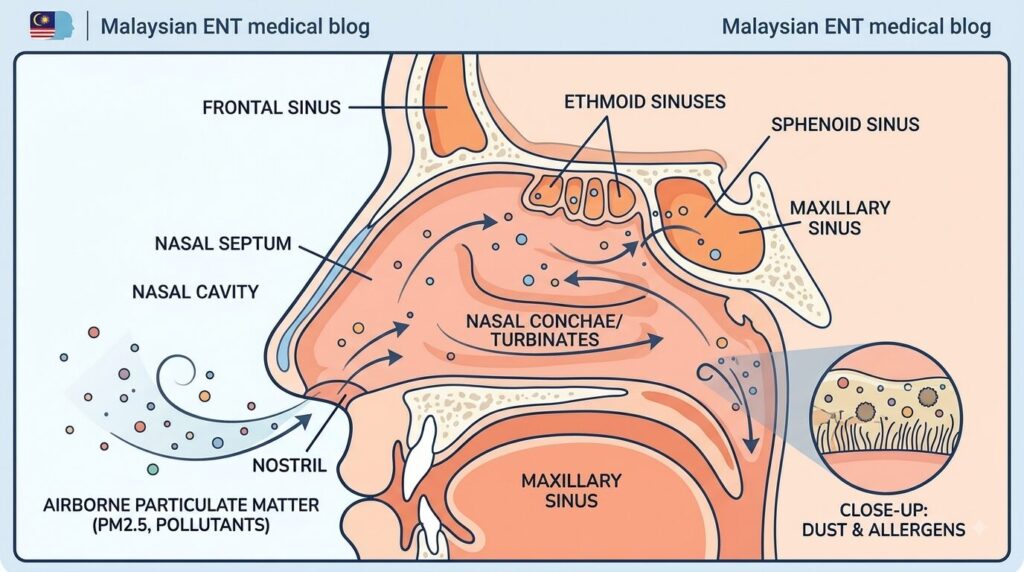
Once there, it does more than cause temporary irritation. Recent laboratory research has shown that PM2.5 exposure disrupts the protective barrier of the nasal lining, triggers oxidative stress, and switches on inflammatory pathways directly linked to chronic rhinosinusitis — the medical term for long-term sinus inflammation. Other research has found that people with long-term particulate matter exposure carry a measurably higher risk of developing chronic rhinosinusitis with nasal polyps, a condition that can eventually require surgery. This is why haze exposure isn’t just an uncomfortable few days — repeated haze seasons, year after year, may be quietly loading the dice for chronic nose and sinus disease.
Your throat takes a hit too. Haze particles dry out and inflame the mucous membranes lining your throat, which is why so many people report a scratchy, raw throat and a nagging cough that doesn’t feel like a proper cold — it’s chemical and particulate irritation, not infection.
Why Malaysia Keeps Going Through This
It’s worth being honest about where haze actually comes from, because the framing matters for how you protect yourself. The bulk of the smoke reaching Malaysia in episodes like this one originates from land and forest fires — largely agricultural burning — in Indonesia, carried across by seasonal wind patterns. Malaysia’s own Department of Environment has documented haze episodes going back more than four decades, and the current advisory system — the Air Pollutant Index, or API — exists precisely because this is a recurring, not occasional, problem for the country.
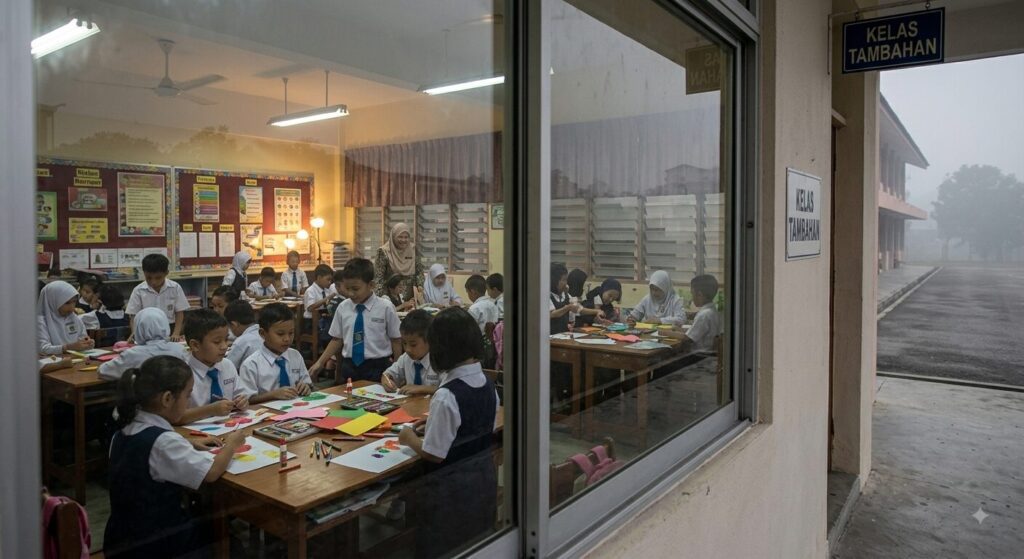
Under the National Haze Action Plan, schools are required to halt all outdoor activities — sports, PE, assemblies — once API readings in their area pass 100, and schools, kindergartens and childcare centres must close entirely once API exceeds 200. If your children’s school has cancelled outdoor activities or sports day recently, this is why — and it’s a reasonable, evidence-based precaution, not an overreaction.
Who’s Most at Risk
Haze affects everyone’s airway to some degree, but a few groups feel it faster and worse: children, whose airways are smaller and who breathe more air relative to their body size; the elderly; pregnant women; and anyone with an existing diagnosis of asthma, allergic rhinitis or chronic sinusitis.
That last group is larger than most people assume. Malaysian studies looking specifically at allergic rhinitis have found the condition affects around 7% of the general population, but as high as 18.8% among adolescents and 21–24% among office workers, and closer to 40% in one Singapore–Malaysia cohort of young adults — driven partly by Malaysia’s humid climate, which favours house dust mites, and worsened further by haze episodes layered on top. If you already know you have a sensitive nose, haze season is when it tends to show.
Common Haze Myths, Sorted From Fact
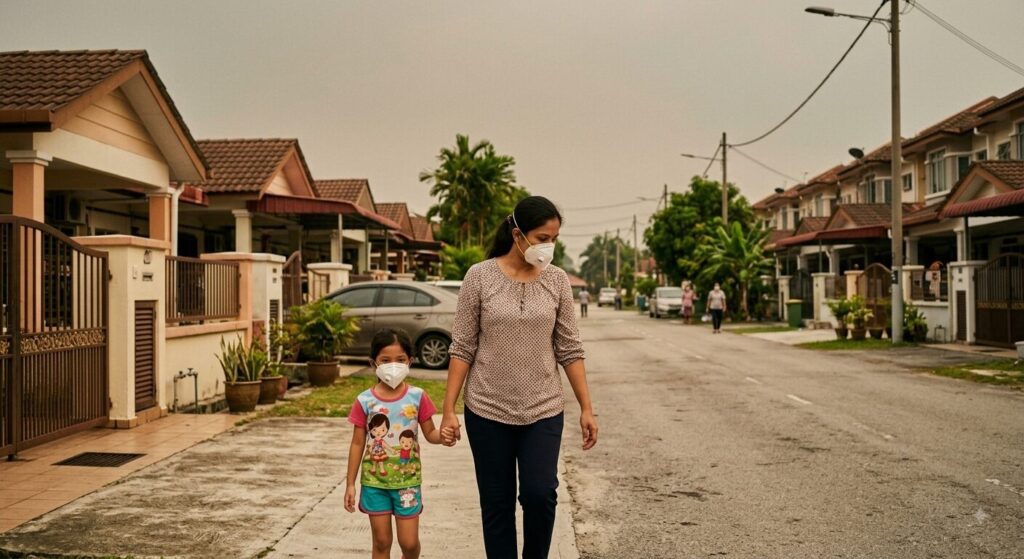
“A surgical mask is enough protection.” It isn’t. The Ministry of Health has been explicit on this point: ordinary surgical and cloth masks are not designed to filter particles as small as PM2.5. A properly fitted N95 respirator is the minimum standard for meaningful protection outdoors — though the Ministry also notes that N95 masks aren’t automatically suitable for young children, pregnant women or people with chronic heart or lung disease, who should check with a doctor first rather than assume a tight-fitting respirator is safe for them.
“If I stay indoors, I’m safe.” Staying indoors helps, but it isn’t a complete shield — PM2.5 seeps into homes through windows, doors and gaps, especially in older or naturally ventilated buildings. Indoor air can still carry a meaningful particulate load during a bad haze episode, which is one reason some people notice symptoms even after days spent mostly at home.
“Steaming, garlic or strong herbal remedies will clear it out.” I’ve written before about why garlic and other “miracle” sinus remedies don’t hold up medically — the same logic applies during haze. There’s no home remedy that removes PM2.5 that has already settled into inflamed nasal tissue; the fix is reducing further exposure and calming the inflammation, not trying to “flush it out” with kitchen ingredients.
“It’s just a cold, some rest will fix it.” Haze-related nose and throat irritation can look a lot like a viral infection, but the pattern is usually different — symptoms track with API readings rather than following the typical rise-and-fall of a cold, and there’s usually no fever. If your “cold” seems to flare every time the sky turns grey and settle down when it rains, haze is the more likely explanation.
What Actually Helps
The single most effective step is reducing how much haze you breathe in the first place. That means checking the API for your area before planning outdoor time, wearing a properly fitted N95 respirator when you do need to be outside during unhealthy readings, and keeping windows closed with air conditioning or a HEPA air purifier running if you have one, rather than relying on open windows for ventilation.
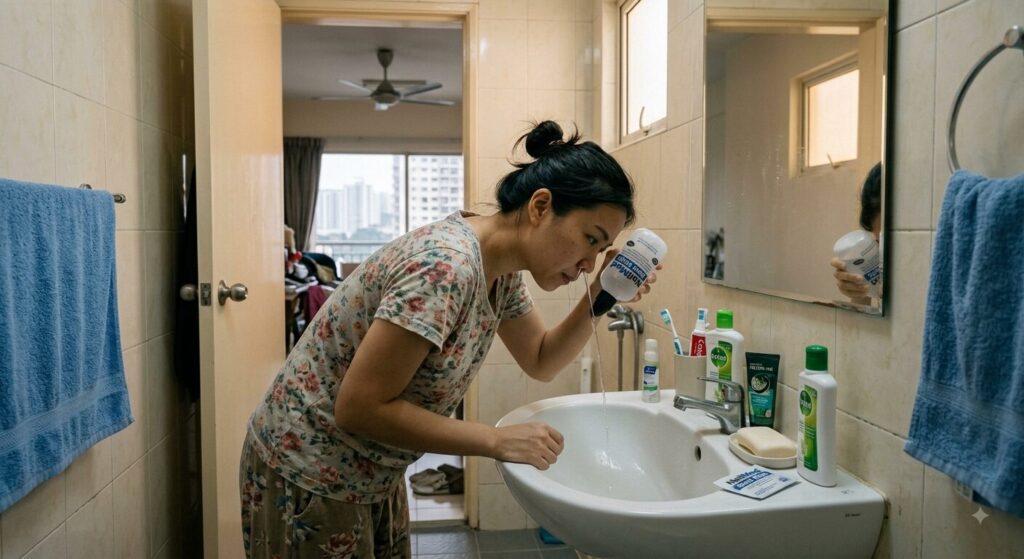
For the nose itself, a saline rinse is genuinely useful during haze season — it physically flushes out trapped particles and allergens rather than just masking symptoms, which is different from what a decongestant spray does. If you do reach for a decongestant nasal spray for quick relief, use it exactly as directed and for no more than a few days; overusing it during a prolonged haze episode is a common way people end up with rebound congestion that outlasts the haze itself, a topic I’ve covered in detail separately.
Staying well hydrated helps keep the mucous lining of your nose and throat functioning as intended, and it’s worth cutting back on smoking or vaping during haze episodes specifically, since both add further irritation to airways that are already under strain — advice the Ministry of Health has also issued directly to smokers during haze periods.
If you already manage a chronic condition like asthma, allergic rhinitis or sinusitis, haze season is the time to be more consistent with existing treatment, not less — this is not the moment to skip a prescribed nasal steroid spray or inhaler.
When a Blocked Nose Is More Than Just Haze
Most haze-related symptoms — a blocked or runny nose, mild facial pressure, a scratchy throat — settle down within a few days of air quality improving. But it’s worth knowing the difference between ordinary haze irritation and something that needs a proper look. Facial pain that’s severe or one-sided, thick discoloured discharge together with fever, symptoms lasting more than two to three weeks without improvement, or a headache pattern that doesn’t fit typical sinus pressure are all reasons to get checked rather than wait it out.
Not every haze-season symptom needs a specialist — a GP is often the right first stop. But if you’re dealing with recurring sinus infections every haze season, nasal polyps, or sinus symptoms that never fully resolve between episodes, that’s a pattern worth discussing with a nose specialist rather than treating each flare-up in isolation. If you’ve had sinus surgery before, I’ve written separately about why sinusitis can return even after surgery and what reduces the chances of it happening again.
Talk to an ENT About Your Sinuses This Haze Season
If haze season leaves you dealing with a blocked nose, sinus pressure or a throat that won’t settle down, you don’t have to just wait it out every year. Dr. Julius Goh Liang Chye sees patients across Kuala Lumpur and Petaling Jaya for exactly these concerns, from allergic rhinitis to chronic sinusitis.
Message us on WhatsApp to ask a question or book a consultation.
Frequently Asked Questions
Is haze in Malaysia getting worse every year?
Not necessarily worse each year in a straight line — Malaysia’s worst recorded episodes were in 1997, 2005 and 2015 — but it is a recurring, near-annual event during the dry season, driven mainly by transboundary smoke from land and forest fires in Indonesia and worsened by dry conditions like the current El Niño pattern.
What API reading should make me worried about my sinuses?
Malaysia’s Department of Environment classes API 101–200 as “unhealthy” and 201–300 as “very unhealthy.” Sensitive groups — including anyone with existing sinus, nose or lung conditions — can notice symptoms even in the “moderate” range (51–100), so it’s reasonable to start taking precautions before readings reach “unhealthy.”
Can haze cause a sinus infection, or just irritation?
Haze itself is a chemical and particulate irritant rather than an infection, but the inflammation and barrier damage it causes to your nasal lining can make it easier for a genuine bacterial or viral sinus infection to take hold afterwards. If you develop fever, thick discoloured discharge or facial pain that doesn’t fit typical haze irritation, it’s worth getting checked.
Do air purifiers actually help against haze?
A genuine HEPA air purifier can meaningfully reduce indoor PM2.5 levels in a closed room, which is useful since haze particles do seep indoors. It’s not a substitute for reducing outdoor exposure and wearing an N95 respirator when you’re outside, but it’s a reasonable addition for bedrooms or main living spaces, especially for children or anyone with asthma or chronic sinusitis.
Should children stay home from school during haze?
That decision follows Malaysia’s National Haze Action Plan rather than individual judgement: schools are required to suspend outdoor activities once API passes 100 in their area, and to close entirely above 200. Outside of official closures, if your child already has asthma or a sensitive nose, it’s reasonable to be more cautious even at moderate readings.
Is it safe to exercise outdoors during haze?
It’s best to move outdoor exercise indoors, or postpone it, once API readings enter the unhealthy range, since exercising increases how much air — and therefore how much particulate matter — you breathe in. If you must exercise outdoors during moderate haze, lower intensity and shorter duration reduce your total exposure.
Comments are closed