

A patient came into my clinic last week clutching her phone, showing me a news article her sister had forwarded on the family WhatsApp group: a woman overseas had died after rinsing her sinuses with untreated water. “Doctor, I rinse my sinuses every morning for my allergies. Am I in danger?”
It’s a fair question, and one I expect to hear more often as the story keeps circulating on Malaysian Facebook and TikTok pages. Nasal rinsing comes up in my clinic constantly — especially during haze season, or in the weeks after nose surgery — so every household doing this deserves a straight, practical answer instead of a forwarded scare.
Nasal Rinsing Is a Malaysian Household Habit, Not a Fad
Nasal irrigation isn’t an imported wellness trend. It’s one of the most evidence-backed, low-cost things I recommend for allergic rhinitis, chronic sinusitis, and recovery after nasal or sinus surgery. Malaysian public health messaging has promoted saline nasal washing for years as a simple way to manage chronic nasal allergies, particularly during haze season when the API climbs and airborne particles irritate the nasal lining, or during the pre-festival cleaning season when dust and mould are stirred up in every household.
Pre-packaged saline sachets and rinse bottles are sold in almost every Guardian, Watsons, and Caring outlet in the country, and the Know Your Medicine Portal lists nasal washing among the standard, doctor-recommended measures for sinusitis. Done correctly, a simple saline rinse clears allergens, thins mucus, and reduces how much long-term medication you need. I am not writing this to scare anyone away from nasal rinsing — I still recommend it to patients every week in clinic. I’m writing this so your household keeps doing it safely.
What’s Actually in the Water You’re Using?
Here’s the part that rarely makes it into the WhatsApp forwards: the danger has nothing to do with Malaysia’s drinking water being unsafe to drink. Air Selangor, for example, reported 99.96% compliance with the Ministry of Health’s national drinking water quality standard in 2025 — comfortably above the 99% benchmark it has held for five straight years. If your worry is whether Klang Valley tap water is fit to drink, the data says yes.
But “safe to drink” and “safe to flush directly into your nasal passages” are two different standards — medically and hydraulically — and that’s true everywhere in the world, not just Malaysia. Drinking water passes through stomach acid on its way down, which destroys the free-living amoebae that can survive in trace amounts in piped water. Nasal rinsing bypasses that defence completely: the rinse fluid runs along the roof of the nasal cavity, inches from the olfactory nerve, which is the amoeba’s one direct route into the brain.
Treated water can also pick up organisms after it leaves the treatment plant — in rooftop storage tanks baking under a tin roof, in ageing internal pipework, and in the low-flow, low-turnover corners of household plumbing common in Malaysian apartments and landed homes, especially units left empty during a long trip back to a hometown or an extended holiday. None of that shows up in a compliance report measured at the treatment plant; it’s a downstream, building-level variable that no water utility can fully control on your behalf.
Why Malaysia’s Climate Adds a Layer Most Countries Don’t Have
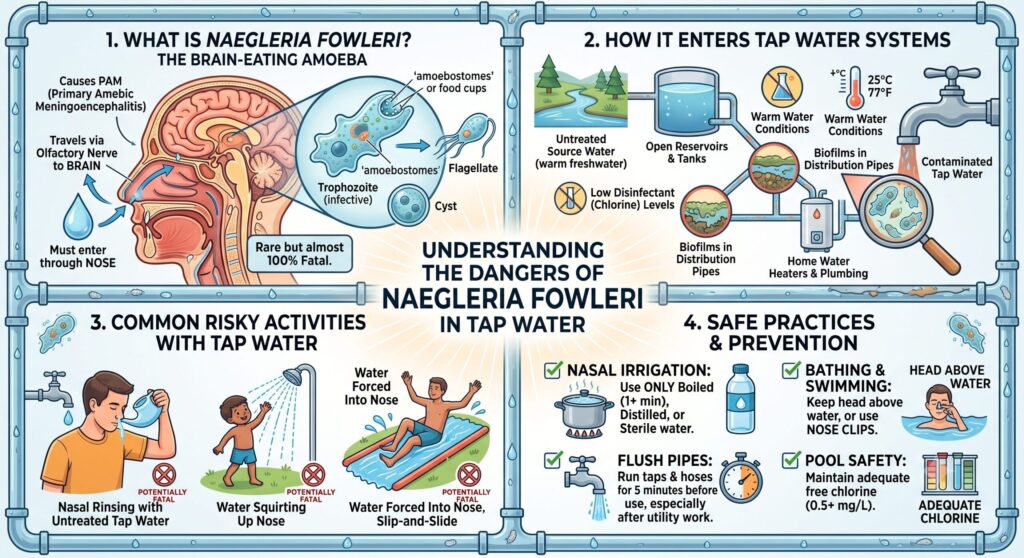
In the United States, health authorities usually frame this as a “summer” risk, because the organisms involved — mainly Naegleria fowleri and Acanthamoeba — are thermophilic: they thrive in warm freshwater, roughly 25–45°C, and struggle in anything cold. American rivers and lakes are only warm enough for part of the year, so the warnings spike every summer and fade every winter.
Malaysia doesn’t have a cold season. Ambient temperature here — and the temperature of water sitting in a rooftop tank or an outdoor pipe — sits inside this organism’s preferred range all year round. To be clear, this does not mean Malaysian tap water is contaminated, and there is no confirmed local case linking nasal rinsing to this kind of infection that I’m aware of. It simply means the precaution is at least as relevant here as anywhere colder, and arguably deserves more consistent attention, not less, precisely because there’s no “off season” to relax during.
The Rare but Serious Illness Behind the Headlines
To keep this in proportion: the illness is rare. A CDC review of cases from 1994 to 2022 found only a small number of nasal-rinsing-linked Acanthamoeba infections across the entire United States over nearly three decades — but roughly 82% of them were fatal, which is why the story keeps resurfacing internationally. As recently as 2024, the CDC documented a case in Texas linked to unboiled water used in a home irrigation system. The rarity is real. So is the near-certainty of a bad outcome if it does happen — which is exactly why the fix below is worth adopting even though any individual person’s odds are already low.
How to Rinse Your Sinuses Safely — This Is the Entire Fix
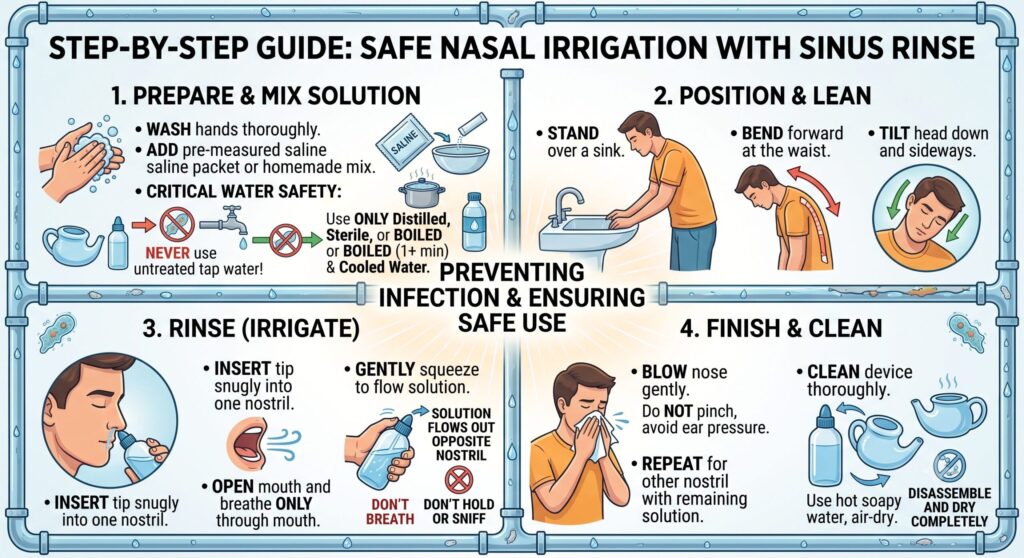
None of this requires giving up nasal rinsing. It requires being deliberate about one ingredient:
- Use distilled or sterile water — pre-packaged saline sachets or plain distilled water from any Malaysian pharmacy are the easiest route, and cost very little more than tap water.
- If preparing your own at home, boil tap water for at least one minute, then let it cool to lukewarm before mixing your rinse. Previously boiled water that has cooled and been kept covered also works.
- Don’t rinse with water straight from the tap, a filter jug, or an office/home water dispenser without boiling it first — most activated-carbon filter jugs are not rated to remove parasitic cysts, whatever else they improve about the water’s taste.
- Wash your neti pot, squeeze bottle, or irrigation device after every single use with soap and safe water, then air-dry it completely before the next use — a damp, unwashed device is its own contamination risk, separate from the water question.
- Mix a fresh batch of saline each time rather than storing made-up solution in the bottle for later use, even in the fridge.
- Don’t share your device with other family members, especially children.
The FDA’s guidance on neti pot safety sets out the same rule, and it costs you nothing beyond the minute it takes to boil a kettle. If you’re not sure whether your ongoing congestion is actually a sinus problem or something else entirely, I’ve written about how to tell the difference here.
When It’s More Than a Sinus Problem
Please don’t self-diagnose a brain infection from an ordinary headache — the overwhelming majority of congestion and facial pressure I see in clinic is plain sinusitis or allergy, not this. But do seek urgent medical attention if, after nasal rinsing, you develop a severe headache, stiff neck, fever, confusion, or a sudden change in smell or taste. And if regular nasal rinsing isn’t relieving your symptoms after a week or two, that’s a sign to have your nose properly examined rather than rinsing harder or more often.
If that’s you, get in touch with our clinic and we’ll take a proper look.
Frequently Asked Questions
Is Malaysian tap water safe to drink?
Generally yes — treated municipal water in areas served by operators like Air Selangor consistently exceeds the Ministry of Health’s national compliance benchmark. That’s a separate question from whether it’s safe to rinse directly into your sinuses without boiling it first.
Can I use water from my home filter jug or an office water dispenser?
Not without boiling it first. Most pitcher-style carbon filters and mains-fed dispensers are designed to improve taste and reduce chlorine or sediment — they are not certified to remove parasitic cysts. Treat that water the same as tap water for nasal-rinsing purposes.
Can I use bottled mineral water instead of distilled water?
Only if it’s specifically labelled distilled or sterile. Many bottled natural mineral waters are safe to drink but are not sterile, and haven’t been tested against this specific risk. When in doubt, boil and cool, or buy water labelled distilled.
How long can I keep a batch of prepared saline solution?
Use it the same day and discard whatever is left over. Don’t store mixed saline in the bottle for the next morning, even in the refrigerator — mix fresh each time.
Is nasal rinsing safe for children?
Yes, with age-appropriate technique, gentle pressure, and the same safe-water rule. For younger children, or if you’re ever unsure how to introduce it, it’s worth checking with a paediatric ENT specialist before starting a home routine.
The Bottom Line
Nasal rinsing remains one of the safest, cheapest, and most effective things I recommend for sinus health, and nothing in this article changes that. The rare risk you’ve seen circulating on social media is real but avoidable, and the entire fix is one habit: never rinse your sinuses with water straight from the tap, a filter jug, or a dispenser. Boil it, or buy it distilled. Keep doing it — just mind the water.
Comments are closed