

The 2026 Throat Virus
If you have been on TikTok or Instagram over the past few weeks, you have almost certainly seen it. Someone films themselves looking miserable, types something like “Day 4 of this mystery virus — throat is destroyed, ears feel blocked, tested negative for everything,” and within hours the comments fill up with thousands of people saying “same.”
The phrase “2026 throat virus” has accumulated millions of views across platforms. People describe it as worse than a regular cold, different from COVID, and frustratingly resistant to whatever they try. Some lose their voice for days. Others say the scratchiness in their throat just will not go away.
As a Consultant ENT surgeon here in Malaysia, I have been watching this with interest — partly because the patients coming through my clinic over the past month are describing the same thing, and partly because the amount of misinformation swirling around this topic is genuinely concerning.
So let me tell you what is actually going on.
There Is No New “2026 Virus”

The first thing worth saying clearly: there is no novel virus that emerged this year and is uniquely responsible for the illness people are describing online.
What is happening is something that occurs every year during peak respiratory season — a convergence of multiple well-known viral and bacterial infections, all producing overlapping symptoms, all hitting at the same time. People search for a unifying name, someone coins “the 2026 throat virus,” and the label spreads faster than the infections themselves.
The actual culprits causing what people are calling this “mystery illness” are the same organisms that cause upper respiratory infections every single year: adenovirus, rhinovirus, Group A Streptococcus (strep throat), and in some cases a new COVID variant or influenza strain. The fact that home tests come back negative is not surprising — these home kits only test for COVID and flu. They tell you nothing about adenovirus or strep.
In Malaysia specifically, we sit in a tropical climate with year-round respiratory virus circulation, no true winter die-off, and heavy indoor air-conditioning that dries out the mucosal lining of the nose and throat. The back-to-school calendar, Hari Raya travel patterns, and office occupancy cycles all create periods where transmission peaks. We are in one of those periods now.
The Three Most Likely Culprits , And How to Tell Them Apart
Here is the part of the content online that is almost always missing: an actual attempt to help you figure out whichinfection you have, because the answer matters for treatment.
Adenovirus
Adenovirus is probably the most common cause of the “mystery virus” presentations I am seeing described online. It causes a very particular constellation of symptoms that people find confusing because it hits in a way that does not quite fit the usual cold template.
The classic picture is a raw, burning sore throat combined with red, gritty, watery eyes — what doctors call pharyngoconjunctival fever. Not everyone gets the eye involvement, but when present it is a strong clue. There is usually a fever, significant fatigue, and a cough. The throat looks very inflamed and sometimes has a grey-white membrane overlying the tonsils, which worries people into thinking it is strep.
Here is the critical point: adenovirus is a virus, which means antibiotics do nothing for it. If a doctor prescribes antibiotics without a throat swab confirming bacterial infection, you are taking medication that will not help and may disrupt your gut flora. The illness typically runs 7 to 14 days and must simply run its course with supportive care — rest, adequate hydration, paracetamol for fever and throat pain, and saltwater gargles.
Adenovirus spreads through droplets and contact with contaminated surfaces. In schools, offices, and gyms in particular, it moves efficiently. It is not dangerous in healthy adults, but in the immunocompromised or the very elderly it can progress to pneumonia.
Rhinovirus
This is the virus behind most common colds. If what you have feels like a very bad version of a cold — blocked nose, runny nose, scratchy throat, sneezing, no significant fever, no marked eye symptoms — rhinovirus is the most likely explanation.
Rhinovirus infections tend to be shorter, peaking at 3 to 5 days, and the sore throat is often mild and overshadowed by the nasal symptoms. The “lingering cough from post-nasal drip” that people describe at the tail end of their illness — sometimes lasting two to three weeks — is a classic rhinovirus aftermath. The virus has cleared, but the inflamed nasal lining continues to drip secretions down the back of the throat, triggering the cough reflex.
This is not dangerous and does not require further treatment. The cough will resolve on its own. Saline nasal rinses can help clear the post-nasal drip and speed up the resolution.
Strep Throat (Group A Streptococcus)
Strep throat is the one member of this group that you genuinely need antibiotics for — and not just for symptom relief, but to prevent serious complications including rheumatic fever and kidney damage.
The features that distinguish strep from viral infections are fairly characteristic. The onset is sudden, often within hours. The sore throat is severe. There is a high fever, frequently above 38.5°C. When you look in the mirror and press your tongue down, the tonsils are swollen and often covered in white or yellow spots. Your cervical lymph nodes — the glands under your jaw — are tender and enlarged. Crucially, there is usually no cough, no runny nose, and no eye symptoms. Strep is a throat infection without the viral “cold” picture.
If this is your presentation, please do not manage it yourself with honey and warm water. You need a throat swab and, if positive, a course of penicillin or amoxicillin. The treatment is straightforward but it has to happen.
What That “Metallic Taste” and “Film in the Throat” Actually Mean
This detail has been doing the rounds on social media and deserves a direct answer because it is causing unnecessary alarm.
Some people describe a strange metallic taste, or the sensation of a “film” or “stickiness” at the back of the throat that no amount of swallowing seems to clear. Others mention losing their voice completely, without any significant pain.
These symptoms, taken individually, are not signs of a dangerous new pathogen.
The metallic taste during acute throat infections is usually caused by a combination of inflamed mucous membranes altering your taste perception, post-nasal drip triggering taste receptors at the back of the tongue, and in some cases the byproducts of bacterial metabolic activity if there is secondary bacterial colonisation.
The “film in the throat” sensation is almost always post-nasal drip — secretions from the inflamed nasal cavity or nasopharynx coating the back of the throat. It is uncomfortable but not ominous.
Voice loss (dysphonia) with a viral upper respiratory infection occurs when the larynx — your voice box — becomes inflamed, a condition called laryngitis. The vocal folds swell and cannot vibrate normally. This resolves on its own in most cases within one to two weeks. Voice rest, adequate hydration, and steam inhalation help. What does NOT help: whispering (which actually strains the vocal folds more than speaking normally), clearing your throat aggressively (which causes further vocal fold trauma), or smoking.
When to Stop Managing This at Home
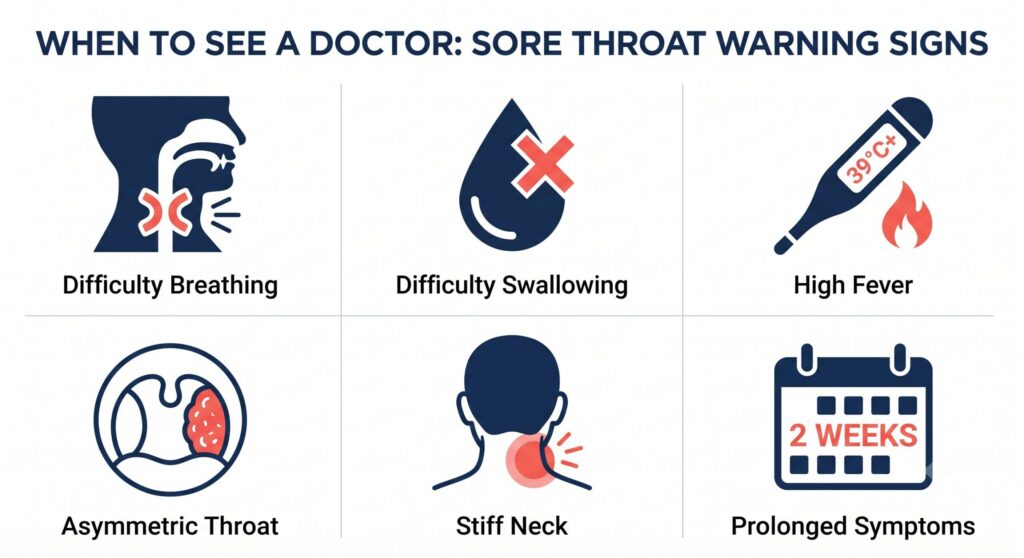
Most cases of the “2026 throat virus” — whatever the underlying cause — will resolve without medical intervention. But there are warning signs that mean you need to be seen by a doctor, and seen promptly.
Go to the emergency department or see a doctor urgently if you experience:
Difficulty breathing or stridor — any noisy, laboured breathing is a red flag for airway compromise. This is a medical emergency.
Difficulty swallowing saliva — if your throat is so swollen that you cannot swallow your own saliva, you may be developing a peritonsillar abscess or severe epiglottitis. Both require urgent assessment.
Drooling — same reason as above.
Voice that sounds “hot potato” — a muffled, low, thick-sounding voice, as if you have a hot potato in your mouth, is a classic sign of a peritonsillar abscess.
High fever above 39°C lasting more than 4 days despite paracetamol.
Throat symptoms lasting more than 2 weeks without improvement.
One-sided throat swelling — particularly if one tonsil appears much larger than the other, with the uvula deviated to one side.
Neck stiffness combined with throat symptoms and fever — this combination needs ruling out of serious central nervous system involvement.
See a doctor within a day or two (not emergency, but do not delay) if you have had more than 4 days of fever, if you have recently been in contact with a confirmed strep case, or if you are in a high-risk group: pregnant, immunocompromised, elderly, or have a heart condition.
The Antibiotic Question
I want to address this directly because I see it coming up constantly in the comment sections of these viral posts.
Antibiotics do not treat viruses. Adenovirus and rhinovirus — the two most likely causes of what people are calling the 2026 throat virus — are both viruses. Taking antibiotics for them does not shorten your illness. It does not reduce symptoms. What it does do is contribute to antibiotic resistance and can disrupt your gut microbiome.
In Malaysia, antibiotic prescribing rates for upper respiratory infections remain high, partly because patients request them and partly because clinical uncertainty pushes doctors toward prescribing. If your doctor recommends supportive care without antibiotics for your sore throat, that is usually the correct and evidence-based decision — not a dismissal.
Strep throat is the exception. If a throat swab or rapid antigen test confirms Group A Streptococcus, antibiotics are necessary and you should complete the full course.
What Actually Helps When You Have This Illness
Since the question always arises: here is what the evidence actually supports for symptomatic relief of viral throat infections.
Salt water gargles (a teaspoon of salt dissolved in a glass of warm water) reduce throat inflammation temporarily and are safe to do several times a day. Adequate fluid intake — aiming for clear urine — keeps the throat mucosa moist and supports immune function. Paracetamol taken regularly (not just when the pain is severe) provides better sustained pain and fever relief than reactive dosing. Throat lozenges containing benzocaine or flurbiprofen provide local anaesthesia and are genuinely helpful. Honey has some evidence behind it for cough suppression and is safe for adults. Steam inhalation can ease laryngitis symptoms.
Things that do not help, despite what you may have seen online: garlic in the nose (causes nasal irritation and more mucus secretion, not less), hot toddy with alcohol (alcohol dehydrates and suppresses immune response), antibiotic tablets bought without prescription (no viral benefit, resistance risk), and extremely cold ice water (provides momentary relief but does not shorten illness duration).
A Note on Voice Loss That Persists
Most cases of laryngitis linked to acute infection resolve within two weeks. If your voice has not returned to normal after three weeks, or if you notice persistent hoarseness that began without any clear infection trigger, please see an ENT.
Persistent hoarseness that is not clearly linked to a recent viral illness can occasionally be an early sign of a vocal cord lesion, laryngeal reflux, or — rarely — something that needs further investigation. The key word is persistent. A week of voice loss during an active throat infection is expected. Three or more weeks of hoarseness that is not improving is not something to manage with honey and warm beverages.
The Bottom Line

The “2026 throat virus” is real in the sense that a lot of people are genuinely sick right now, many of them with worse-than-usual symptoms and prolonged courses. It is not real in the sense that a new and distinct virus has emerged that your regular doctor cannot handle.
What you most likely have is adenovirus, rhinovirus, or strep throat — all manageable, none novel, all with well-understood treatment pathways. The investigation that will actually help you is a throat swab, not a TikTok comment section.
If you are in Malaysia and your symptoms fit any of the warning signs described above, or if you have a sore throat or hoarseness that has lasted more than two weeks, I see patients at PPUM and also via theentdr.com — you can book a consult directly.
Dr. Julius Goh is a Consultant Otorhinolaryngologist, Head & Neck and Sleep Surgeon at Universiti Malaya Specialist Center, Kuala Lumpur.
FAQs
Q: What is the “2026 throat virus”? A: There is no new virus specifically causing the “2026 throat virus.” The illnesses being described online are caused by well-known infections — most commonly adenovirus, rhinovirus, or strep throat — occurring at high rates simultaneously.
Q: How do I know if I have strep throat or a viral infection? A: Strep throat typically causes sudden, severe throat pain, high fever, swollen tonsils with white spots, and enlarged neck glands — but no cough or runny nose. Viral infections like adenovirus usually include cough, runny nose, and sometimes red eyes alongside the sore throat. A throat swab is the only reliable way to confirm strep.
Q: Should I take antibiotics for the 2026 throat virus? A: No — if the cause is viral (adenovirus or rhinovirus), antibiotics will have no effect. Antibiotics are only needed if a throat swab confirms bacterial strep throat. Taking antibiotics without confirmation contributes to antibiotic resistance.
Q: When should I see a doctor for a sore throat? A: See a doctor urgently if you have difficulty breathing, cannot swallow your own saliva, have a very muffled (“hot potato”) voice, or one tonsil appears much larger than the other. See a doctor within 24-48 hours if fever lasts more than 4 days or you have been in contact with a confirmed strep case.
Q: How long does voice loss from this illness last? A: Most voice loss associated with viral laryngitis resolves within 1-2 weeks. If hoarseness persists beyond 3 weeks, an ENT assessment is recommended to rule out other causes.
Q: Can I go to an ENT for a sore throat? A: Yes. For persistent sore throat, recurrent tonsillitis, hoarseness lasting more than 3 weeks, or throat symptoms with warning signs, you can book a consultation via theentdr.com or at UMSC.
Links
Adenovirus Overview
Adenoviral Pharyngitis in the Paediatric Emergency Department: The Pivotal Role of Rapid Antigenic Testing
Pharyngoconjunctival fever
Rhinovirus and the common cold (The Lancet)
Strep throat clinical guidance (CDC, updated 2025)
Streptococcal pharyngitis rapid evidence review (American Family Physician 2024)
Acute laryngitis (StatPearls / NCBI, updated 2025)
Antibiotic prescribing for pharyngitis in Malaysian primary care (PubMed OA, 2022)
Prescribing patterns for URTI
Comments are closed