Your Earphones Are Not Hearing Aids !
I’ve started noticing a pattern.
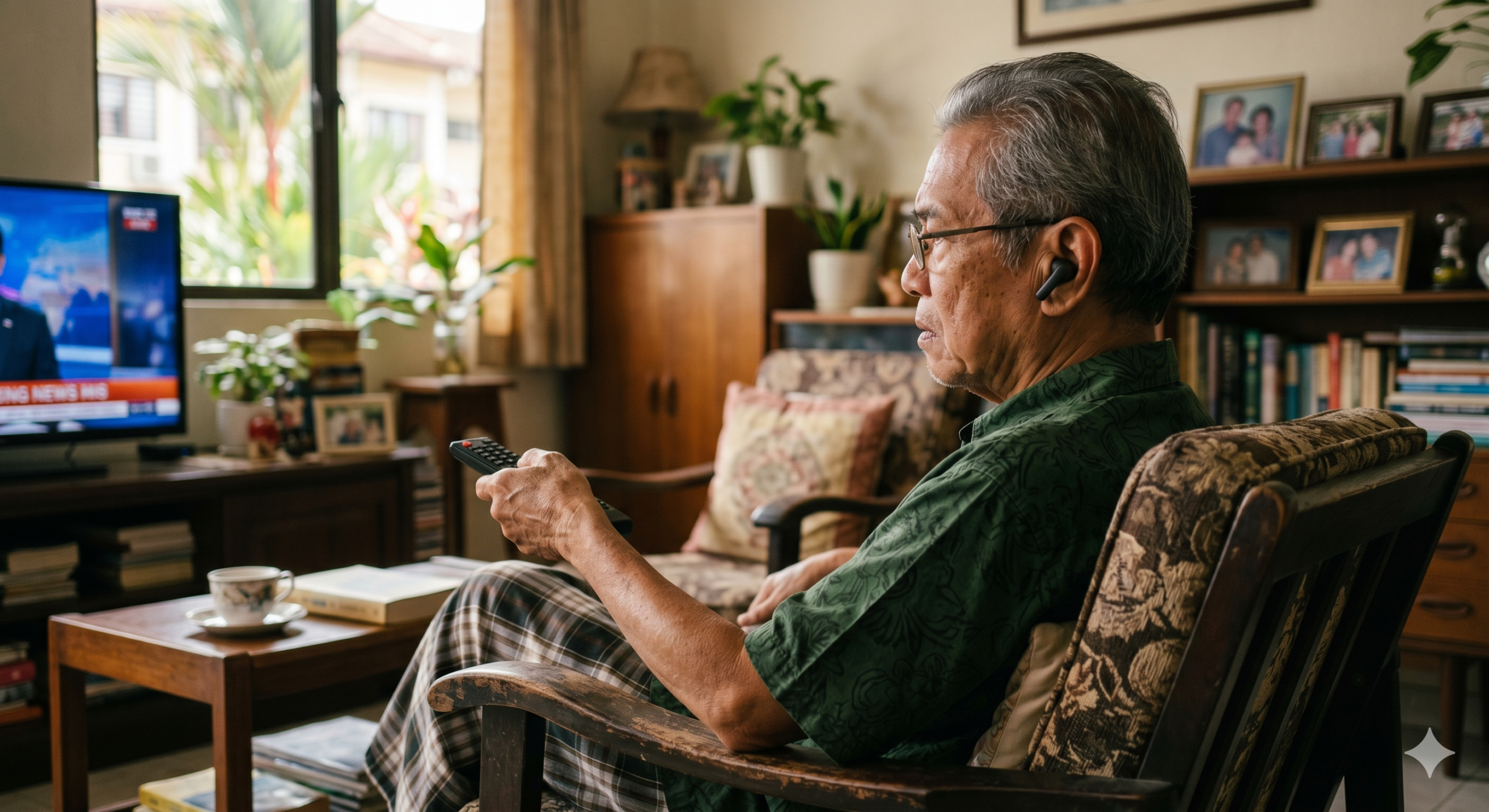
Patients — or more often, their adult children — come in and mention, almost as an aside, that their father has been wearing his earphones around the house lately. Not to listen to music. Not for calls. Just to hear the television better. Or to follow conversations at the dinner table. Or because someone in the family read that you could turn the volume up on a smartphone and use it as a makeshift amplifier.
The intention is good. The solution is not.
Malaysia is quietly in the middle of a hearing loss crisis. According to Health Minister Dzulkefly Ahmad, an estimated 1 in 5 Malaysians — roughly 21.5% of the population — have some form of hearing problem, with nearly 44,000 cases recorded in 2025 through the National Otorhinolaryngology Registry alone. Adults and the elderly account for 86.4% of that total. And yet, among Malaysians with audiometrically confirmed hearing loss, only 4.4% use hearing aids. Of those who self-reported hearing problems, only 28.5% had sought any professional help at all.
The gap between people who need hearing help and people who actually get it is enormous. And in that gap, a worrying substitute has taken hold: commercial headphones and earphones, treated as a workaround for a medical device.
This post is for anyone who’s been doing this — or watching a parent do it. Because the difference between a hearing aid and a pair of earphones isn’t just price or appearance. It’s the difference between treatment and damage.
Why Malaysians Are Reaching for Earphones Instead
Before we get to the clinical problems, it’s worth acknowledging why this happens.
Hearing aids in Malaysia are not cheap. Entry-level devices start at around RM3,000, with premium AI-enhanced models reaching RM15,000 or more. For many families, especially those in rural areas or caring for elderly parents on a fixed income, that price point is genuinely out of reach. Government hospitals offer subsidised audiology services, but waiting times are long and awareness of what’s available remains patchy.
There’s also stigma. In Malaysian Chinese and Malay communities particularly, wearing a hearing aid carries an unspoken association with old age, frailty, and decline. An elderly parent may flat-out refuse. A working adult may worry about how it looks to colleagues. And in that awkward middle ground between “I can manage” and “I need a device,” a pair of wireless earbuds seems like a dignified workaround — discreet, already owned, socially acceptable.
Add to that the explosion of noise-cancelling and sound-enhancing consumer audio products, some of which now actively market themselves with language like “conversation mode” or “transparency mode,” and the confusion becomes understandable. These features sound medical. They aren’t.
What a Hearing Aid Actually Does
To understand why earphones can’t substitute for a hearing aid, it helps to understand what a proper hearing aid is actually doing.
A hearing aid is a prescription medical device. It is programmed — by a qualified audiologist, using data from a full audiometric assessment — to amplify specific frequencies of sound that a specific person, with their specific pattern of hearing loss, cannot hear well.
Hearing loss is rarely uniform. Most people don’t lose hearing equally across all sound frequencies. More commonly, high-frequency sounds drop first — consonants like “s,” “f,” “th,” and “sh” become harder to distinguish, while lower-pitched sounds remain audible. This is why someone with hearing loss often says “I can hear you talking, I just can’t make out what you’re saying.” The volume is reaching them. The detail isn’t.
A properly fitted hearing aid addresses exactly this. The audiologist maps the person’s audiogram — a graph of hearing sensitivity across frequencies — and programs the hearing aid to selectively boost the frequencies where the loss is greatest. The result is not amplified noise. It is clarified speech, tailored to that individual’s ears.
Beyond frequency shaping, modern hearing aids do things that no pair of consumer headphones can replicate:
Directional microphones that separate speech from background noise, so a conversation in a busy kopitiam doesn’t get swallowed by the sound of other tables.
Feedback suppression that eliminates the whistling that older hearing devices used to produce.
Real-ear verification, where the audiologist physically measures what the hearing aid is delivering at the eardrum, not just what it’s set to deliver in theory.
Dynamic compression, which ensures that soft sounds are amplified enough to be heard while loud sounds don’t become painfully overwhelming.
None of this is happening in a pair of AirPods or Sony earphones, no matter how premium they are.
What Earphones and Headphones Actually Do
Consumer audio devices are designed for one thing: to make music and media sound as good as possible to the average listener with normal hearing.
The amplification they produce is broad and indiscriminate. When you turn up the volume on a pair of earphones to better hear a conversation, you are not targeting the frequencies you’ve lost — you’re boosting everything, at the same time, by the same amount. The television gets louder. So does the background music, the air conditioning, the traffic outside, and every other ambient sound competing for your attention.
For someone with normal hearing, this is just a matter of preference. For someone with hearing loss, this creates several specific problems.
1. Volume compensation accelerates the damage
This is the most counterintuitive and most dangerous part.
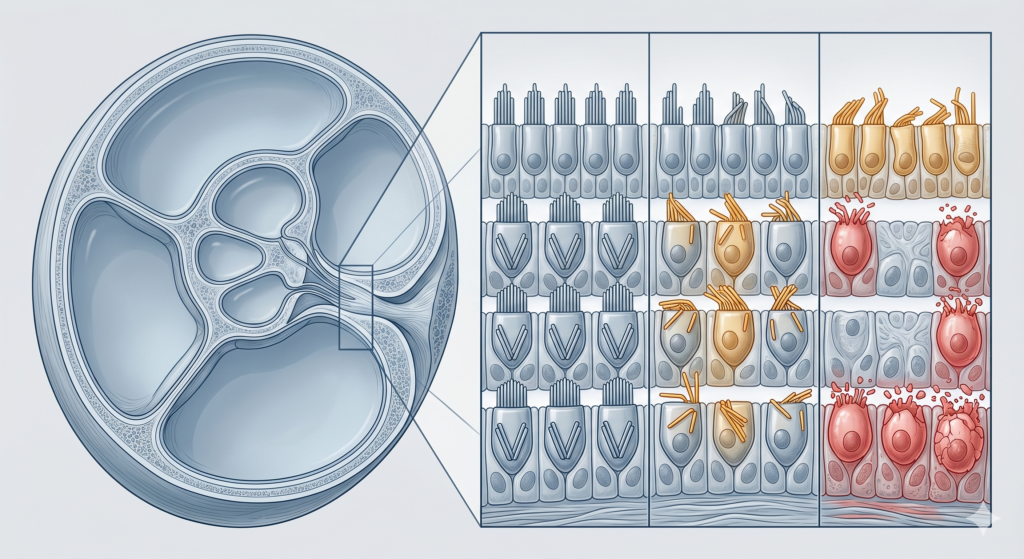
When someone with hearing loss turns their earphone volume up to hear better, they are exposing their cochlea — the inner ear structure responsible for converting sound into nerve signals — to sound pressure levels well above what is safe. Loud volumes damage the tiny hair cells in the inner ear, and this damage leads to sensorineural hearing loss. These hair cells do not regenerate. Once damaged, they are gone.
Earbuds sit closer to the eardrum than over-ear headphones, increasing sound pressure by 6–9 dB at the same volume setting. For someone already managing hearing loss, regularly using earbuds at high volume isn’t treating the problem — it is making it irreversibly worse, quietly, every day.
The cruel irony is that a person who reaches for earphones because they can’t afford a hearing aid may end up with a degree of hearing loss that requires a more expensive, more powerful device by the time they finally seek help.
2. Earphones cannot target your specific frequency loss
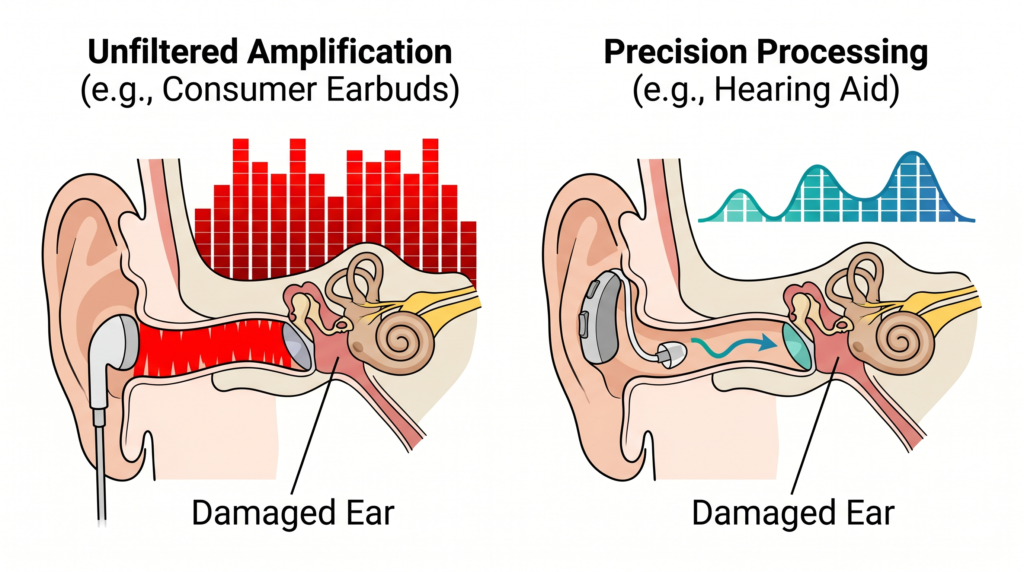
As described above, hearing aids are programmed to your audiogram. Earphones are not. There is no audiogram involved. There is no audiologist. There is no prescription.
What you get is amplified sound — the same amplified sound a teenager with perfect hearing would get if they turned the volume up. The frequencies you’ve lost don’t get targeted. The frequencies you can still hear perfectly get pushed even louder. The result is fatiguing, often painful, and not particularly useful for understanding speech.
3. Poor fit means poor performance — and ear problems
Hearing aids are fitted to the ear canal. Custom moulds are made. The device sits correctly, delivers sound at the right pressure point, and stays in place during normal movement.
Consumer earphones are designed for an average ear shape. They come in a one-size-fits-all pattern that will not fit perfectly in every ear, will not sit comfortably for extended hours as needed, and will not properly adjust to allow for effective hearing.
A poor-fitting device that’s being worn for hours daily — because the person needs it to function — creates its own problems: pressure on the ear canal, irritation, and a warm, occluded environment that increases the risk of otitis externa (ear canal infection). Research published in Scientific Reports has noted that earbuds can promote outer ear infections by trapping humidity and introducing bacteria. For elderly patients who may already have dry, sensitive ear canal skin, this is a real concern.
4. Earphones cannot address the underlying cause
Hearing loss is not a single condition. It can result from age-related cochlear degeneration, chronic ear infections, a perforated eardrum, otosclerosis (abnormal bone growth in the middle ear), a cholesteatoma, noise-induced damage, or — critically — a tumour on the hearing nerve.
Some of these conditions are treatable. Some are surgically correctable. Some require urgent investigation.
An earphone amplifies around the problem. A proper assessment identifies what the problem actually is.
If someone reaches for earphones instead of seeing an ENT or audiologist, they may be masking a symptom that needs diagnosis. Sudden hearing loss in one ear, hearing loss accompanied by tinnitus, or asymmetric hearing loss (one ear worse than the other) are red flags that require prompt evaluation — not volume adjustment.
“But What About Those Personal Sound Amplifiers? They Look Just Like Hearing Aids.”
This is a fair question, and it comes up often.
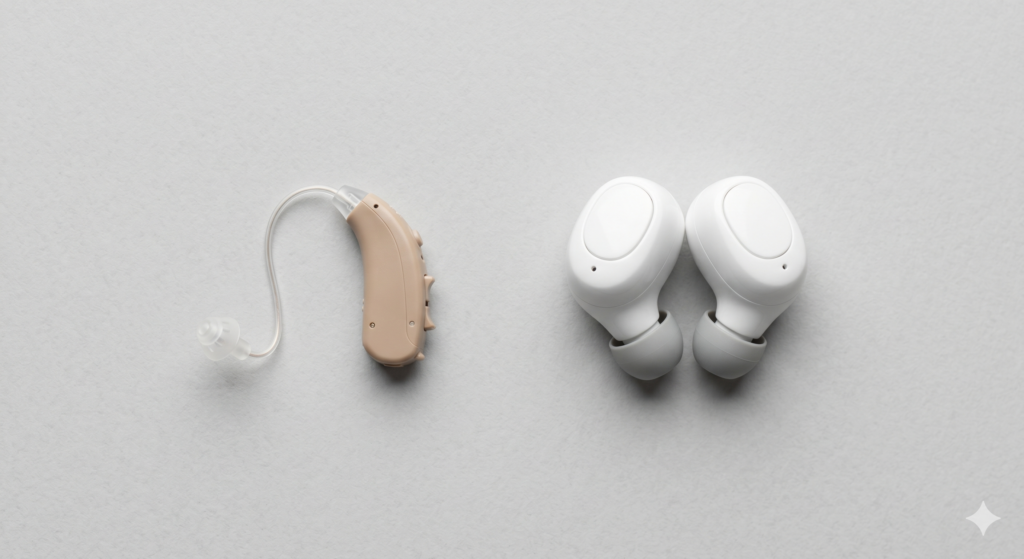
Personal Sound Amplification Products (PSAPs) — often sold online for RM50 to RM500, sometimes looking almost identical to behind-the-ear hearing aids — occupy a confusing middle ground. They amplify environmental sounds and are marketed as helpful for people with mild hearing difficulty.
The key word is marketed. PSAPs are consumer electronics, not medical devices. They are not regulated as hearing aids. They are not programmed to an audiogram. They amplify sound broadly, not selectively. And they are not fitted or verified by an audiologist.
For someone with very mild, early hearing loss and no underlying pathology, a PSAP might provide some functional benefit in the short term. But even in that narrow scenario, using one without a professional assessment means not knowing whether the loss is mild, not knowing whether it’s treatable, and not knowing whether it’s progressing — because nobody is measuring it.
In Malaysia, PSAPs are increasingly available on Shopee and Lazada, often without any guidance about who they’re appropriate for or how to use them safely. Buying one feels like a practical solution. It is, at best, a stopgap that delays proper care.
What Actually Happens When You Get a Proper Hearing Assessment
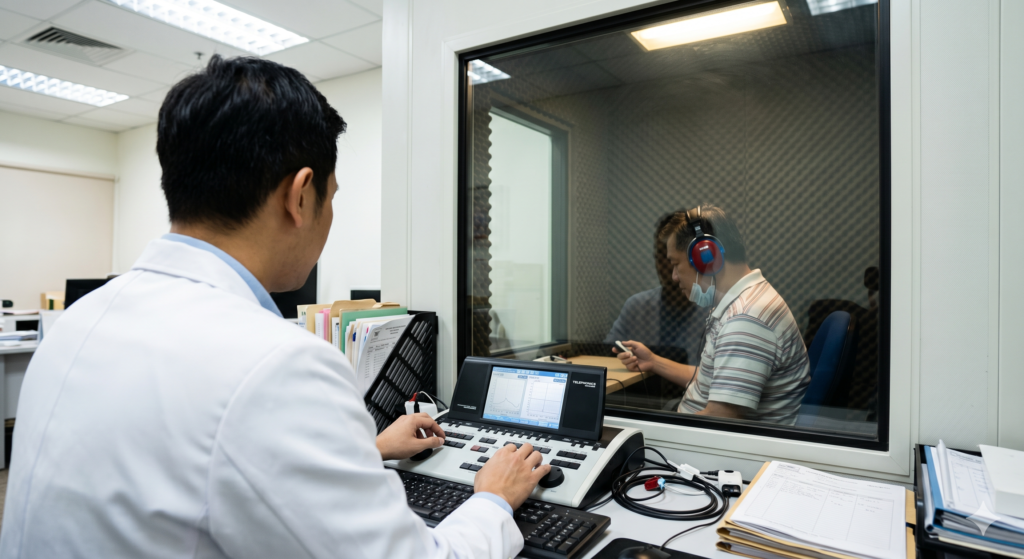
I want to be clear about what seeing an audiologist or ENT for hearing loss actually involves, because some patients imagine it to be more complicated or more expensive than it is.
A comprehensive hearing assessment typically includes pure tone audiometry — where you listen to a series of tones at different frequencies and indicate when you hear them — plus speech audiometry and, where indicated, tympanometry to assess middle ear function.
The audiogram produced tells both you and your doctor exactly which frequencies are affected, how severely, and what type of hearing loss is present. From there, the right management pathway becomes clear: whether that’s a hearing aid fitting, a referral for further ENT investigation, medical treatment for a reversible cause, or — in some cases — reassurance that the loss is mild and regular monitoring is sufficient for now.
In Malaysia, audiology services are available through government hospitals at heavily subsidised cost, through university hospitals like UMMC, and through a growing number of private hearing centres. The first step does not have to be expensive. It does have to be professional.
A Note for Adult Children
Much of what I’ve described above applies directly to elderly parents — which is who many readers are thinking about as they read this.
If your father has been quietly turning the TV volume up for years, or has started asking people to repeat themselves, or has been nodding along in family conversations without really following them: he likely has hearing loss, and he likely hasn’t mentioned it.
Hearing loss in older adults is associated with social withdrawal, cognitive decline, and depression — not because losing hearing is inherently depressing, but because the isolation it creates accumulates quietly over years. People stop attending family dinners because they can’t follow the conversation. They stop calling relatives because the phone is too difficult. They disengage, and their families often interpret this as personality change rather than sensory loss.
A pair of earphones handed to an elderly parent does not solve this. A hearing assessment — and if indicated, properly fitted, properly programmed hearing aids — can genuinely restore participation in family life in ways that matter.
The cost is real. The benefit is also real.
The Bottom Line
Earphones are not hearing aids. They were not designed to be, they cannot function as one, and using them as a substitute carries genuine risks — including the possibility of making your hearing loss worse.
If you or someone in your family has been managing hearing difficulty with commercial audio devices, the right next step is an audiometric assessment. Not because hearing aids are always the answer — sometimes they are, sometimes the cause is treatable by other means — but because you cannot make a good decision about your hearing without knowing what’s actually happening to it.
The ears you have are the only ones you’ll get. Worth looking after them properly.
Dr. Julius Goh Liang Chye is a Consultant Otorhinolaryngologist, Head & Neck and Sleep Surgeon at Universiti Malaya Medical Centre (UMMC). For ENT consultations including hearing assessment and referral, visit theentdr.com or contact us here.
Further reading on theentdr.com:
- Why aircon is damaging your nose and throat
- Understanding obstructive sleep apnea in Malaysia
- When to see an ENT vs your GP
External Links
- Health Minister: 21.5% of Malaysians Have Hearing Problems (April 2026)
- Are Earbuds Bad for Your Ears? (Feb 2026)
- Hearing Aids vs. Headphones: Clinical Comparison
Discover more from The ENT Doctor
Subscribe to get the latest posts sent to your email.
Comments are closed