
AI Hearing Aids Are Here — What’s Actually New, and What’s Just Marketing
A patient in his sixties came to see me last month holding a printed article about “AI hearing aids” from the CES technology show in Las Vegas. He wanted to know whether he should wait for these to reach Malaysia before finally getting fitted, something he had been putting off for two years. I had to explain two things: part of what he had read was already available at audiology clinics a short drive from his house, and part of it was a product category that, as things stand, is not sold in Malaysia in the form he had seen online.
That mix-up is becoming common. Every January, CES turns hearing technology into tech news, and every year some of that coverage reaches Malaysian patients slightly scrambled. This year was no exception, so let’s sort out what’s real, what’s already here, and what’s mostly still marketing.
Two Different “AI Hearing Aid” Stories Right Now
There are genuinely two separate trends getting bundled together under the same “AI hearing aid” headline, and mixing them up is where most of the confusion starts.
The first is the over-the-counter (OTC) wave. At CES 2026 in January, companies such as Elehear, Ceretone, and Cearvol showed off tiny, discreet devices — some weighing about a gram — built around branded “AI engines” that promise real-time noise reduction, adaptive sound processing, and even built-in translation features. EssilorLuxottica also returned with its Nuance Audio glasses, which pack a hearing aid into an ordinary-looking pair of spectacles using beamforming technology to sharpen conversation in noisy rooms. Nearly all of these devices are cleared or registered specifically for the United States OTC hearing aid category, a regulatory pathway the US created in 2022 for adults with perceived mild-to-moderate hearing loss.
Some of the specifics are worth knowing simply to judge the marketing claims properly. Elehear’s Delight, for instance, promises up to 24 decibels of noise reduction and 45 decibels of amplification from a device small enough to sit entirely inside the ear canal, while Ceretone’s Core One Pro, at about one gram, offers four listening modes controlled entirely from its charging case rather than a smartphone app. These are genuinely clever pieces of engineering. They are also, for now, built and regulated for a different market than ours.
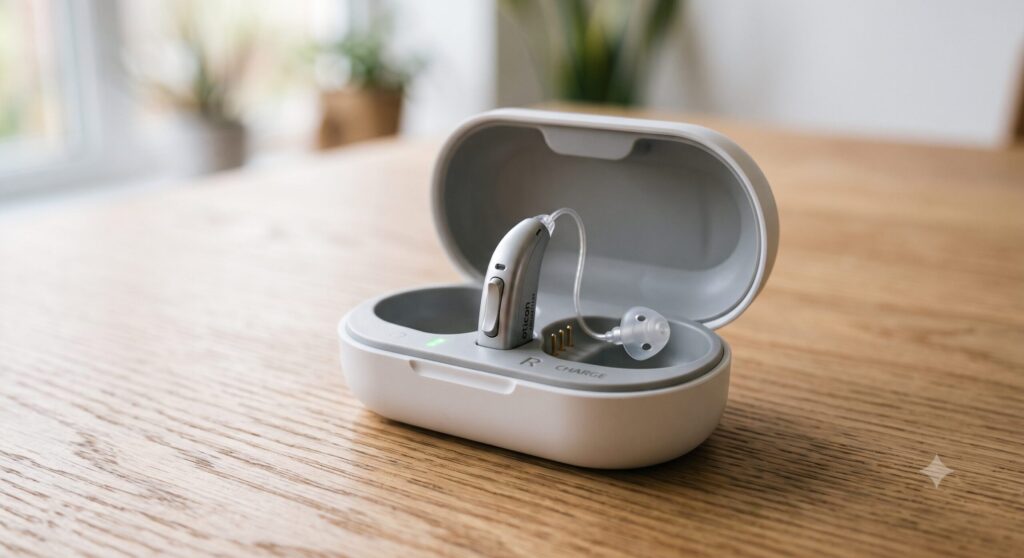
The second is the premium prescription hearing aid, which has quietly been getting genuinely smarter over the past two to three years. Oticon’s Intent uses onboard motion and orientation sensors to judge what the wearer is actually trying to listen to and adjusts the soundscape accordingly. Phonak’s Audéo Infinio Sphere runs a dedicated AI chip alongside its main processor specifically to separate speech from background noise. ReSound’s Vivia uses a similar dual-chip, deep-learning approach to prioritise voices over clutter. These are not OTC gadgets — they are prescription-grade devices fitted by an audiologist after a proper hearing assessment, and unlike the CES products above, they are already sold through hearing care providers here in Malaysia.
What “AI” Actually Means Inside a Hearing Aid
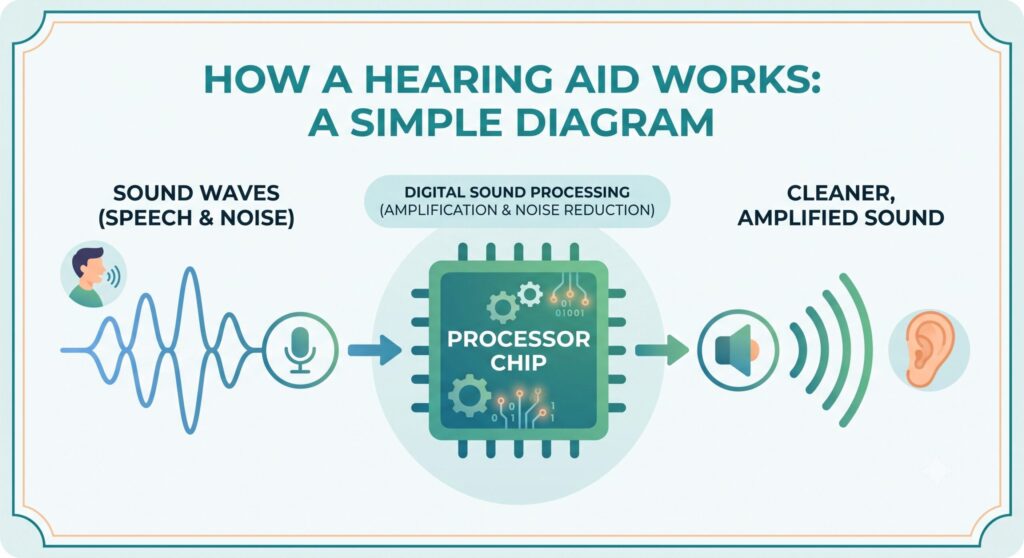
None of this involves a chatbot living in your ear. In this context, “AI” almost always means a small onboard neural network trained to recognise different acoustic environments — a quiet living room, a crowded hawker centre, a car with the windows down — and adjust amplification and noise suppression accordingly, in real time, without you touching a switch.
Older digital hearing aids already did some of this with rule-based processing: set thresholds, fixed responses. What’s changed is that the newer chips can weigh far more variables at once and adapt faster and more precisely, particularly at separating a voice you want to hear from noise you don’t. That is a genuine engineering improvement. It is not, however, a form of general intelligence, and it does not “fix” hearing loss any more than a very good pair of glasses fixes short-sightedness. It amplifies and cleans up sound; your ear and brain still do the actual hearing.
Discreet Design Is Doing a Lot of the Selling
A good part of what’s driving this wave, on both the OTC and prescription side, is design as much as processing power. Smart glasses like Nuance Audio, and charging-case-controlled devices like the Ceretone, are clearly aimed at people who associate hearing aids with looking old or unwell, and would rather not visibly wear one. That’s not a frivolous concern. Hearing aid stigma is one of the most consistently documented reasons people delay treatment for years after they first notice a problem, often long enough for the brain to lose practice processing sounds it isn’t hearing well anymore. If a more discreet, better-designed device gets someone into a clinic for a hearing test five years earlier than they otherwise would have gone, that’s a genuine win, regardless of how much of the surrounding marketing is hype.
Malaysia Still Treats Hearing Aids as Medical Devices — And That Matters

Here is the detail that gets lost when Malaysian readers see US tech coverage: in Malaysia, hearing aids are regulated as medical devices by the Medical Device Authority under the Medical Device Act 2012, and they are typically obtained through a registered audiologist or ENT clinic after a proper hearing assessment, not bought directly off a shelf or a website. Malaysia has not adopted a separate over-the-counter hearing aid category the way the United States did in 2022, which is one reason the CES OTC devices making headlines are not simply available here yet in that form. It also means ordering one of these devices from an overseas online store and shipping it to Malaysia sidesteps that safety check entirely — worth knowing before adding something to an international cart because a review looked convincing.
I don’t think that’s a loss. A hearing assessment exists to answer a question that no amount of “AI” in a device can answer for you: is this actually noise-induced or age-related hearing loss that amplification will help, or is it something else — wax impaction, a perforated eardrum, otosclerosis, or in rarer cases a growth pressing on the hearing nerve — that a self-fitted device would only mask? Malaysia’s National Otorhinolaryngology Registry recorded close to 44,000 hearing-related cases in 2025 alone, and our Health Minister has put the number of Malaysians with some degree of hearing problem at roughly one in five. That’s a lot of very different underlying causes hiding behind the same complaint of “I can’t hear properly,” and sorting through them is exactly what an assessment is for.
Myths I’m Already Hearing About “AI” Hearing Aids
- “AI hearing aids don’t need a proper fitting.” They do. Even the most sophisticated processor still needs to be programmed to your specific hearing loss and verified against your ear canal’s acoustics; skipping that step wastes most of what the technology can offer.
- “AI translation earbuds are basically the same as a hearing aid.” They’re not. Consumer earbuds with translation or “conversation enhancement” modes are convenience features built for people with normal hearing, not calibrated medical devices for diagnosed hearing loss, and relying on one when you actually need the other tends to delay proper treatment.
- “If it’s not the newest AI model, my current hearing aid is obsolete.” Not necessarily. If your current device is meeting your needs, a newer processor mainly helps in specific situations — busy restaurants, group conversations, background traffic — rather than replacing a device that already works for your day-to-day life.
- “More AI automatically means better hearing.” More accurately, it usually means better hearing in noise and faster adaptation between environments — a real and valuable improvement, just not the same claim as “better hearing” in general.
Who Should Actually Consider Upgrading
The people who benefit most from these newer AI-driven platforms tend to be existing hearing aid users who do fine one-on-one but still struggle specifically in loud, crowded settings — the kind of extended family gatherings, wet markets, and hawker centres that make up a lot of daily life in Malaysia. If that description fits you, or if you’re being fitted for the first time and want to discuss what these newer platforms offer, that’s a conversation worth having with your audiologist rather than a decision to make from a CES headline. And if a sleeker, more discreet design is what finally gets a first-time user through the clinic door after years of putting it off, that matters just as much as the processing chip inside.
What This Means for Your Wallet
These flagship AI platforms sit at the premium end of the pricing I laid out in my earlier guide to hearing aids in Malaysia, generally in the same upper bracket as other advanced and premium devices rather than a separate cost category of their own. If you want the full breakdown of prices by tier, financing routes, and Malaysian assistance schemes such as PeKa B40, that guide covers it in detail and is still current.
The Bottom Line
The AI in this year’s hearing aid headlines is real, and some of it — particularly the environment-adapting processors now sold through Malaysian audiology clinics — is a genuine step forward for people who struggle most in noisy settings. But it’s an upgrade to how a hearing aid processes sound, not a replacement for a proper hearing assessment, and most of the flashiest OTC devices from CES aren’t yet something you can walk into a Malaysian pharmacy and buy. If your hearing has been quietly getting harder to rely on, the useful first step is still the boring one: get it tested properly, then decide which processor is worth paying for. I’ve written before about why your earphones are not a substitute for a real hearing aid, and why treating hearing loss early matters for more than just your ears — the same principle holds here, AI chip or not.
FAQ Section
Are AI hearing aids available in Malaysia?
Yes, for prescription devices — Oticon, Phonak, and ReSound’s latest AI-driven platforms are sold through Malaysian audiology and ENT clinics. Several of the newer OTC devices shown at CES 2026 are registered specifically for the US market and are not yet sold here in that form.
What does “AI” actually do in a hearing aid?
It uses an onboard neural network to recognise your listening environment in real time and adjust noise reduction and amplification accordingly, primarily improving speech understanding in noisy settings rather than increasing raw hearing ability.
Do I need a hearing test before getting an AI hearing aid?
Yes. Fitting still requires a proper hearing assessment and programming to your specific hearing loss; skipping this step, as some OTC or consumer devices allow, risks masking an underlying problem that needs different treatment.
Are AI translation earbuds a substitute for hearing aids?
No. They are convenience devices for people with normal hearing, not calibrated medical devices for diagnosed hearing loss.
Do AI hearing aids cost more than standard models?
Generally yes — they sit at the advanced-to-premium end of Malaysia’s typical hearing aid pricing, rather than being a separate cost category.
Contact or visit us here for an appointment
Discover more from The ENT Doctor
Subscribe to get the latest posts sent to your email.
Comments are closed