

A woman in her mid-thirties, working in an office in Kuala Lumpur, stands in her bathroom after dinner, shining her phone torch into the back of her throat. There it is again: a small, pale speck sitting in a pocket of her left tonsil. She coughed one up last month and felt sure it was over. Now there is another one. (This is an illustrative composite, not a real patient, but anyone who has searched for answers about tonsil stones will recognise the scene.)
The question she types into her phone is one of the most common in the tonsil stone conversation: do tonsil stones ever go away on their own? Most online advice answers with a flat “no, they keep coming back”, or with a flat “yes, just gargle”. The honest answer sits in between, and recent imaging research gives us a surprisingly clear picture of what tonsil stones actually do over time. This article walks through that evidence, explains what it means for Malaysians dealing with a persistent stone or bad breath, and sets out when waiting stops being a sensible plan.
If you want the basics first, our earlier guides cover them: Tonsil Stones: What TikTok Won’t Tell You explains the treatment ladder in detail, and Tonsil Stones: The Secret Cause of Your Chronic Bad Breath introduces the smell problem. This post looks at a different question: what happens to a stone over time.
First, a quick reminder of what a tonsil stone is
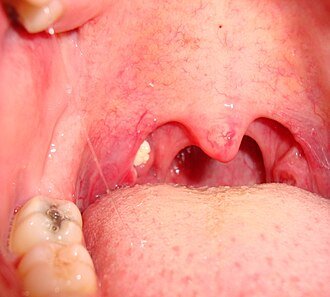
Your palatine tonsils, the two lumps of tissue at the back of your throat, are not smooth. Their surface is folded into deep pockets called crypts. Debris such as shed cells, mucus, and food particles can settle in these pockets. Over time that material can harden with calcium into a small, pale, firm lump. Doctors call it a tonsillolith. Most people just call it a tonsil stone.
Stones range from the size of a grain of rice to larger lumps. Some people feel nothing at all. Others notice a foul taste, bad breath, a sense of something stuck at the back of the throat, or throat and ear discomfort. For a fuller look at symptoms, see our guide on the constant lump in your throat.
How common are tonsil stones? More than most people think
One reason tonsil stones feel mysterious is that many people have them without knowing. A Japanese study of 482 patients compared CT scans with ordinary dental panoramic X-rays. According to PubMed, tonsil stones showed up on CT in 46.1% of patients, yet the dental X-rays picked up only 7.3% of them. Detection also rose with age, and was significantly higher in people over 40. The typical stone was small, about 3 to 4 millimetres across (Oda et al., 2013).
Other studies using dental X-rays alone report lower numbers. A study of 500 adults in Lebanon found stones in 7.2%, and found that they became more common with age (Aoun et al., 2018). The gap between those figures is the point: the stones are common, but ordinary X-rays miss most of them. Having one does not mean something is wrong with you.
A note on local data: we could not find a published Malaysian estimate of how common tonsil stones are, so the figures above come from Japan and Lebanon. They describe the biology of the tonsil, which does not change at the border, but they are not Malaysian statistics.
The surprise from follow-up CT scans: stones are not frozen in place

Most explanations treat a tonsil stone as a fixed object: it forms, sits there, and stays until someone removes it. A team at Kyushu Dental University in Japan tested that assumption. They looked at 326 sets of CT scans, each patient having an initial scan and at least two follow-up scans, and tracked how individual stones changed (Yamashita et al., 2021). The patients were having imaging for various mouth and jaw conditions rather than for tonsil problems, so this is not a group chosen because they had symptoms. Here is what the follow-up scans showed:
- 12.1% of stones disappeared over the follow-up period.
- About 26% changed in size, and most of those grew, at an average of roughly 0.6 millimetres a year.
- About 37% changed position, and in 92% of those the stone moved toward the airway side of the tonsil.
- The hardness (calcification) of almost every stone changed, rising in about 84% and falling in about 13%.
The authors concluded that tonsil stones are not inert. Their pattern of constant change, and their drift toward the airway, suggests the body tends to push them out. They described tonsil stones as possibly being in a “permanently active phase” that helps remove foreign matter from the tonsil.
That finding is the heart of the “do they go away?” question, and it deserves a careful reading. Yes, stones do sometimes leave. In this study about one in eight disappeared. But that is far from a promise. A stone that has formed may stay, may keep growing slowly, or may move and eventually be coughed up or swallowed unnoticed. Waiting is a reasonable plan for a small, painless stone. It is not a plan that works for everyone.
So why does a stone seem to come back right after you cough one up?
Here the research and everyday experience line up neatly. A stone leaving does not change the shape of the tonsil. The crypt, the pocket where the stone formed, is still there, and so are the conditions that let debris collect in it. When one stone leaves, the same crypt (or its neighbour) can start collecting the next one.
This also explains why the “cure” of poking a stone out never feels permanent. Removing a stone treats what you can see today. It does not reshape the pocket. Stones that return often, month after month, are a sign of crypts deep enough to keep trapping debris, which is the situation where a doctor may talk about changing the crypts themselves rather than only removing stones. We return to those options below.
Why do tonsil stones smell so bad?
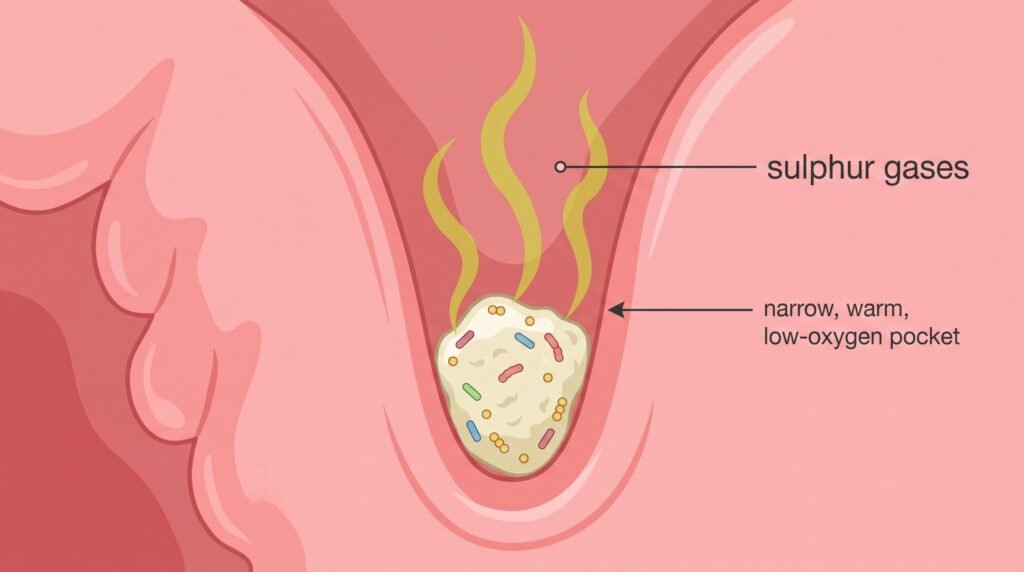
“Why do tonsil stones smell so bad” is among the most searched tonsil questions, and the answer is partly about bacteria and partly about chemistry.
A study that analysed the bacteria inside stones from six people found a community dominated by anaerobic bacteria, which are bacteria that thrive without oxygen, such as those from the genera Fusobacterium, Porphyromonas, Prevotella, and Eubacterium. The researchers noted that all of these types appear to be associated with producing volatile sulphur compounds, the gases that give bad breath its rotten, sulphurous character (Tsuneishi et al., 2006). A tonsil crypt, which is narrow, warm, and low in oxygen, is an almost ideal home for such bacteria.
A Brazilian study of 49 people with bad breath and chronic cheesy tonsil infections measured their breath sulphur levels. Having a visible stone at the time of examination was associated with about a tenfold higher chance of an abnormal breath reading (Dal Rio et al., 2007). Notably, though, most of the people in that study (about 84%) had normal readings. A stone may raise the chance of bad breath, but not everyone with a stone has it.
So the practical message is this: if your breath is bad and you can see a stone, the stone is a very plausible culprit. If your breath is bad and you cannot see one, it is worth looking for other causes rather than assuming it must be the tonsils. Bad breath has many sources, including the tongue, the gums, and dry mouth. If you often wake with a dry mouth, our guide on waking up with a dry throat is a useful companion.
Do bacteria cause tonsil stones? The story is less simple than social media suggests
Online, you will often read that tonsil stones are caused by a specific bacterial “infection” that needs killing. The evidence does not support that tidy story. A study of 134 adults who had their tonsils removed looked for a bacterium called Actinomyces. It was found in 95% of the tonsils that contained stones. But it was also found in 73% of tonsils removed for recurrent tonsillitis and in 83% of tonsils removed for enlargement, and in 58% of normal-looking tonsils tested. The authors concluded that this organism is unlikely to be the main driver of stone formation and that treatments aimed only at killing it may not work (Arvisais-Anhalt et al., 2020).
For patients, it fits with the point that antibiotics may calm a flare of inflammation but are not expected to dissolve stones or stop them forming. If you have been told that a stone problem is “just a bacteria problem”, this research suggests the cause is more about the shape of the tonsil and what collects in it.
What to do while you wait, and what to avoid
If you have a small stone that is not hurting, the safest approach is gentle and boring:
- Keep your mouth clean. Brush your teeth and your tongue, and rinse well after meals. Bacteria on the back of the tongue add to bad breath whether or not you have a stone.
- Gargle gently. Warm salt water or an alcohol-free mouthwash may help loosen debris and freshen the mouth. Do not expect it to dissolve a stone.
- Stay hydrated. A dry mouth makes bad breath worse, and sipping water through the day, particularly in air-conditioned offices, is easy to do.
What to avoid is just as important. The tonsil has a rich blood supply and a delicate surface. Cotton buds, toothpicks, fingernails, and other sharp or improvised tools can scratch the tonsil, cause bleeding, push debris deeper, and introduce infection. Social media videos make stone removal look easy, but these methods are one of the main reasons people end up in a clinic with a sore, inflamed tonsil and a stone that is still there. Our post on what TikTok doesn’t tell you about tonsil stones covers this in more detail.
When waiting is no longer a good plan
Given that stones sometimes leave, watching and waiting is sensible for a small, painless, occasional stone. But some situations call for a proper assessment rather than more waiting. See an ENT specialist if any of the following apply:
- Stones keep coming back, month after month, despite good hygiene.
- Bad breath persists for several weeks even though you clean your mouth and tongue well.
- You have repeated sore throats, a constant feeling of something stuck, or pain that spreads to the ear.
- You see blood, or the area is swollen, ulcerated, or painful.
- One tonsil is clearly larger than the other, or you notice a lump, ulcer, or white patch that does not go away. A stone does not cause this pattern, and it needs a prompt check. Our guide to early throat cancer symptoms explains which warning signs matter.
In Malaysia, many people begin with a general practitioner, who can examine the throat and refer you to an ENT specialist if the problem persists. If you are unsure which doctor to see first, read GP or ENT: Which One Should You Visit? For general health information from the national health authority, the Ministry of Health Malaysia’s MyHealth portal is a reliable place to start.
What an ENT can offer when stones do not leave
An ENT assessment starts with looking at the tonsils, usually with a light and sometimes with a small camera. This confirms whether you really have stones, how deep the crypts are, and whether something else is behind your symptoms. Treatment then follows a ladder, from least to most invasive:
- Hygiene measures and watchful waiting for small, occasional stones, as described above.
- Clinic removal of stones that are bothersome, done with proper instruments and good lighting. It treats today’s stone but not the crypt.
- Cryptolysis, in which the deep pockets are smoothed out, for example with a laser or coblation device, so that debris has less room to collect. The tonsil itself is kept.
- Tonsillectomy, removing the tonsil entirely, reserved for severe or persistent cases. Because the tonsil is gone, stones cannot form there. The trade-off is that surgery in adults is more painful to recover from and carries a real risk of bleeding, so it is a decision to take with your surgeon, not a first step.
One more point matters when weighing surgery. Removing the tonsils is not a free decision. A 2026 population study from Taiwan and the United States linked tonsil and adenoid removal with a higher later risk of an autoimmune condition called Sjogren’s syndrome, especially when the surgery happened in childhood (Chi et al., 2026). This kind of study shows an association rather than proof of cause, and it concerned a wide range of operations, not stone surgery specifically. But it is a good reason to match the treatment to the problem. A person with an occasional small stone does not need an operation. A person whose life is repeatedly disrupted by stones and bad breath may reasonably need one.
The bottom line
Tonsil stones are common, they are not fixed objects, and they sometimes leave on their own. In one CT follow-up study, about one in eight disappeared, others grew slowly, and many moved toward the airway where they could be cleared. That is genuinely reassuring for people with a small stone and no symptoms. It is also a reminder not to rely on hope: the tonsil crypt that produced one stone can produce another. If stones keep returning, if your breath will not improve, or if anything about your tonsils looks or feels unusual, an ENT assessment is a better plan than another round of home experiments.
Talk to Us about your tonsil stones
If you are tired of recurring tonsil stones, persistent bad breath, or a throat that never quite feels right, you do not have to work it out alone. Dr. Julius Goh Liang Chye, an ENT surgeon in Kuala Lumpur, can examine your tonsils, tell you whether waiting is reasonable, and discuss treatment if it is not.
Contact Us on WhatsApp to arrange a consultation
Frequently asked questions
Do tonsil stones go away on their own?
Sometimes. In a CT follow-up study of 326 patients, about 12% of stones disappeared over the follow-up period, while others grew slowly or moved. A small, painless stone can reasonably be watched, but there is no guarantee it will go.
Why do tonsil stones keep coming back?
The pocket in the tonsil where a stone formed (the crypt) remains after the stone leaves, and the same conditions that let debris collect are still there. Frequent recurrence usually points to deep crypts.
Do all tonsil stones smell?
No. In a study of people with bad breath and chronic tonsil problems, having a visible stone was associated with roughly ten times the chance of an abnormal breath reading, but most participants still had normal readings. Smell depends on the stone, the bacteria in it, and other mouth factors.
Are tonsil stones dangerous?
Usually not. They are common and often harmless. But a persistently enlarged tonsil on one side, a lump, an ulcer, bleeding, or a white patch that does not go away is not a typical stone pattern and should be checked promptly by a doctor.
Is it safe to remove a tonsil stone at home?
Gentle gargling is generally fine. Using cotton buds, fingernails, toothpicks, or other sharp tools is not recommended because it can injure the tonsil, cause bleeding, and push debris deeper.
When should I see an ENT specialist about tonsil stones?
See one if stones keep returning despite good hygiene, bad breath lasts for weeks, you have pain or swelling, or one tonsil looks different from the other. A general practitioner can also examine you first and refer you if needed.
References
- Oda M, et al. Prevalence and imaging characteristics of detectable tonsilloliths on 482 pairs of consecutive CT and panoramic radiographs. BMC Oral Health, 2013. DOI
- Yamashita K, et al. Changes in tonsillolith characteristics detected in a follow-up CT study. BMC Oral Health, 2021. DOI
- Aoun G, et al. Palatine tonsilloliths: a retrospective study on 500 digital panoramic radiographs. J Contemp Dent Pract, 2018. PubMed
- Tsuneishi M, et al. Composition of the bacterial flora in tonsilloliths. Microbes Infect, 2006. DOI
- Dal Rio AC, et al. Relationship between the presence of tonsilloliths and halitosis in patients with chronic caseous tonsillitis. Br Dent J, 2007. DOI
- Arvisais-Anhalt S, et al. Palatine tonsilloliths and Actinomyces: a multi-institutional study of adult patients undergoing tonsillectomy. Otolaryngol Head Neck Surg, 2020. DOI
- Chi HW, et al. Surgical removal of Waldeyer’s ring and long-term risk of Sjogren’s syndrome. Front Immunol, 2026. DOI
- Ministry of Health Malaysia. MyHealth portal. myhealth.moh.gov.my
No responses yet