
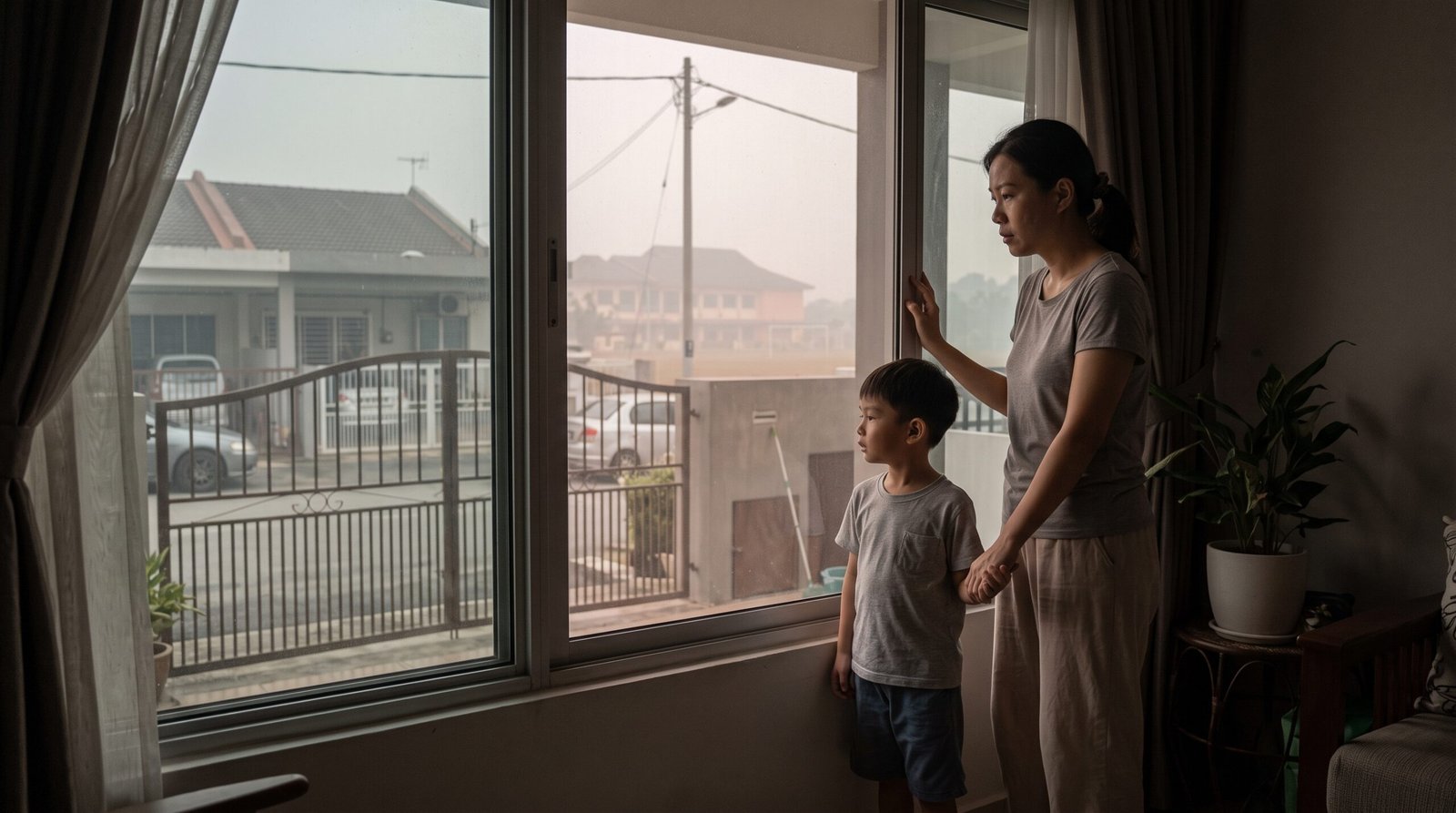
On Wednesday morning, 27 of the country’s 68 air quality stations were in the unhealthy range. Pasir Gudang read 177. Nilai jumped from 151 to 174 overnight. Cheras was at 168 and Petaling Jaya, where a lot of my patients live, sat at 154 (Malay Mail, 14 October 2026).
For parents in Johor, those numbers have turned into a very practical problem. Every school in the state has been shut since 8 October, and the state government has extended the closure to 16 October. That is 1,198 schools and more than 617,000 children at home (The Star, 10 October 2026). Melaka, Negeri Sembilan and Putrajaya closed their schools on 13 October as well, and so did selected districts in Selangor, Pahang, Sabah and Sarawak.
I’ve written about the haze twice already this year, in August and again in September when readings in parts of the country went past 500. Both of those were written with adults in mind. This one is for parents, because during haze season the questions I get are mostly about children. A nose that won’t stop running. A pillow with blood on it. A toddler who keeps pulling at her ear. And the one I hear most often: is a mask enough?
Short answer: for young children, usually not. Here’s what the smoke actually does, and what I’d do at home.
Why children feel the haze before adults do

A child is not a small adult, at least not when it comes to breathing. Children breathe faster than we do and take in more air for their body weight, so for every hour spent in hazy air they inhale a bigger dose of whatever is floating in it.
Their noses are also narrower. A millimetre of swelling inside an adult nose is a nuisance. Inside a four-year-old’s nose it can block most of the passage. Then there are the adenoids, the pad of tissue at the back of the nose that is at its largest in early childhood. When the adenoids swell they block the back of the nose, which pushes the child into breathing through the mouth. And once a child is mouth-breathing, the nose’s built-in filter is bypassed altogether.
The part of the haze that worries doctors most is PM2.5: particles 2.5 micrometres across or smaller, roughly thirty times thinner than a strand of hair. The nose is good at catching larger dust. These finer particles get further in. On their way through, they irritate the lining of the nose, the throat and the airway, and that irritation is where most of the symptoms below come from.
The nose: runny, blocked, and sometimes bleeding
The first thing most parents notice is the nose. Clear runny mucus, sneezing, a blocked nose at night, rubbing at the nostrils. This is the lining of the nose reacting to the irritation, and in most children it settles within days of the air clearing.
Children who already have a sensitive nose tend to have a much harder time. A 2022 study of 4,146 schoolchildren aged 10 to 13 in Chongqing, China found that allergic rhinitis was more common where yearly and monthly PM2.5 levels were higher (Qiu et al., Frontiers in Public Health). That was a Chinese study looking at long-term pollution, not a Malaysian haze episode, so I wouldn’t stretch it too far. But it matches what I see: the child with known rhinitis is the one whose nose falls apart first. If that sounds like your child, my guide to rhinitis covers the longer-term options.
Nosebleeds are the symptom that frightens parents most. The usual source is a small patch of blood vessels just inside the nostril, on the middle wall of the nose. Dry, irritated lining cracks more easily there, and children rub and pick. Researchers in Korea have linked higher PM10 levels with more hospital visits for nosebleeds in children (Kwak et al., Scientific Reports, 2022), which fits with what we see in clinic during bad air weeks.
If your child’s nose bleeds, sit them up and lean them slightly forward. Pinch the soft part of the nose, below the bony bridge, firmly and without letting go for ten minutes by the clock. Don’t tilt the head back; the blood just runs down the throat and they swallow it, which often makes them vomit. My nosebleed post goes through this step by step.
One caution that is specific to Malaysia right now. A nosebleed in a child who also has a fever, bruising, or bleeding gums is not a haze problem until proven otherwise. That combination needs a doctor the same day, because dengue is still circulating. I wrote about how to tell the two apart in August.
Saline helps. A saline spray or gentle saline rinse washes particles and dried mucus out of the nose and keeps the lining moist. Use sterile water or water that has been boiled and cooled, never straight from the tap. I explained why in this post on nasal rinsing. For small children a spray is easier than a rinse bottle, and doing it after time outdoors makes the most sense.
The ears: how a smoky week ends in an ear infection
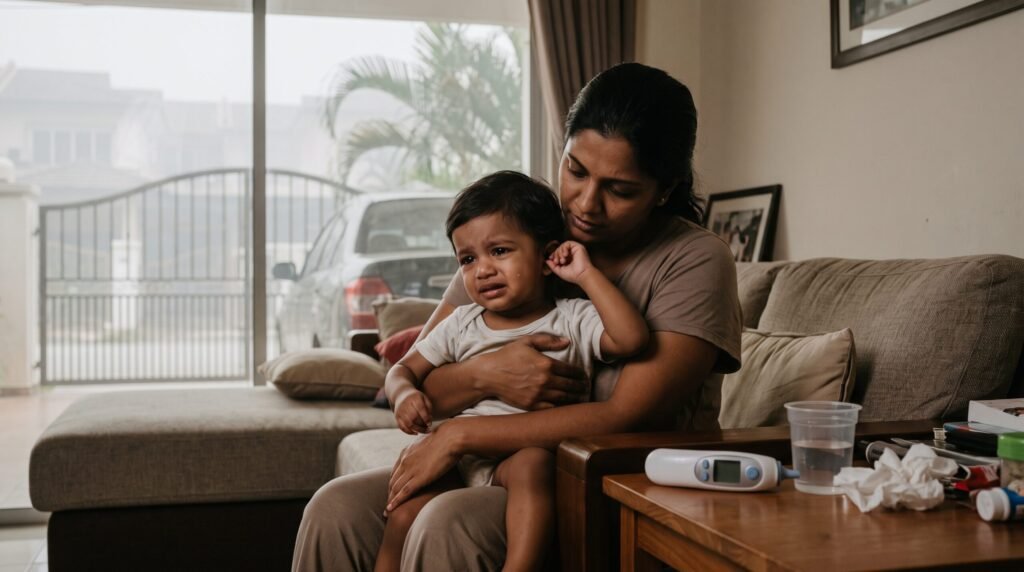
This is the link most parents don’t expect. The ear is connected to the back of the nose by a narrow channel called the Eustachian tube, which lets air into the middle ear and lets fluid drain out. In young children the tube is short, floppy and nearly horizontal. When the nose and adenoids swell, the tube stops working properly. Fluid collects behind the eardrum, and that fluid is a comfortable place for bacteria to grow.
There is research behind this. A 2020 analysis pooling 12 studies found that the risk of middle ear infection went up as PM2.5 levels rose, and the effect was strongest in children under two (Lee et al., 2020). A study across seven Korean cities found the same pattern in children up to three years old, and children who had recently had a cold were more affected (Oh et al., 2020). I should be honest about the limits. These are international studies, the effect for any single child is small, and nobody has published Malaysian haze data on ear infections. But with flu and colds still circulating, I’d keep an eye on the ears of anyone under five.
Watch for ear tugging, a child who is crying more at night, fever, or discharge from the ear. In older children the clue is often quieter: they don’t answer when you call from another room, or they keep turning the television up. That can be fluid sitting behind the eardrum after the infection has settled, sometimes called glue ear. It often clears by itself over a few weeks. If hearing still seems off a couple of months after the haze has gone, get it checked. My post on preventing middle ear infections in children and the one on ears that stay blocked after the flu cover what happens next.
The throat: scratchy, coughing, and snoring more
A sore, scratchy throat and a dry cough are common in hazy weeks. Some of it is direct irritation. Some of it is mucus from an irritated nose dripping down the back of the throat, which is why the cough is often worse when the child lies down. A child who is mouth-breathing at night also wakes up with a dry, sore throat.
You may also notice your child snoring for the first time, or snoring louder than usual. Swollen adenoids and a blocked nose narrow the airway during sleep. Snoring that comes and goes with a bad air week is usually temporary. Snoring with pauses, gasping, or a child who is unusually sleepy or cranky during the day is worth a proper assessment. I’ve written about the difference between ordinary snoring and noisy breathing in children.
Wheezing, a tight chest, or breathing that looks like hard work is a lung problem rather than a throat problem. Children with asthma are at real risk during haze, and their paediatrician or GP should see them early rather than late.
Masks: what actually works for children
This is where I disagree a little with the way masks are often talked about. N95 respirators are designed and tested for adult faces. Back in 2019 Malaysia’s then Director-General of Health said plainly that the N95 is not designed for children, and that hasn’t changed: a respirator that leaks around the edges does very little. Children’s sizes of KN95 and KF94 masks exist and can help older children who will keep them on, but getting a proper seal on a small face is hard. Children under two should not wear masks at all, because they can’t take them off if they struggle to breathe.
A respiratory physician at Pantai Hospital put it well in a recent interview: “Masks are usually not sufficient on their own. For kids, protection has to come from the environment itself” (Twentytwo13). I agree. For most children the mask is the backup, not the plan.
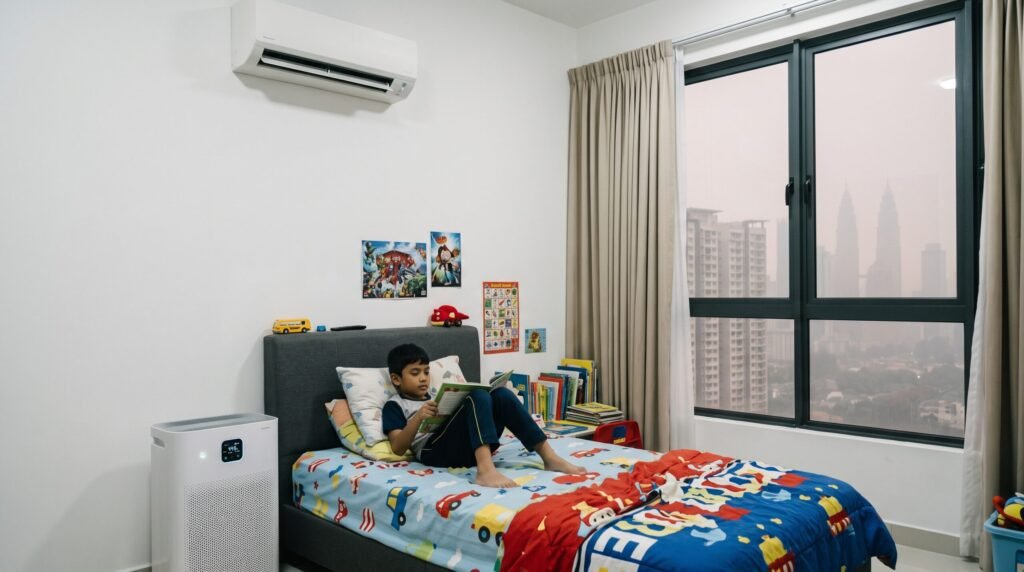
The plan is cleaner air indoors:
- Keep windows and doors closed when the API is above 100, and use air-conditioning on recirculate if you have it.
- Run an air purifier with a true HEPA filter in the room where your child sleeps. Check that it is rated for the size of the room; a small unit in a large living room won’t keep up.
- Don’t add smoke indoors. Incense, mosquito coils, candles and cigarette or vape smoke all add fine particles to the same air you’re trying to clean.
- Wipe and mop surfaces with a damp cloth rather than sweeping, which throws settled dust back into the air.
- Give plenty of water. A well-hydrated child has thinner mucus and a less irritated throat.
Check the Department of Environment’s API portal before any outdoor play. The Education Ministry suspends outdoor activities at schools once the reading goes above 100, and that is a sensible rule to copy at home. The Star’s parents’ checklist from earlier this month is also a useful one to keep on the fridge.
When to take your child to a doctor
Most haze symptoms in children are irritation, and they settle once the air improves. Antibiotics don’t help irritation, so please don’t push for them. These are the signs that need a doctor:
- Fast breathing, the skin between the ribs pulling in with each breath, or lips turning bluish. Go to the emergency department.
- A fever above 39°C, or any fever lasting more than three days.
- Ear pain with fever, discharge from the ear, or swelling and redness behind the ear.
- A nosebleed that doesn’t stop after 20 minutes of proper pressure, nosebleeds every day, or any nosebleed with bruising or bleeding gums.
- A blocked nose on one side only with smelly discharge. In young children this is a foreign body until proven otherwise.
- Snoring with pauses or gasping, or hearing that still seems reduced two to three weeks after the air has cleared.
After the haze lifts
Children’s noses recover quickly. Most of the runny noses, coughs and scratchy throats I see during haze weeks are gone within a week or two of clean air. What lingers is usually fluid in the middle ear or a flare of rhinitis in a child who already had it, and both are worth following up if they haven’t settled in a month.
The northeast monsoon usually arrives in mid-November, and with it the usual wave of colds and flu. A child whose nose and ears haven’t fully recovered from the haze goes into that season at a disadvantage. If your child had a rough few weeks, now is a good time to get the lingering problems sorted rather than waiting.
Talk to Dr. Julius
If your child’s nose, ears or throat haven’t settled since the haze started, or you’re worried about nosebleeds, ear infections or snoring, you can contact me directly on WhatsApp to arrange a consultation at UM Specialist Centre. You can read more about the paediatric ENT services I offer.
Frequently asked questions
Should my child wear an N95 mask during the haze?
N95 masks are made for adult faces and rarely seal well on a child. Older children can use a properly fitted child-size KN95 or KF94 if they will keep it on. Children under two should not wear masks. For all children, keeping indoor air clean with closed windows and a HEPA air purifier matters more than the mask.
Can haze cause nosebleeds in children?
Yes. Haze dries and irritates the lining at the front of the nose, which bleeds more easily, especially if the child rubs or picks. Pinch the soft part of the nose for ten minutes with the head tilted slightly forward. If your child also has a fever, bruising or bleeding gums, see a doctor the same day to rule out dengue.
Can haze cause ear infections?
It can contribute. Haze swells the lining of the nose and the adenoids, which stops the Eustachian tube from draining the middle ear. International studies have linked higher PM2.5 levels with more ear infections, especially in children under two.
Is it safe to rinse my child’s nose during the haze?
Yes, and it helps. Use a saline spray or a gentle rinse made with sterile water or water that has been boiled and cooled. Never use water straight from the tap.
At what API reading should my child stay indoors?
The Education Ministry stops outdoor school activities once the API is above 100. That is a reasonable cut-off for home too, and children with asthma or allergic rhinitis may need to stay in at lower readings.
No responses yet