
Malaysia Haze Emergency: What API Above 500 Does to You
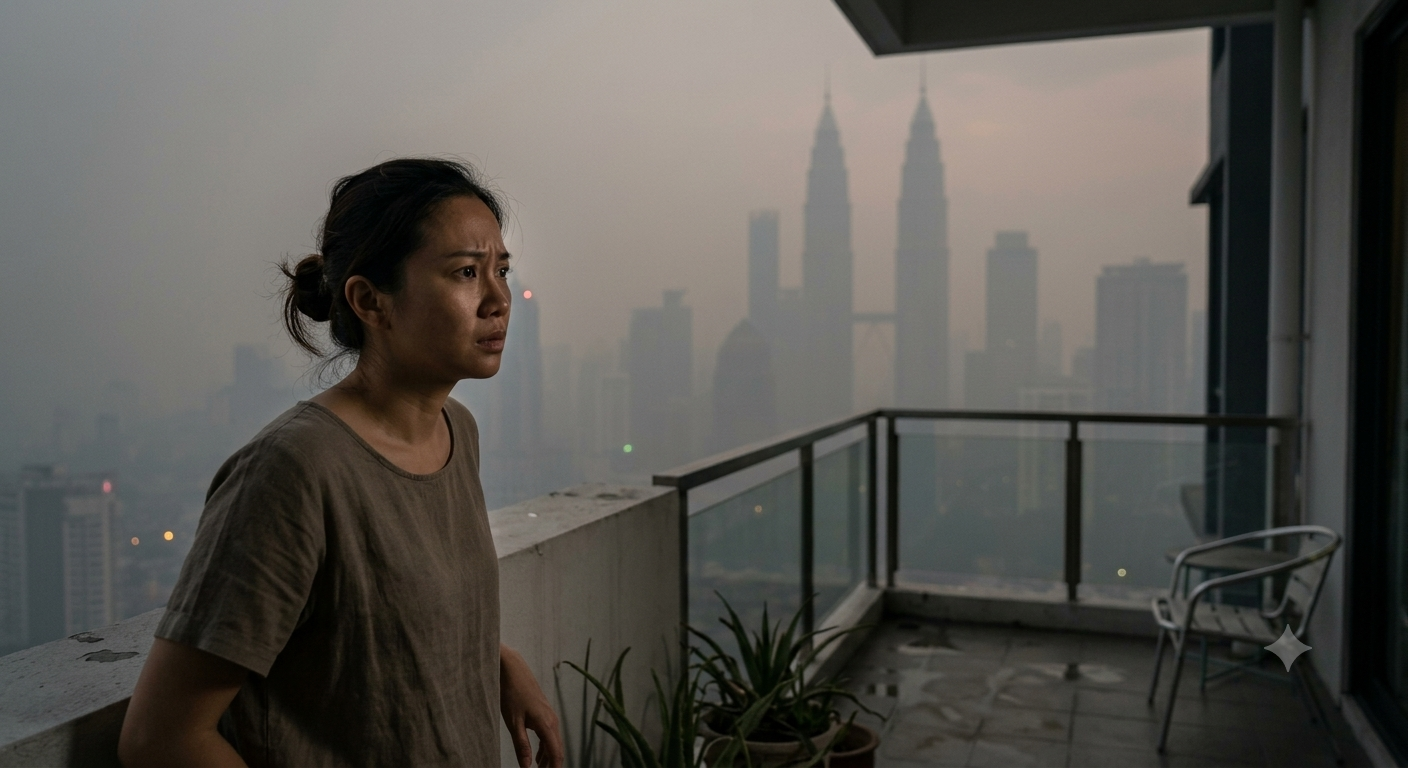
A 52-year-old accountant sat across from me in my clinic in Petaling Jaya this week, checking her phone before we had even finished exchanging greetings. Her parents live in Kuching, she told me, and she had just read that the government had declared a haze emergency in the district of Serian. Should she be telling them to stay indoors entirely? And was the mild nasal block and scratchy throat she herself had been nursing for two days connected to the haze she could see sitting over the city from her apartment balcony, even though she lives more than a thousand kilometres away in the Klang Valley?
I have been fielding some version of this question several times a week since August. But this week the question carries a different weight, because for the first time in years, Malaysia’s haze has not simply moved from “good” to “unhealthy” on the usual seasonal cycle. It has crossed into something Malaysia’s own disaster management system treats as a distinct category: a declared emergency. That distinction matters, and it deserves a more precise answer than the usual advice to wear a mask and stay indoors.

What Actually Happened in Serian
On 4 September 2026, the Sarawak Disaster Management Committee requested, and the Yang di-Pertuan Agong formally consented to, a declaration of emergency in the Serian district after the Air Pollutant Index, or API, breached 500, peaking at roughly 519 to 521 (Malay Mail, 4 September 2026). Neighbouring Kuching itself recorded a hazardous reading of 310 on the same day. Under Malaysia’s Department of Environment classification, any API above 300 already sits in the “hazardous” band; a reading beyond 500 is the point at which a local state of emergency becomes a real option rather than just a warning label (Yahoo News Malaysia). This was not routine haze. Smoke drifting across the South China Sea from fires and peatland burning in Kalimantan, Indonesia, combined with a prolonged dry spell, pushed Serian into territory that most Malaysians have simply never lived through before (Euronews).
The response matched the severity. Some 647 schools in the affected area were closed. Government and private offices, plantations, construction sites and quarries in Serian shut down entirely except for essential services. Drinking water was distributed to affected communities, and residents were told to avoid outdoor activity altogether, wearing N95 or three-ply masks whenever stepping outside was unavoidable, with particular emphasis on protecting children, the elderly, and anyone already living with a heart or lung condition.
A Haze Season That Has Moved in Stages
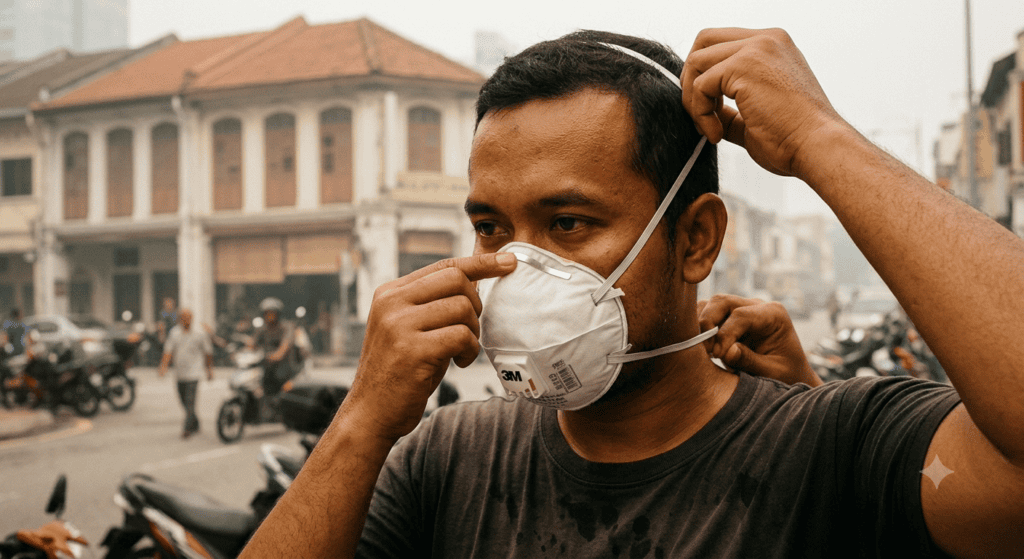
It’s worth being precise about how this year has actually unfolded, because the Klang Valley’s own experience has been quite different from Sarawak’s. We wrote about the first wave of this year’s haze back in August, when API readings across the Peninsula were sitting in the “unhealthy” band. Conditions then worsened again in the last week of August: Cheras and Batu Muda in Kuala Lumpur touched the 150s, and Putrajaya recorded 152 on 28 August (Malay Mail, 28 August 2026). Uncomfortable, and worth taking seriously, but still a different order of magnitude from what Serian experienced a week later.
As of this week, air quality in the Klang Valley has actually eased. Kuala Lumpur and Petaling Jaya are both back down in the moderate range. So the emergency, right now, is a Sarawak and Borneo story rather than a Klang Valley one. But that geography matters less than it might seem, for one specific reason: this year’s national Malaysia Day celebration is centred on Kuching on 16 September (Pocket News) — the very city sitting beside the district that has just come out of an emergency declaration. Thousands of Malaysians from across the country, plus dignitaries and performers, are about to travel into the affected region regardless of where they normally live or how their own local API reads today.
What “Hazardous” Actually Means Inside Your Nose, Sinuses and Lungs
Malaysians have grown used to talking about API numbers the way we talk about weather forecasts, but the numbers correspond to genuinely different biological events, not just different shades of grey sky. Malaysia’s Department of Environment groups API readings into bands, summarised here:
| API Range | Classification | What It Means |
| 0–50 | Good | No meaningful effect on a healthy respiratory system. |
| 51–100 | Moderate | Sensitive individuals (existing rhinitis, asthma) may notice mild symptoms. |
| 101–200 | Unhealthy | Irritation of the eyes, nose and throat becomes common even in healthy adults. |
| 201–300 | Very Unhealthy | Symptoms become more pronounced; outdoor activity should be limited. |
| 301–500 | Hazardous | Significant risk for the general population, not just vulnerable groups. |
| Above 500 | Emergency threshold | The level Malaysian authorities treat as grounds to consider a formal local emergency. |
The nose is not a passive tube. Its lining is covered in a thin layer of mucus sitting on top of microscopic, hair-like structures called cilia, which beat in a coordinated rhythm to sweep dust, pollen and airborne debris backward toward the throat, where it is swallowed and neutralised by stomach acid long before it can reach the lungs. This system, called mucociliary clearance, is one of the body’s more elegant pieces of everyday engineering, and on ordinary days it works quietly enough that most people never think about it at all.
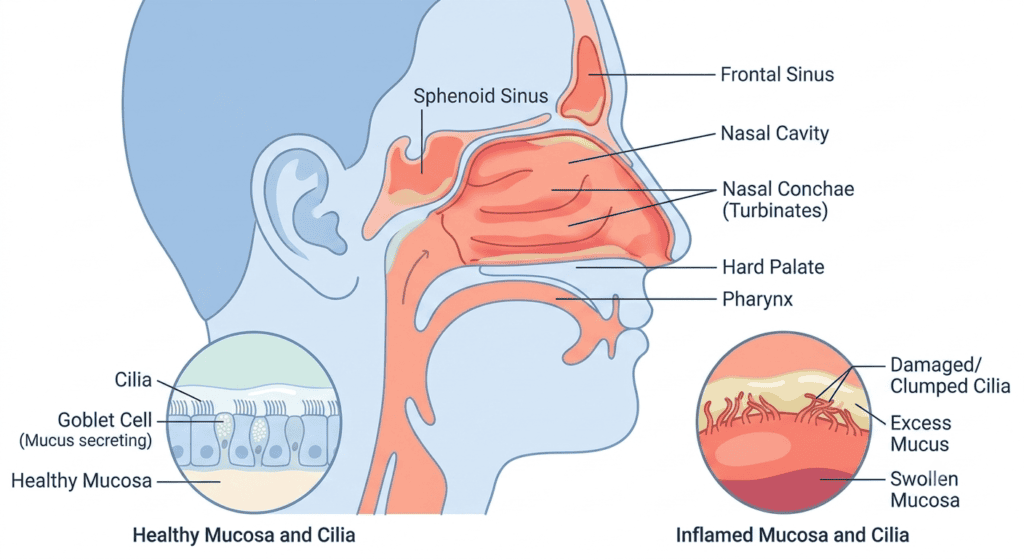
Fine particulate matter, measured as PM2.5, is the main hazardous component of haze, and it is small enough to disrupt this system directly. Research on PM2.5 exposure has found that it can damage the metabolism of nasal epithelial cells, weaken the integrity of the barrier those cells form, and slow mucociliary clearance itself, on top of triggering inflammation in the nasal lining (NCBI). In plain terms, haze doesn’t just sit uncomfortably in your nose; it temporarily disables part of the system your nose relies on to clean itself. That is why the congestion, runny nose and post-nasal drip that arrive with haze season can feel disproportionate to how “dirty” the air actually looks outside. The irritation is happening at a cellular level, not simply a dust-in-the-nostrils level.
At higher concentrations, PM2.5 is small enough to bypass the nose’s filtering almost entirely and travel directly into the lower airway and lungs, where it can trigger coughing, shortness of breath, and inflammation deep in lung tissue, and can worsen existing heart and lung conditions (US EPA). This is part of the biological reason API bands escalate the way they do. At “unhealthy” levels, the nose and throat absorb most of the damage. At “hazardous” and emergency levels, the lungs and cardiovascular system are increasingly in the firing line as well, which is exactly why Serian’s response involved shutting down outdoor work entirely rather than simply recommending masks.
Who Is Most at Risk, and Why
Malaysia’s Ministry of Health has consistently flagged the same groups during haze advisories: children, the elderly, pregnant women, and anyone with asthma, chronic lung disease, or heart conditions (KKM). The reasons are specific to each group rather than a generic caution. Children breathe faster relative to their body size than adults do, so they take in proportionally more polluted air per minute, and their airways start out narrower, meaning the same degree of swelling produces a bigger drop in airflow. Elderly patients often have less physiological reserve in both their lungs and their cardiovascular system, so the added strain from hazardous air has less room to be absorbed without symptoms appearing. And anyone who already lives with allergic rhinitis, chronic sinusitis, or asthma is, in effect, starting haze season with a nasal lining and airway that are already somewhat inflamed and less resilient before the haze adds anything on top.
What Actually Helps: Masks, Indoor Air, and a Few Things to Avoid
A properly fitted N95 or equivalent respirator is genuinely more protective than a surgical or cloth mask during haze, because it seals against the face and is designed to filter particles in the PM2.5 size range, rather than simply covering the nose and mouth (KKM). But “properly fitted” is doing real work in that sentence. Facial hair breaks the seal. Many N95 masks are sized for adult faces and do not seal properly on children, which is one reason Malaysian health authorities advise against relying on N95 masks for young children and instead prioritise staying indoors with filtered air. And for anyone with an existing lung or heart condition who finds an N95 mask makes breathing feel more effortful or uncomfortable, the official advice is to stop wearing it and speak to a doctor rather than push through the discomfort.
Indoors, a room with the doors and windows closed and, where possible, a HEPA air purifier running does more for your nose and sinuses during a hazardous spell than any mask does, simply because it is where most people, especially children and the elderly, spend the majority of their time during an emergency-level event. It is also worth resisting two common instincts. The first is reaching repeatedly for over-the-counter decongestant nasal sprays to fight the congestion; used for more than a few days in a row, these can backfire into rebound congestion that persists even after the haze clears. The second is assuming any nasal rinse is fine as a way to physically flush particles out; we’ve written before about why tap water specifically isn’t the right choice for nasal rinsing, and that distinction matters more, not less, when more people are rinsing more often.
When It’s More Than Ordinary Haze Irritation
Most haze-related nasal and throat irritation settles within a few days of the air genuinely clearing, and doesn’t need anything beyond the basic measures above. It is worth seeing a doctor, rather than waiting it out, if congestion or a blocked nose persists well beyond a week, if breathing becomes noticeably effortful or you develop wheezing or chest tightness, if a child’s breathing sounds laboured or unusually noisy, or if facial pain and pressure across the cheeks or forehead is severe enough to suggest acute sinusitis rather than simple congestion. None of this is common, even during a hazardous spell, but it is exactly the group of symptoms where an ENT assessment, rather than another week of over-the-counter remedies, is the right next step.
If Your Malaysia Day Plans Take You to Sarawak
With this year’s national Malaysia Day celebration centred on Kuching on 16 September, anyone travelling into the state for the occasion should check the day’s actual API for Kuching and Serian specifically, rather than assuming conditions have returned to normal simply because the emergency declaration has been lifted. Pack a properly fitted N95 mask if you have one, keep any existing asthma or allergy medication with you rather than in checked luggage, and treat “the emergency is over” as a description of the legal and administrative status, not a guarantee that the air is back to its normal, low-API self.
Talk to an ENT Specialist
If you or a family member are dealing with nasal congestion, sinus pain, or breathing difficulty that doesn’t feel like ordinary haze irritation, it is worth having it examined rather than guessing. You can reach Dr. Julius Goh Liang Chye’s clinic directly to ask a question or arrange a consultation: message us on WhatsApp.
Frequently Asked Questions
Is N95 the right mask for haze, or should I use a surgical mask?
For adults without breathing difficulty, a properly fitted N95 or equivalent respirator filters haze particles more effectively than a surgical mask, because it seals against the face rather than simply covering it. If wearing one makes breathing feel harder, or you have an existing heart or lung condition, Malaysia’s Ministry of Health advises stopping and speaking to a doctor rather than continuing.
Can children wear N95 masks during a haze emergency?
Generally, N95 masks are designed and sized for adult faces and don’t create a reliable seal on children. Malaysian health authorities recommend prioritising staying indoors with filtered air for young children over relying on N95 masks.
How long do haze symptoms last after the air clears?
Nasal and throat irritation from PM2.5 exposure typically settles within a few days once air quality genuinely improves, since the underlying issue is temporary inflammation and disrupted mucus clearance rather than permanent tissue damage. Symptoms lasting well beyond a week are worth having assessed.
Does haze cause permanent sinus or lung damage?
A single haze season, even a severe one, is unlikely to cause permanent damage in someone without an existing condition. The greater concern is cumulative, repeated heavy exposure over years, and acute risk to people who already have asthma, chronic lung disease, or heart conditions, for whom even one hazardous-level episode can be medically significant.
Is it safe to travel to Kuching or Sarawak now that the emergency has been lifted?
An emergency declaration being lifted means the API has fallen back under the threshold that triggers that specific administrative response, not that air quality has returned to a “good” reading. Check the day’s actual API for your specific destination before travelling, and bring a properly fitted mask and any usual asthma or allergy medication with you.
Internal Links Used
Haze Is Back: What “Unhealthy” Air Is Doing to Malaysian Noses, Sinuses and Throats — https://theentdr.com/blog/haze-is-back-what-unhealthy-air-is-doing-to-malaysian-noses-sinuses-and-throats/
Can You Really Get “Addicted” to Nasal Spray? — https://theentdr.com/blog/can-you-really-get-addicted-to-nasal-spray-an-ent-explains-rebound-congestion/
Is Tap Water Safe for Nasal Rinsing? — https://theentdr.com/blog/nasal-rinse-tap-water-safety-malaysia/
Not Every Headache Is a Sinus Problem — https://theentdr.com/blog/headache-sinus-or-something-else-malaysia/
External Sources Used
Malay Mail — Serian API hits hazardous 518, emergency declaration possible (4 Sept 2026): https://www.malaymail.com/news/malaysia/2026/09/04/serian-api-hits-hazardous-518-emergency-declaration-possible/233873
Malay Mail — Haze worsens as 18 areas across Malaysia, including KL, Putrajaya, record unhealthy air quality (28 Aug 2026): https://www.malaymail.com/news/malaysia/2026/08/28/haze-worsens-as-18-areas-across-malaysia-including-kl-putrajaya-record-unhealthy-air-quality/232952
Yahoo News Malaysia — Malaysia declares emergency in Serian district (4 Sept 2026): https://malaysia.news.yahoo.com/malaysias-sarawak-declares-emergency-serian-080130767.html
Euronews — Malaysia declares air quality emergency as haze linked to Indonesia fires reaches critical level (4 Sept 2026): https://www.euronews.com/2026/09/04/malaysia-declares-air-quality-emergency-as-haze-linked-to-indonesia-fires-reaches-critical
Pocket News — Malaysia Day 2026 Celebration Set for Sept 16 in Kuching (1 Sept 2026): https://pocketnews.com.my/2026/09/01/malaysia-day-2026-celebration-set-for-sept-16-in-kuching/
Ministry of Health Malaysia (KKM) — Usage Of Personal Protection During Haze: https://www.moh.gov.my/en/core/health-information/jerebu/artikel-dan-panduan-pengguna-berkaitan-jerebu/usage-of-personal-protection-during-haze
US EPA — Health and Environmental Effects of Particulate Matter (PM): https://www.epa.gov/pm-pollution/health-and-environmental-effects-particulate-matter-pm
NCBI/PMC — The Relationship between Fine Particle Matter (PM2.5) Exposure and Upper Respiratory Tract Diseases: https://www.ncbi.nlm.nih.gov/pmc/articles/PMC10817350/
Comments are closed