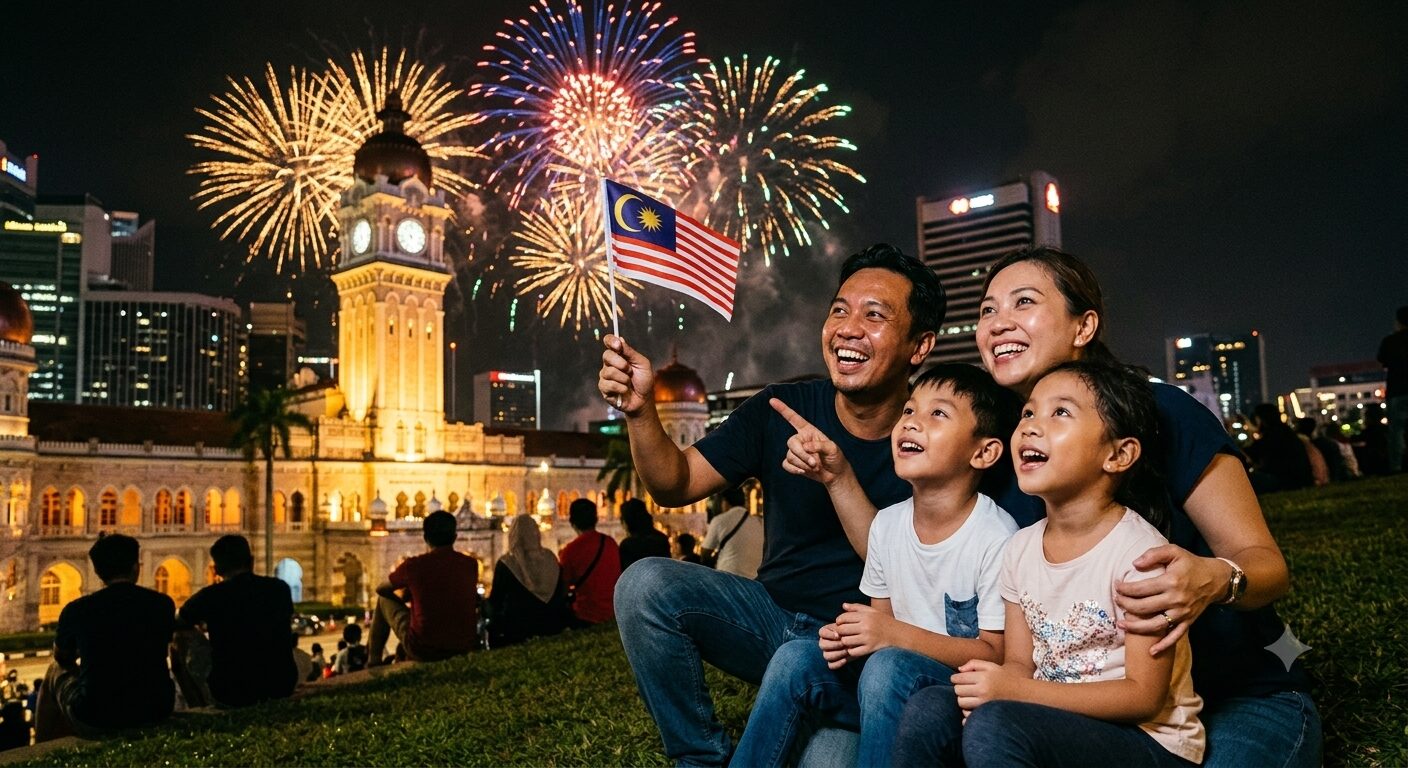
A father brought his nine-year-old daughter to see me two weeks after last year’s National Day celebrations. They had watched the countdown fireworks from less than ten metres away, close enough that she could feel the booms in her chest, she told me. She had her hands over her ears, but not quite fast enough for the first few bursts. For three days afterward, she kept telling her parents that sounds felt “far away,” like she was underwater. They assumed it would pass on its own, the way a loud gig leaves your ears ringing until you wake up the next morning and everything is normal again.
Mostly, it did pass. But when I tested her hearing a week later, there was a small, measurable dip in her right ear, not enough to affect her daily life, but a real, permanent change on the audiogram. She was lucky. Many of the patients I see after Merdeka season, or after a big concert at Bukit Jalil, are not quite so lucky, and most of them had no idea that what happened to their ears that night could have been avoided with a cheap pair of foam earplugs.
Why This Matters Right Now
Malaysia is heading into its loudest stretch of the year. Merdeka Day on 31 August, followed just over two weeks later by Malaysia Day on 16 September, brings a run of fireworks displays, countdown parties, and concerts to cities across the country: the crowds at Dataran Merdeka, the fireworks over Lake Putrajaya, the countdown gathering at KL Tower, and a concert calendar that keeps venues like Bukit Jalil National Stadium and Axiata Arena busy through the month. Add in wedding season, festival celebrations, and the fact that Malaysians simply love a good countdown, and this five-to-six-week window exposes ears to more short, high-intensity noise than almost any other stretch of the calendar.
As an ENT surgeon, I don’t say this to spoil the celebrations. I say it because almost none of the noise-related hearing damage I see every year was inevitable. It happens because most people genuinely don’t know how loud “loud” actually is, or how quickly the damage can happen.
What’s Actually Happening Inside Your Ear
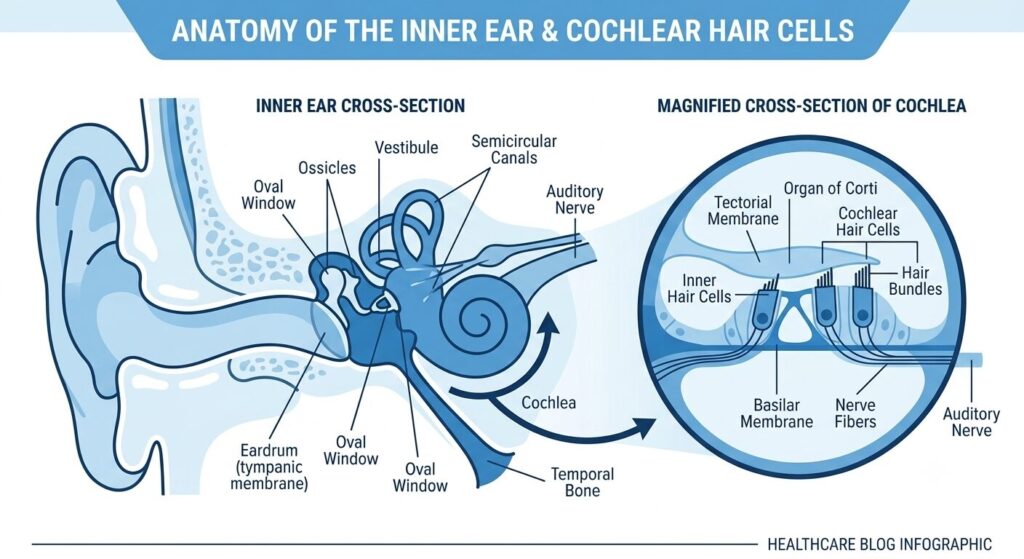
Sound is pressure. When a sound wave, whether it’s a bass line at a concert or the shockwave from a firework, reaches your inner ear, it moves thousands of microscopic hair cells inside the cochlea, the snail-shaped organ responsible for converting vibration into the electrical signal your brain reads as sound. Gentle sound bends these hair cells gently. Loud, sudden sound bends them violently, sometimes hard enough to snap them or exhaust them to the point they stop working properly.
This is where the distinction between fireworks and concerts really matters medically. A concert produces continuous noise: loud, but sustained and relatively predictable, which gives your ear’s natural defence mechanism, a tiny muscle called the stapedius, a chance to react and dampen some of the sound before it does damage. A firework produces impulse noise: a single, explosive pressure spike that arrives and disappears in milliseconds. The stapedius reflex takes roughly 30 to 150 milliseconds to engage, often too slow to protect you from a blast that’s already come and gone by the time your ear tries to defend itself. That’s part of why, according to the US National Institute on Deafness and Other Communication Disorders (NIDCD), fireworks are considered more dangerous per exposure than continuous noise at a similar volume reading.
How Loud Are We Actually Talking About?
Numbers help put this in perspective. A normal conversation sits around 60 decibels (dB). Standing beside busy traffic is closer to 80 to 85 dB. The threshold most occupational health authorities treat as hazardous over a working day is 85 dB, which is the exact limit set out in Malaysia’s own Occupational Safety and Health (Noise Exposure) Regulations 2019, enforced by the Department of Occupational Safety and Health (DOSH), capping safe workplace exposure at 85 dB(A) averaged over eight hours.
A concert or big sporting event typically runs from 94 dB up to around 110 to 120 dB near the speakers. Under the internationally recognised “exchange rate” used by bodies like the US National Institute for Occupational Safety and Health (NIOSH), every 3 dB increase halves the amount of time you can safely be exposed. At 100 dB, that safe window shrinks to about 15 minutes, yet most concerts run for two to three hours.
Fireworks are in an entirely different category. Measured close to the launch point, they can register anywhere from 150 to 175 dB. The World Health Organization advises that adults avoid any sound above 140 dB, and sets a stricter 120 dB ceiling for children, a limit that a standard fireworks display blows past instantly, sometimes from as far as 30 to 100 metres away, depending on shell size. A single impulse above 120 dB can cause immediate, irreversible damage to the inner ear’s hair cells. There’s no “getting used to it.” The damage that happens, happens in that instant.
Children’s Ears Are Not Just Small Adult Ears
I see this misunderstanding often: parents assume that if a firework or a concert isn’t uncomfortably loud for them, it must be fine for their child standing right beside them. It isn’t. Children’s auditory systems are still developing, which is exactly why the WHO sets their safe threshold 20 dB lower than the adult limit. Just as importantly, a young child usually can’t reliably judge when a sound is hurting them, can’t always get themselves to a safer distance, and may not even know how to describe muffled hearing or ringing afterward. They might just seem unusually quiet, clingy, or irritable in the days after.
Undetected noise-induced hearing loss in a child is a genuinely different problem from the same injury in an adult, because even a mild, one-sided dip can subtly affect how a young child processes speech and language while their brain is still wiring those pathways. If you’re bringing children to a Merdeka or Malaysia Day fireworks show this year, keep them well back from the launch site, much further than feels necessary for you, and use proper infant or toddler ear defenders rather than adult foam earplugs, which are simply too large to seal a small ear canal properly. If you’re ever unsure whether your child’s hearing or speech development is on track, our paediatric ENT service is a good place to start.
The Numbers Behind Malaysia’s Hearing Health Picture
This isn’t a fringe concern. In April 2026, Health Minister Dzulkefly Ahmad told Parliament that an estimated 21.5% of Malaysians, roughly one in five, have some degree of hearing impairment, with almost 44,000 new cases logged through the National Otorhinolaryngology Registry in 2025 alone, and adults and the elderly accounting for the vast majority of cases. As of February 2026, more than 50,000 Malaysians were formally registered as hearing-impaired. If that number includes you or someone you love, it’s worth reading what modern hearing loss treatment actually looks like before assuming nothing can be done.
Not all of that is noise-related; age and genetics play a large role too. But the minister specifically named prolonged noise exposure, at work and in daily life, as a contributing factor. It’s worth sitting with the fact that DOSH already treats 85 dB as a genuine occupational hazard requiring regulation, hearing protection, and mandatory audiometric testing for Malaysian workers, yet there’s no equivalent public health messaging around the 150-plus dB Malaysians voluntarily stand next to every festive season, entirely unprotected.
Ringing Ears After the Show: When It’s Normal, and When It Isn’t
Almost everyone who’s been to a loud concert knows the feeling: ears ringing, sound slightly muffled, as if you’re hearing the world through a pillow. This is called a temporary threshold shift, and it happens when the hair cells in your inner ear are overwhelmed and temporarily stop responding properly. For most people, it resolves within 24 to 72 hours as those cells recover.
Here’s the part that surprises most patients: the fact that it goes away doesn’t mean no damage occurred. It means the damage was mild enough for your ear to bounce back this time. Cells that have just recovered from a temporary threshold shift are, for a period afterward, more vulnerable to further noise, which is exactly why back-to-back loud nights during a festive season add up to more risk than any single event on its own.
See an ENT doctor if ringing, muffled hearing, or a feeling of fullness lasts more than three to four days, if you notice hearing that’s clearly worse in one ear than the other, if there’s any pain, dizziness, or discharge from the ear (which can signal a ruptured eardrum after a very close firework blast), or, most urgently, if you experience sudden hearing loss. Sudden sensorineural hearing loss is an ENT emergency; the sooner it’s treated, typically with steroids, the better the odds of meaningful recovery, and that window can close within days.
Practical Protection for the Weeks Ahead
None of this means avoiding Merdeka celebrations, concerts, or countdown parties. It means treating your hearing the way you’d treat sun exposure: not something to fear, just something worth a little preparation.
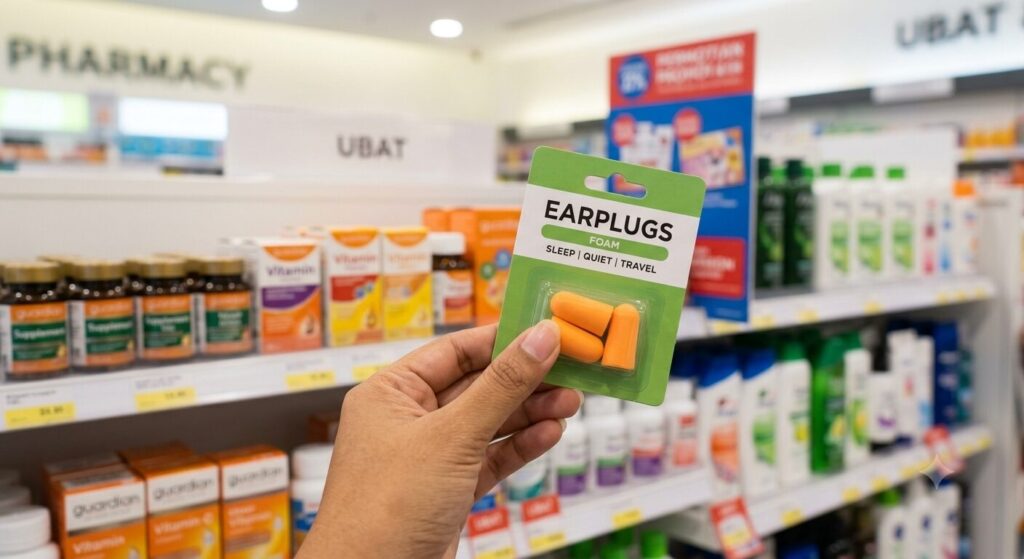
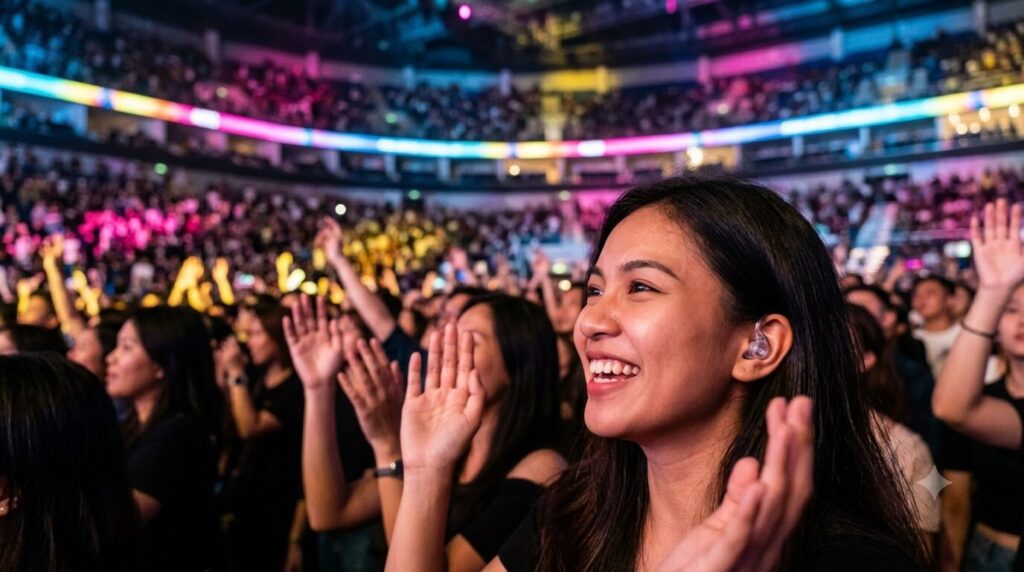
Simple foam earplugs, sold at practically any pharmacy in the country, cut noise by roughly 15 to 30 dB and are the single most effective, lowest-effort protection available for a fireworks show or concert. If you attend concerts regularly, or you’re a musician, custom-molded earplugs from an audiologist reduce volume evenly across frequencies rather than just muffling everything, so the music still sounds like music. Distance is free protection too: sound intensity drops off sharply the further you are from the source, so watching fireworks from a slightly greater distance makes a real difference without spoiling the view. At concerts, step away from the speaker stacks periodically to give your ears a break. For personal listening devices on the way home, the 60/60 guideline is a reasonable rule of thumb: no more than 60% volume, for no more than 60 minutes at a stretch, before giving your ears a rest.
When to Get Checked
If your ears are still ringing, muffled, or simply not back to normal more than two or three days after a concert or fireworks display, or if a child in your care seems to be struggling to hear, respond to their name, or is unusually irritable after a loud event, it’s worth getting checked rather than waiting it out. This is especially true for sudden hearing loss, where early treatment genuinely changes the outcome.
If this sounds like you or someone in your family this Merdeka and Malaysia Day season, don’t wait it out and hope it settles. You can book a consultation with Dr. Julius Goh Liang Chye through our ear specialist service at UM Specialist Centre in Kuala Lumpur, or message directly on WhatsApp to ask a question or arrange an appointment:
Chat with Dr. Julius on WhatsApp
Frequently Asked Questions
How long should ringing in my ears last after a concert or fireworks display?
For most people, ringing or muffled hearing, known as a temporary threshold shift, resolves within 24 to 72 hours. If it lasts longer than three to four days, or keeps happening after every loud event, it’s time to see an ENT doctor.
Are fireworks really louder than concerts?
Yes, significantly. Concerts typically run from about 94 to 110–120 dB. Fireworks measured near the launch point can reach 150 to 175 dB, and because that noise arrives as a sudden pressure spike rather than sustained sound, it’s considered more dangerous per exposure, not less.
Do ordinary foam earplugs actually help against something as loud as fireworks?
Yes. A standard foam earplug reduces noise by roughly 15 to 30 dB, which meaningfully lowers your risk even against fireworks-level noise, especially combined with keeping a reasonable distance from the launch point.
Can hearing loss from a single loud night really be permanent?
It can. A single noise exposure above about 120 dB can cause immediate, irreversible damage to the inner ear’s hair cells, which do not regenerate. Not every loud night causes permanent damage, but there’s no way to know in advance which one might.
Is it safe to bring young children to Merdeka fireworks displays?
It can be, with precautions. Keep children further from the launch site than feels necessary, use properly fitted infant or toddler ear defenders rather than adult earplugs, and watch for signs of discomfort like clinginess, irritability, or complaints that sounds seem muffled in the days after.
Discover more from The ENT Doctor
Subscribe to get the latest posts sent to your email.
Comments are closed