

A mother messaged me last week, worried after her seven-year-old came home from swim class complaining that her ear “felt blocked.” By that evening, the child couldn’t sleep, and even touching her ear made her cry. “She was just swimming,” the mother said, sounding almost apologetic, as though the pool visit itself had been the mistake. It wasn’t. But this scene — a happy day at the pool followed by a painful ear a day or two later — is one of the most common reasons parents bring children into my clinic every single year, right around this time.
Malaysia’s Term Two school break runs from 24 August to 5 September this year, a stretch that swallows up National Day and sends families straight from the classroom into the nearest pool, water park, or out-of-town trip. Somewhere in that rush of water slides and floaties, a good number of children will end up with a sore, swollen ear canal that has nothing to do with a cold or the flu, and everything to do with water that never quite dried out.

What Swimmer’s Ear Actually Is
The medical term is otitis externa, and despite the common nickname, it isn’t really an infection “in” the ear the way most parents picture it. It’s an infection of the thin skin lining the ear canal itself — the passage that runs from the outer ear to the eardrum — rather than the space behind the eardrum. When that skin stays damp for too long, it softens, and bacteria that are almost always present in small, harmless numbers (most often Pseudomonas aeruginosa) get the opportunity to multiply and take hold.
This is a genuinely different condition from the middle ear infections (otitis media) most Malaysian parents already know well: the ones that follow a cold, arrive with a fever, and usually settle with time or a course of oral antibiotics. Swimmer’s ear typically shows up without any cold beforehand, rarely causes a high fever, and needs a different kind of treatment altogether — ear drops rather than syrup. According to the American Academy of Pediatrics, the two conditions are frequently confused by parents, and the mix-up matters, because an intact eardrum blocks ear drops from ever reaching a true middle ear infection. Treating the wrong one with the wrong medicine simply doesn’t work.
Why Malaysian School Holidays Are Peak Season
There’s a reason ENT clinics across Malaysia see a jump in these cases every school break. Our climate is warm and humid year-round, which already keeps ear canals damper than in temperate countries; otitis externa is well documented in medical literature to be far more common in tropical regions than in cooler ones, with some estimates putting lifetime prevalence as high as 10 percent in humid climates. Layer several weeks of pool visits, water parks, and river trips on top of that baseline humidity, and the risk climbs noticeably.
This year’s holiday window bridges Merdeka Day, meaning an unusually long stretch of family outings packed into a short break. The Star reported parents flocking to Sunway Lagoon’s water slides as soon as school let out earlier this year, with some families visiting three or more times annually around each school holiday. Multiply that pattern across every water park, condominium pool, and hotel pool in the country, and it becomes easy to see why an ENT clinic’s appointment list looks different in late August than it does in, say, March. Fungal ear canal infections in particular are known to peak between July and September — the exact window Malaysian children are heading into now.
The Part Most Parents Get Wrong
Here’s where I want to gently correct a common assumption. A Malaysian study from Universiti Kebangsaan Malaysia followed 157 patients — 180 affected ears in total — treated for acute otitis externa across three government hospitals in the Klang Valley. Swimming alone turned out to be a relatively small direct trigger, present in only around 8 percent of cases. The single biggest risk factor by a wide margin was cotton bud use, found in nearly two-thirds of cases, followed by ear digging with other objects such as hairpins or wooden sticks.
Put those two findings together, and the real picture becomes clearer. It is rarely the pool water itself that causes the problem. It’s what happens afterward: a parent or child reaching for a cotton bud to “dry” or “clean” the ear once they’re home. That instinct, completely understandable after a day at the pool, is precisely what scratches the delicate skin of the ear canal and lets bacteria in. Among the swimming-related cases in that same Malaysian study, most infections were traced back to public swimming pools rather than rivers, which lines up neatly with how most Malaysian families actually spend their school holidays. The most common complaints in that dataset were ear pain (present in roughly three-quarters of cases), discharge, and a sensation of reduced hearing — all worth watching for in your own child over the coming weeks.
Swimmer’s Ear or Just “Water in the Ear”? How to Tell
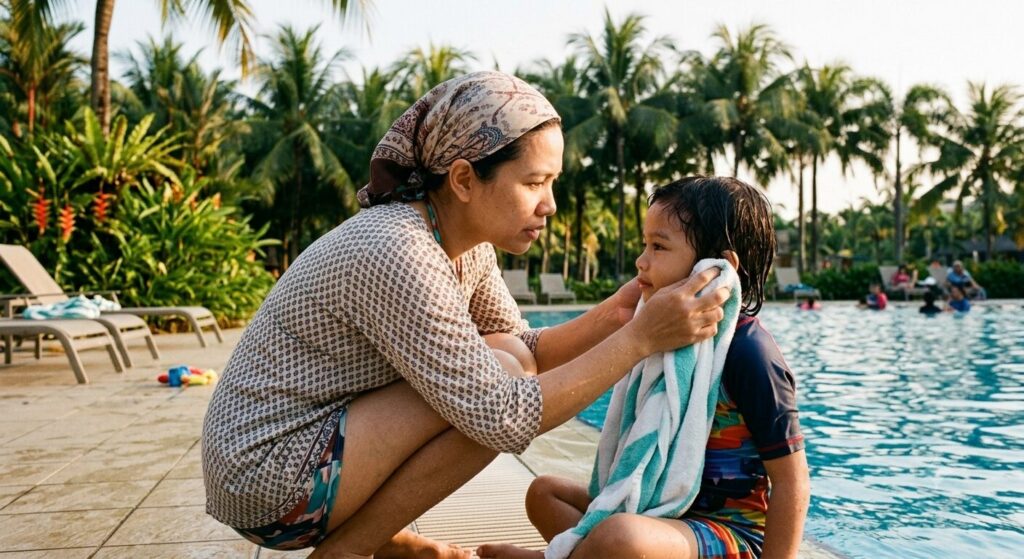
Every child gets that odd, muffled, underwater feeling after a swim, and it usually clears on its own within a day as trapped water drains or evaporates. What should make a parent look closer is when that feeling doesn’t pass, or when it’s joined by:
- Pain that gets noticeably worse when you gently tug the outer ear or press the small flap of cartilage just in front of the ear canal — a simple check you can try at home before deciding whether a clinic visit is needed
- Visible redness, swelling, or flaking around the ear opening
- Yellow, cloudy, or foul-smelling discharge
- Itching that becomes constant rather than occasional
- A child who suddenly refuses to let anything touch that ear, including a pillow
None of these point to “just water.” They point to an infection that needs to be examined rather than waited out. If you’re ever unsure whether what you’re looking at is wax, water, or infection, I’ve previously written about how to tell earwax and ear infections apart, which is a useful first check before deciding whether a clinic visit is needed.
When to Take It Seriously
Most cases of swimmer’s ear are straightforward and respond well to treatment within about a week. A few situations, though, deserve a same-week visit to an ENT rather than a wait-and-see approach: pain severe enough to disrupt sleep or eating, fever, swelling significant enough to partly close the ear canal, discharge that keeps increasing rather than settling, or any ear infection in a family member with diabetes or a weakened immune system. In older adults with poorly controlled diabetes especially, what starts out looking like an ordinary case of otitis externa can, in rare instances, progress into a much deeper infection at the base of the skull. This is uncommon in otherwise healthy children, but it’s part of why I would always rather examine an ear early than have a family assume it will simply resolve on its own.
Protecting Your Child’s Ears This Holiday Season

None of this means keeping children out of the water. Swimming is one of the better things Malaysian kids can be doing with five to six weeks of free time, especially with this year’s haze season also on the horizon. A handful of habits make a real difference.
- Dry ears properly, not aggressively. Tilt the head to each side after swimming or bathing and let trapped water drain out on its own, then gently pat the outer ear dry with the corner of a clean towel. Resist the urge to go further in with a cotton bud, a finger, or a rolled tissue — based on the Malaysian data above, this single habit is the biggest thing to avoid
- For children who’ve had swimmer’s ear before, well-fitted swim earplugs are worth considering, particularly across a run of repeated water park days
- A hairdryer on its coolest, lowest setting, held a safe distance from the ear, can help finish drying the canal for children who are especially prone to this — a tip also recommended in the CDC’s healthy swimming guidance
- Avoid letting children swim in visibly cloudy or poorly maintained pools, or in rivers and storm drains shortly after heavy rain, when bacterial counts tend to be at their highest
- Hold off on ear drops or home remedies, including diluted vinegar mixtures, without checking with a doctor first — particularly if there’s any chance the eardrum has ever been perforated, since the wrong drops in that situation can cause real harm rather than help
How Swimmer’s Ear Is Actually Treated
If your child does develop otitis externa, treatment is usually straightforward. It typically involves prescription antibiotic or antifungal ear drops, sometimes combined with a mild steroid to bring down swelling, used for about seven to ten days. Paracetamol or ibuprofen helps manage pain in the meantime. Keeping the ear completely dry until treatment finishes matters more than most parents expect; swimming, showering with the head tipped back, and even certain hair-washing positions can reintroduce moisture and undo several days of progress. In more swollen cases, an ENT specialist may need to place a small wick in the canal first, simply to make sure the drops can actually reach the infected skin rather than pooling at the entrance. This is one of the reasons a proper examination matters more than guessing from home: an ear specialist can see exactly how swollen the canal is and adjust treatment accordingly, rather than leaving a family to reapply drops that may never be reaching where they’re needed.
For children who seem to develop this every holiday season without fail, it’s worth a longer conversation with a paediatric ENT specialist about what’s making that particular child more prone to it. Sometimes it’s simply anatomy, since younger children generally have narrower ear canals that trap water more easily, and sometimes there’s an underlying skin condition like eczema that needs its own treatment running alongside the ear care.
School holidays should be about water slides and family trips, not unplanned clinic visits. The reassuring part is that swimmer’s ear is one of the most preventable conditions I see in practice, and it almost always responds quickly once it’s properly diagnosed and treated. The habit that matters most isn’t complicated. It’s drying ears gently — and leaving the cotton buds in the drawer.
Worried About Your Child’s Ear Pain?
If your child has ear pain, discharge, or discomfort that isn’t settling on its own — especially during the school holidays — it’s always better to have it examined than to guess. Message Dr. Julius Goh Liang Chye directly to ask a question or book a consultation at The ENT Doctor in Kuala Lumpur / Petaling Jaya.
Chat with Dr. Julius on WhatsApp →
Frequently Asked Questions
Can my child still swim if they’ve had swimmer’s ear before?
Yes, in most cases, once the infection has fully cleared. Well-fitted swim earplugs and thorough ear-drying afterward significantly lower the chance of it coming back.
Is swimmer’s ear contagious?
No. It isn’t passed from person to person the way a cold is. It develops from moisture and bacteria already present in the ear canal environment, not from contact with another infected child.
How long does swimmer’s ear take to heal?
Most cases improve within 7 to 10 days of starting the correct ear drops, though discomfort often eases noticeably within the first two to three days.
Can I use olive oil or home remedies instead of seeing a doctor?
It’s best not to put anything into the ear canal — oil, vinegar, or otherwise — without a proper examination first, particularly if there’s any possibility of a perforated eardrum or if you’re not certain it’s swimmer’s ear rather than another condition.
Should I keep my child out of the pool completely during the school holidays?
Not necessarily. Swimming has real value for children, especially during a long break. The goal is careful ear-drying afterward and choosing well-maintained pools, not avoiding water altogether.
Discover more from The ENT Doctor
Subscribe to get the latest posts sent to your email.
Comments are closed