

The Flu Is Gone, So Why Does Your Ear Still Feel Blocked?
A 38-year-old mother from Subang Jaya sat down in my clinic last week and, before I could ask anything, pressed her palm flat against her right ear. “The fever is gone. The cough is almost gone. But this ear has felt like I’m underwater for ten days,” she said. Her teenage son had brought the flu home from his school hostel, the whole household had gone down with it one by one, and she was the last to recover. “Everyone keeps telling me it will pop by itself. Should I just wait?”
It is one of the most common questions I hear at this time of year, and it is a fair one. Most of the time, a blocked ear after the flu really does settle on its own. But “most of the time” is not “every time”, and a small group of people who are told to wait are actually losing hearing that could have been saved with treatment in the first two weeks. So let me walk you through what is happening inside your ear after influenza, how to tell the harmless kind of blockage from the kind that needs attention, and what you can safely do at home in the meantime.
Why This Is Coming Up Now in Malaysia
Influenza is circulating in our schools again. In mid-September, health officers from the Kinta District Health Office assessed 61 symptomatic students at a boarding secondary school in Ipoh after an Influenza A cluster was detected there. According to the Perak state health committee chairman, 46 were found to have influenza-like illness and 14 had upper respiratory tract infections, and nasopharyngeal swabs were sent for laboratory confirmation (New Straits Times; Bernama via Astro Awani). The state also advised parents to consider influenza vaccination for their children.
A week later, The Star reported that hospitals were seeing more admissions for bronchitis and asthma flare-ups as the haze coincided with rising influenza activity, citing the World Health Organization’s Western Pacific surveillance bulletin, which noted increased flu activity in South-East Asia, particularly in Malaysia, Brunei, Cambodia and Vietnam (The Star, 24 September 2026).
This pattern is not new. Last year, the Health Ministry reported a jump from 14 to 97 influenza clusters in a single week in early October 2025, most of them in secondary schools, primary schools and kindergartens (Bernama). I wrote about that wave at the time in Influenza A: Why Malaysia’s Recent Outbreak Matters, and more recently about sore throats in The 2026 Throat Virus. This article looks at a different part of the story: what the flu leaves behind in your ears after the fever has gone.
How a Throat and Nose Virus Ends Up Affecting Your Ear
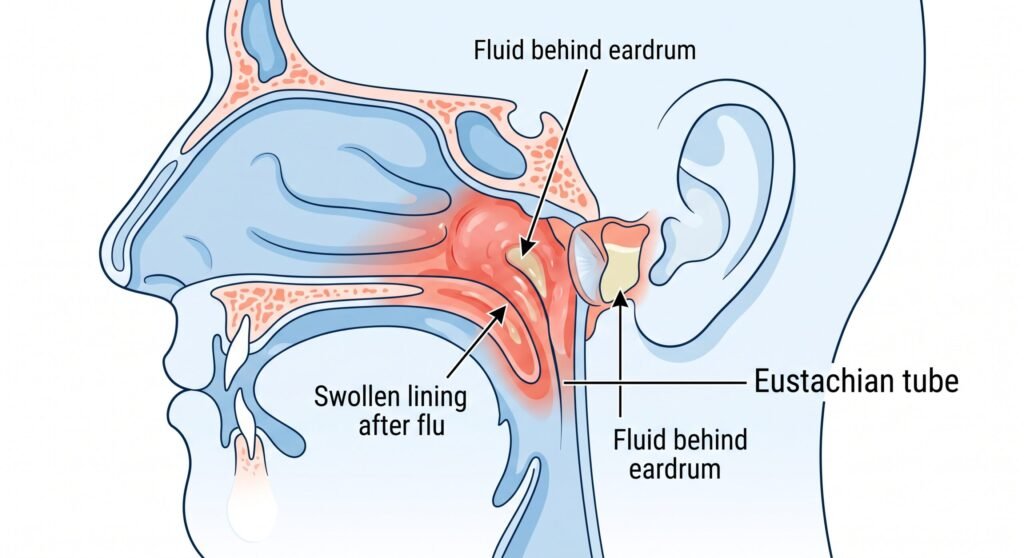
Your middle ear, the small air-filled space behind your eardrum, is connected to the back of your nose by a narrow channel called the Eustachian tube. Every time you swallow or yawn, this tube opens briefly to let air in, keeping the pressure behind your eardrum equal to the air around you. That little “click” you sometimes hear when swallowing is the tube doing its job.
Influenza inflames the whole lining of the nose and the space at the back of the nose (the nasopharynx). When that lining swells and fills with mucus, the opening of the Eustachian tube gets squeezed shut. Air in the middle ear is slowly absorbed, pressure drops, the eardrum is pulled inwards, and fluid can seep into the space. The result is the familiar feeling of fullness, muffled hearing, your own voice sounding loud inside your head, and crackling or popping when you swallow.
Children are especially prone to this because their Eustachian tubes are shorter, narrower and lie flatter than an adult’s. In one large study of young children followed through a year of colds, more than 60 percent of viral upper respiratory infections were complicated by either acute middle ear infection or fluid behind the eardrum (Chonmaitree et al., Clinical Infectious Diseases).
Three Different Things “My Ear Feels Blocked” Can Mean
When a patient tells me their ear is blocked after the flu, I am mentally sorting them into one of three groups. They feel similar to the patient, but they are handled very differently.
1. Eustachian tube dysfunction and fluid behind the eardrum
This is by far the most common. The ear feels full, hearing is muffled, and there may be popping, but there is little or no pain and no fever. If I look in the ear, the eardrum may be pulled back or have a line of fluid behind it. As the nose recovers, the tube starts opening again and the fluid drains. In most adults this settles within a few weeks, although it can take longer, especially if you also have a sensitive nose, sinus problems or ongoing haze exposure.
2. A middle ear infection (acute otitis media)
Sometimes bacteria take advantage of that trapped fluid. The clue is a change in direction: the ear becomes painful, the fever comes back after you seemed to be getting better, or a child becomes irritable, pulls at the ear and sleeps badly. Occasionally the eardrum bursts and there is discharge, which often relieves the pain suddenly.
This is common after influenza in particular. Pooled trial data cited in the paediatric literature suggest that ear infections develop as a complication of influenza in around 40 percent of children under three and around 20 percent of children aged three to six (Block et al., Pediatric Infectious Disease Journal). And timing matters: in a series of more than 10,000 patients with Influenza A, bacterial ear, nose and throat complications appeared a median of 12 days after the flu was diagnosed, more often in the weeks after the illness than at the start (Otolaryngology–Head and Neck Surgery). In other words, “the flu is over” is exactly when you need to keep watching.
Not every ear infection needs antibiotics. Malaysia’s own National Antimicrobial Guideline notes that most uncomplicated middle ear infections do not require antibiotics, with exceptions such as children under two years, people with weakened immunity, and severe disease. That decision is best made by a doctor who has actually looked at the eardrum.
3. Sudden sensorineural hearing loss: the one you must not wait on

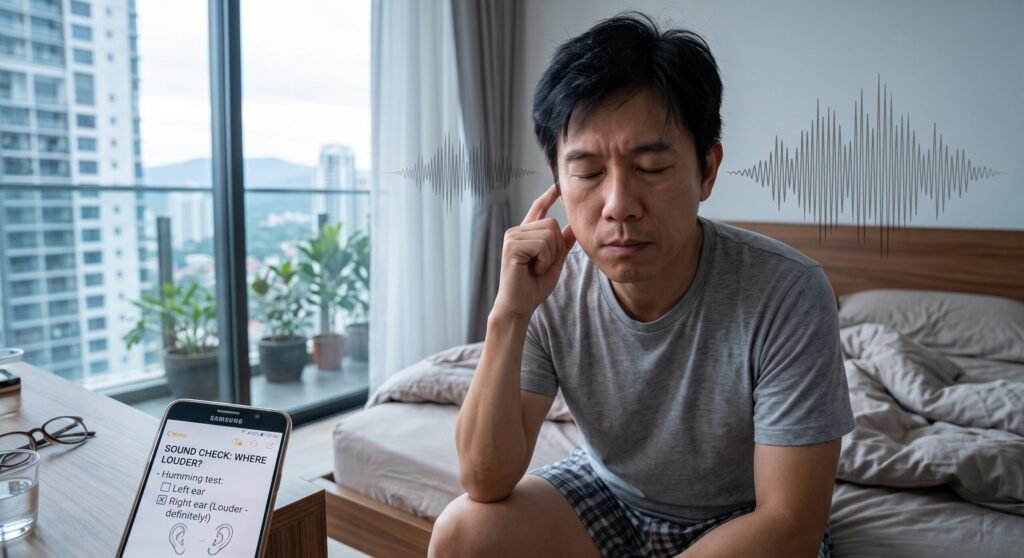
This is the group I worry about most, because it looks like group one to the patient. Here the problem is not in the middle ear at all but in the inner ear or the hearing nerve. A virus is one of the suspected causes. The hearing drops, often over hours or overnight, sometimes with ringing (tinnitus) or dizziness. Crucially, the ear can feel “blocked” in exactly the same way as simple fluid.
The American Academy of Otolaryngology–Head and Neck Surgery recommends a proper hearing test as soon as possible and within 14 days of onset, and states that steroid treatment may be offered within two weeks of symptoms starting (AAO-HNS Clinical Practice Guideline, 2019). Wait a month for it to “pop”, and that window may have closed. I have written more about one-sided hearing loss in What It Means If You’re Losing Hearing on One Side.
A simple check you can do at home: hum a steady note with your mouth closed. If the hum sounds louder in the blocked ear, that usually points to a middle ear problem such as fluid. If the hum sounds louder in your good ear, the blocked ear may have an inner ear problem, and you should see an ENT specialist within days, not weeks. This is only a rough guide and does not replace a hearing test, but it is a useful reason to act quickly.
| What you notice | Most likely | What to do |
| Fullness, muffled hearing, popping; no pain or fever | Eustachian tube dysfunction / fluid | Home care; see a doctor if not better in 2–3 weeks |
| Pain, returning fever, child pulling at ear, discharge | Middle ear infection | See a doctor within 1–2 days |
| Sudden drop in hearing, humming louder in the good ear, ringing or dizziness | Possible sudden sensorineural hearing loss | See an ENT specialist urgently, ideally within days |
Why Malaysian Ears Can Take Longer to Clear This Season
A few local factors tend to keep the Eustachian tube swollen for longer than it otherwise would be.
- Haze on top of a viral infection. Smoke particles irritate the same nasal lining the flu has just inflamed. With parts of Sarawak and the peninsula recording unhealthy readings this month, many of my patients are dealing with both at once. I explained what haze does to the nose in Malaysia’s Haze Emergency.
- Flying while still congested. With the year-end school holidays and festive travel coming, many families will board flights to Sabah, Sarawak or overseas while someone in the household is still recovering. Descent into an airport with a blocked tube can be very painful and can worsen fluid behind the eardrum.
- An underlying sensitive nose. Many Malaysians live with allergic rhinitis triggered by house dust mites, which keeps the nasal lining swollen year-round. After the flu, these patients often take much longer to clear their ears.
- Swimming and diving too soon. Pressure changes when diving to the bottom of a pool or snorkelling can aggravate an ear that has not yet re-equalised.
What You Can Safely Do at Home

If you have fullness and muffled hearing but no pain, no fever and no sudden drop in hearing, these measures are reasonable for the first two to three weeks.
- Rinse your nose with saline. A gentle saline rinse clears mucus from around the opening of the Eustachian tube. Use boiled-then-cooled, distilled or sterile water, never water straight from the tap. I explained why in Is Tap Water Safe for Nasal Rinsing?
- Try gentle ear-popping. Pinch your nose, close your mouth and blow very gently, as if equalising on a plane. Do not force it. For children aged four and above, a nasal balloon device (you blow up a small balloon through one nostril) has been shown in a UK trial to help clear fluid behind the eardrum more often than usual care alone (Williamson et al., CMAJ 2015).
- Use decongestant nasal sprays only briefly. A short course of a few days can help, especially before a flight, but using them for longer causes rebound blockage. See Can You Really Get “Addicted” to Nasal Spray?
- Keep chewing and swallowing. Chewing gum or sipping water encourages the tube to open, particularly during flight descent.
- Treat pain and fever with paracetamol at the correct dose for your age and weight.
And some things I would ask you not to do: do not put cooking oil, herbal oils or garlic into the ear, do not use ear candles, and do not dig with cotton buds or the camera ear-picks sold online. The blockage is behind the eardrum, so nothing you put into the ear canal can reach it, and you risk scratching the canal or injuring the eardrum. More on this in Must We Stop Using Cotton Buds?
Red Flags: When to See an ENT Specialist Without Delay
- A sudden drop in hearing in one or both ears, especially if the hum test points to the good ear
- Severe ear pain, or pain with a fever that returns after the flu seemed to be over
- Discharge from the ear, which may mean the eardrum has burst (see Perforated Eardrum)
- Swelling, redness or tenderness behind the ear, or an ear that is being pushed outwards
- Weakness of one side of the face, severe headache, or a stiff neck
- Spinning dizziness, loss of balance or new ringing in the ear (see Can an Ear Problem Cause Vertigo? and Is Ringing in the Ears a Warning Sign?)
- An adult with fluid in one ear that has not cleared after three weeks
That last point deserves special mention for Malaysians. In adults, persistent fluid behind only one eardrum can occasionally be the first sign of something blocking the Eustachian tube at the back of the nose, including nasopharyngeal carcinoma, which is more common in Malaysia than in most parts of the world. The flu may simply be the reason you finally noticed the ear. This is not a reason to panic, because the vast majority of post-flu blockages are harmless, but it is a reason not to ignore a one-sided blocked ear for months. I have written about this in Why Malaysians Are More Prone to NPC.
What Happens When You See Us
The assessment is quick and painless. I look at the ear canal and eardrum under magnification, then usually do a tympanogram, a short pressure test that tells us whether there is fluid behind the eardrum and how well the Eustachian tube is working. If the hearing seems reduced, a proper hearing test (audiogram) shows whether the loss is in the middle ear or the inner ear. In adults with one-sided fluid, I will also look at the back of the nose with a thin endoscope, which takes a minute and is done under local anaesthetic spray.
Treatment depends on what we find. Many patients simply need reassurance, nasal treatment and a review in a few weeks. A genuine middle ear infection may need antibiotics, guided by the Ministry of Health’s antimicrobial guidance. Sudden sensorineural hearing loss is treated with steroids, either as tablets or as injections through the eardrum, and the earlier this starts, the better. Children with fluid that persists for months and affects their hearing or speech may benefit from small ventilation tubes (grommets). For more on children, see How to Prevent Middle Ear Infections in Children.
Prevention: The Flu Jab Protects Your Ears Too
Most people think of the influenza vaccine as protection against fever and pneumonia. Fewer realise that preventing the flu also prevents the ear infections that follow it. Trials in young children have shown that influenza vaccination reduces middle ear infections during the flu season (Block et al.). The vaccine is not part of Malaysia’s free childhood immunisation schedule, so it usually has to be requested from a clinic or pharmacy, and the Perak health authorities specifically encouraged parents to consider it after the Ipoh cluster. I covered which vaccines matter for your ears, nose and throat in Vaccines & ENT Health.
The everyday measures still matter: keep a child with flu symptoms at home until they recover, wash hands often, cover coughs and sneezes, and wear a mask if you are unwell and must be around others, especially at hostels, kindergartens and in the same room as elderly relatives.
The Bottom Line
A blocked ear after the flu is common and usually harmless, and it tends to clear as your nose recovers. What matters is knowing which kind of blocked ear you have. Pain and a returning fever suggest infection. A sudden drop in hearing is an emergency with a two-week treatment window. A one-sided blockage that lingers beyond three weeks in an adult deserves a look at the back of the nose. If you are unsure which applies to you, that uncertainty is itself a good reason to get checked. If you are not sure whether to start with your GP or an ENT, see GP or ENT: Which One Should You Visit?
Worried About an Ear That Still Feels Blocked After the Flu?
If your ear still feels full or muffled weeks after the flu, if your hearing has dropped suddenly, or if your child keeps complaining of ear pain after a cold, please don’t wait for it to “pop” on its own. You can reach me directly on WhatsApp to arrange a consultation: Message Us on WhatsApp. I see patients at UM Specialist Centre, Kuala Lumpur, and a quick ear examination and hearing test can tell us within one visit whether this is simple fluid or something that needs treatment now.
Frequently Asked Questions
How long does a blocked ear last after the flu?
Most blocked ears after a cold or the flu improve within one to three weeks as the nose settles, although fluid behind the eardrum can take several weeks to clear completely, particularly in children. If there is no improvement after two to three weeks, or if hearing is getting worse, see a doctor.
Can the flu cause permanent hearing loss?
Usually not. Most post-flu hearing problems come from temporary fluid in the middle ear and recover fully. Rarely, a virus can affect the inner ear and cause sudden sensorineural hearing loss. This is treatable, but results are best when steroids are started within two weeks, which is why a sudden drop in hearing should be seen urgently.
Is it safe to fly with a blocked ear after the flu?
If your ear is still clearly blocked, flying can be painful and may worsen fluid behind the eardrum. If the trip cannot be postponed, use a short course of decongestant nasal spray before the flight, chew gum or swallow frequently during descent, and keep babies feeding during take-off and landing. See a doctor before flying if you have ear pain or discharge.
Should I put ear drops or oil in a blocked ear after the flu?
No. The blockage is behind the eardrum, where drops and oils cannot reach. Putting things in the ear canal will not help and, if the eardrum is perforated, some drops can be harmful. Leave the ear canal alone and treat the nose instead.
My child’s school had a flu cluster. What ear symptoms should I watch for?
Watch for ear pulling, crying at night, poor sleep, a fever that returns after improving, discharge from the ear, or your child not responding when called or turning up the television volume. These can signal an ear infection or fluid affecting hearing, and are worth a check with your doctor.
References
- New Straits Times. 46 students at Influenza A cluster school suffer flu-like illness – Perak exco. 16 September 2026. https://www.nst.com.my/news/regional/2026/09/1534007/46-students-influenza-cluster-school-suffer-flu-illness-perak-exco
- Bernama via Astro Awani. 46 students at Ipoh school diagnosed with influenza-like illness, State Health Department monitoring (Malay-language report). 16 September 2026. https://www.astroawani.com/berita-malaysia/46-pelajar-sekolah-di-ipoh-didiagnosis-influenza-jkn-pantau-situasi-exco
- The Star. Respiratory admissions rise amid haze, flu season. 24 September 2026. https://www.thestar.com.my/news/nation/2026/09/24/respiratory-admissions-rise-amid-haze-flu-season
- Bernama. MOH: 97 influenza clusters detected in ME 40/2025. October 2025. https://www.bernama.com/en/news.php?id=2476758
- Ministry of Health Malaysia. National Antimicrobial Guideline: Otorhinolaryngology Infections (Adult A10; Paediatrics B9). https://sites.google.com/moh.gov.my/nag/contents/section-a-adult/a10-otorhinolaryngology-infections ; https://sites.google.com/moh.gov.my/nag/contents/section-b-paediatrics/b9-otorhinolaryngology-infections
- Chandrasekhar SS, et al. Clinical Practice Guideline: Sudden Hearing Loss (Update). Otolaryngol Head Neck Surg. 2019. https://www.entnet.org/quality-practice/quality-products/clinical-practice-guidelines/sudden-hearing-loss-update/
- Block SL, et al. Effectiveness of intranasal live attenuated influenza vaccine against all-cause acute otitis media in children. Pediatr Infect Dis J. 2013. https://pubmed.ncbi.nlm.nih.gov/23271441/
- Chonmaitree T, et al. Viral upper respiratory tract infection and otitis media complication in young children. Clin Infect Dis. 2008. https://academic.oup.com/cid/article/46/6/815/347720
- Otolaryngological complications in patients infected with the influenza A (H1N1) virus. Otolaryngol Head Neck Surg. 2012. https://doi.org/10.1177/0194599811425765
- Williamson I, et al. Effect of nasal balloon autoinflation in children with otitis media with effusion in primary care: an open randomized controlled trial. CMAJ. 2015. https://www.cmaj.ca/content/187/13/961
No responses yet