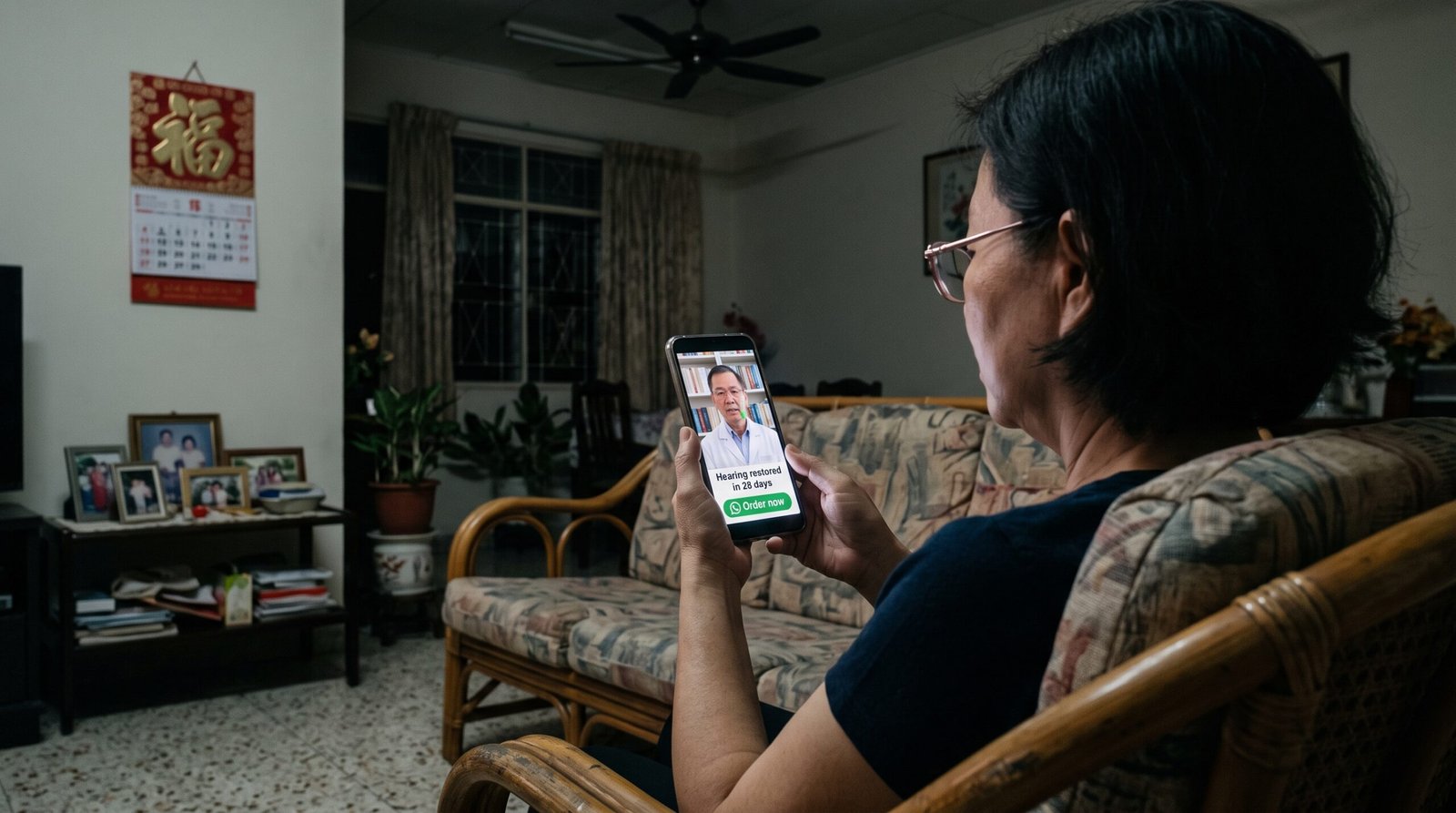
Picture a familiar scene. It is late at night and you are scrolling Facebook or TikTok. A man in a white coat, sitting in front of a bookshelf with a framed certificate behind him, looks straight into the camera. He says he is a senior ear specialist. He says the ringing in your ears, or the hearing you have been slowly losing, can be reversed in 28 days with a few drops of a “natural formula”. No surgery. No hearing aids. Limited stock, so order now through the WhatsApp link below.
The voice sounds real. The face moves naturally. The comments section is full of grateful testimonials. But the doctor does not exist, or worse, he is a real doctor whose face and voice have been stolen by artificial intelligence.
As an ENT surgeon practising in Kuala Lumpur, I now regularly meet patients who arrive with a bottle of something they bought after watching a video like this. Some have lost weeks or months of treatment time. This article explains what is happening in Malaysia right now, why ear, nose and throat problems are such a popular target, and exactly how you can check an advertisement in about two minutes before you spend a single ringgit.
What Is Happening Right Now
This is not a hypothetical problem, and it is not only happening overseas.
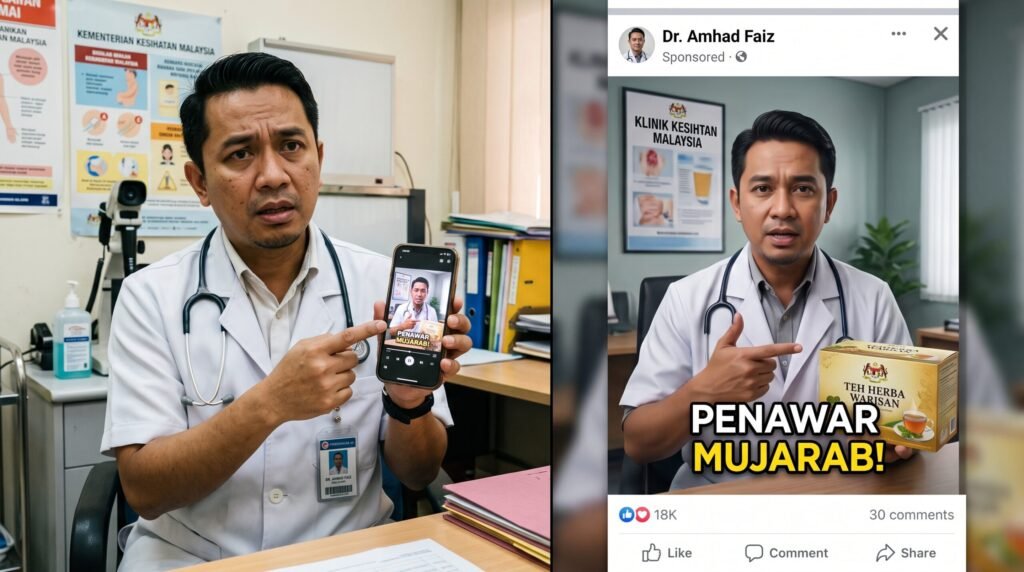
In August 2026, Bernama reported that consultant cardiologist Dr Onn Akbar Ali of KPJ Kajang Specialist Hospital discovered AI-generated deepfake videos of himself on Facebook, selling a herbal tea that supposedly controls diabetes “without medicine, without injections, without side effects”. His own brother-in-law believed one of the videos and shared it with friends, and one of Dr Onn’s patients bought the tea. The same report quoted the Ministry of Health (MOH) as saying that from 2023 to 30 June 2026 it carried out 2,839 raids on unregistered supplements and seized 1.5 million products worth more than RM75 million.
The scale of fake video content is enormous. According to a written parliamentary reply reported in July, the Malaysian Communications and Multimedia Commission (MCMC) asked platforms to remove 13,122 pieces of deepfake content between 1 January and 30 June 2026, and 12,353 of them were taken down (The Sun; New Straits Times).
The government has now stepped in specifically on health advertising. On 20 September 2026, Communications Minister Datuk Seri Fahmi Fadzil announced, after meeting medical associations in Kuala Lumpur, that public complaints about misleading online health advertisements will be referred directly to MCMC for review and action (RetailNews Asia). And just last week, MCMC said it was investigating an AI-manipulated video of Tun Dr Mahathir Mohamad, a reminder that no face, however well known, is safe from being copied (Malay Mail).
Internationally, the picture is the same. A UK study reported in July 2026 found AI-generated content in 40 percent of the most-viewed health videos on TikTok, rising to 84 percent of clips surfaced by searches for “health tips” (The Next Web). These numbers are from the UK, not Malaysia, but Malaysians use the same platforms and see the same type of content.
Why Ear, Nose and Throat Problems Are a Favourite Target
Scammers choose conditions carefully. The ideal “customer” has a symptom that is chronic, frustrating, embarrassing or frightening, and for which honest medicine does not offer a one-bottle fix. Several ENT conditions fit that description perfectly:
- Tinnitus (ringing in the ears). It can be distressing, and there is currently no pill that cures it. That gap is exactly where fake cures thrive.
- Gradual hearing loss. Many people delay hearing aids because of cost or stigma, so a “natural alternative” is very tempting.
- Snoring. It affects relationships and sleep, and many people would rather buy a spray than book a sleep study.
- Chronic blocked nose, sinus problems and nasal polyps. These are long-running and easy to sell “detox” oils for.
- Fear of cancer. In a country where nasopharyngeal carcinoma (NPC) is a well-known concern, “natural” cancer remedies prey on fear.
This is a documented pattern, not just my impression. In 2024, the fact-checking organisation Science Feedback investigated Facebook ads in which an AI-altered video of actor Kevin Costner endorsed a nasal inhaler called “EchoEase” that claimed to eliminate tinnitus in 28 days, attributed to a fake “Harvard” discovery (Science Feedback). The verdict: there is no evidence it works, and there is no known cure for tinnitus. That case was international, but the same template is now localised with Malaysian faces, Malaysian accents and Malaysian WhatsApp numbers.
Five Fake ENT “Miracle Cures” and What the Evidence Actually Says
1. “Hearing restoration” ear drops
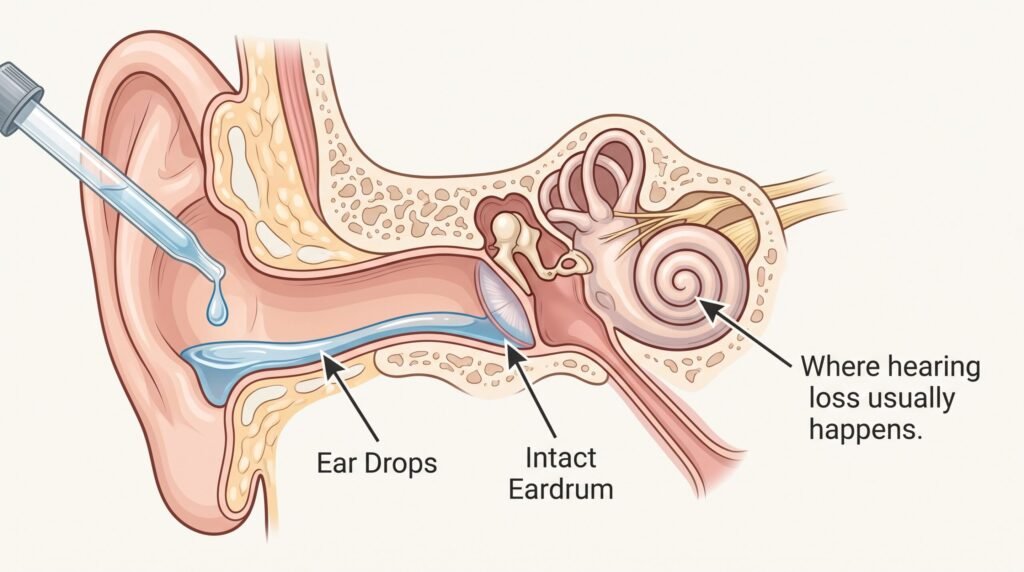
The most common type of permanent hearing loss in adults is sensorineural hearing loss, which means damage to the delicate hair cells of the inner ear or to the hearing nerve. The inner ear sits deep inside the skull, behind the eardrum. Drops placed in the ear canal simply cannot reach it through an intact eardrum, so they cannot regrow hair cells or repair a nerve.
There is also a real risk. If you have an unknown hole in your eardrum (a perforation), some substances dripped into the ear can reach the middle ear and cause irritation, infection or, with certain chemicals, further damage to hearing. I have written about this in Perforated Eardrum: Does Every Hole in Your Eardrum Need to Be Fixed?
2. Tinnitus capsules, sprays and “brain detox” supplements
Tinnitus is a symptom, not a disease. It can come from noise damage, age-related hearing loss, ear wax, middle ear problems, medication side effects, Ménière’s disease or, rarely, a tumour on the hearing nerve. According to the US National Institute on Deafness and Other Communication Disorders (NIDCD), management focuses on treating the underlying cause and on approaches such as hearing aids, sound therapy and behavioural therapy. No supplement has been shown to cure it.
The real danger is not only wasted money. One-sided tinnitus, or tinnitus with one-sided hearing loss, needs proper assessment, because occasionally it is the first sign of something that should not be missed. See Is Ringing in the Ears a Warning Sign of Something More Serious? and Common Causes of Tinnitus You Should Not Ignore.
3. Snoring sprays and gadgets that claim to “cure sleep apnea”
Some anti-snoring products may make snoring a little quieter. But snoring is often the sound of a narrowed airway, and in many adults it comes with obstructive sleep apnea, where breathing repeatedly stops during sleep. A spray that quietens the noise while the apnea continues can give false reassurance while blood pressure, heart and road-safety risks carry on.
Any advertisement claiming that a spray, oil or mouth strip “cures” sleep apnea should be treated with suspicion. Please read Can You Have Sleep Apnea Without Snoring? and Why Mouth Taping in Sleep Apnea Can Be Dangerous.
4. “Polyp-dissolving” nasal oils and sinus detox drops
Nasal polyps are swellings of inflamed sinus lining. Proven treatments include steroid nasal sprays, short courses of oral steroids, surgery and, for selected severe cases, biologic injections. No herbal oil has been shown to dissolve polyps. Some oils and concentrated herbal preparations can irritate or even burn the delicate nasal lining. I covered a similar viral remedy in Garlic for Sinusitis: A Miracle Cure or a Dangerous Trend?
5. “Natural cures” for nose and throat cancer
This is the category that worries me most. Nasopharyngeal carcinoma is relatively common in Malaysia, and when it is found early, treatment outcomes are far better. A one-sided blocked ear, blood-stained mucus from the nose or a painless neck lump in an adult needs an ENT examination, not a herbal tonic. Every month spent on a fake remedy is a month the disease may be progressing. See Why Malaysians Are More Prone to Nasopharyngeal Carcinoma (NPC).
Advertising a Cure for Deafness Is Already Illegal in Malaysia
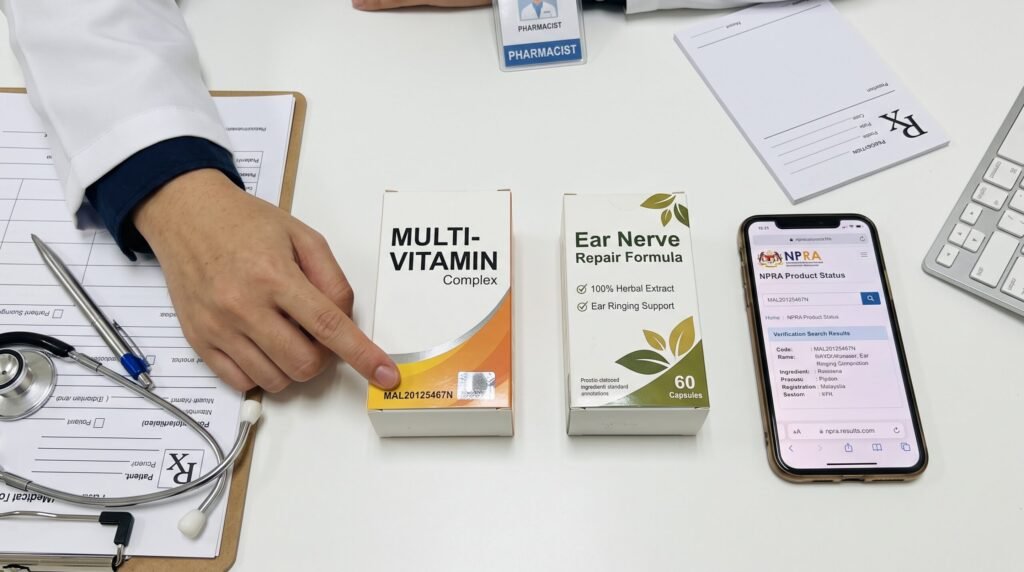
Many people do not realise that Malaysian law already prohibits most of these advertisements. Under the Medicines (Advertisement and Sale) Act 1956, it is an offence to advertise any product for the prevention, treatment or diagnosis of a list of scheduled diseases. That list includes deafness, as well as cancer, diabetes, hypertension, asthma and heart and kidney disease.
Legitimate health supplements, traditional medicines and over-the-counter products that are advertised to the public must have their advertisements approved by the Ministry of Health’s Medicine Advertisements Board. Approved advertisements carry a KKLIU approval number, for example “KKLIU 1234/2026”. This is different from the product’s MAL registration number, which appears on the product itself. According to the MOH Pharmaceutical Services Programme, a registered health supplement has a MAL number ending in N, a traditional medicine ends in T, and an over-the-counter product ends in X.
So an online video that promises to “cure hearing loss” and shows no KKLIU number is not just unhelpful. In Malaysia, it is very likely an illegal advertisement.
How to Spot a Deepfake Doctor in Under a Minute
The technology is getting better, so no single sign is foolproof. But in my experience, and based on the cases reported so far, most fake health videos share several of these features:
- The mouth and the words do not quite match. Watch the lips on words with “p”, “b” and “m”. Look for odd blinking, a stiff neck or teeth that blur.
- The account name is slightly wrong. In one of the Dr Onn Akbar Ali deepfakes reported by Bernama, the account spelled his name “Dr. On Ali”. Check the spelling, the follower count and when the account was created.
- Small mistakes in the background. Misspelled posters, plaques that seem to hang in mid-air and certificates with no readable name are common tell-tale signs.
- “Without medicine, without surgery, without side effects.” Real doctors almost never talk like this. Every effective treatment has limits and possible side effects.
- A miracle timeline. “Hearing restored in 28 days.” “Tinnitus gone in 7 days.” These are sales lines, not clinical results.
- Urgency and secrecy. “Doctors don’t want you to know this.” “Only 50 bottles left.” “Order through WhatsApp only.”
- No KKLIU number on the advertisement, and no MAL number you can verify on the product.
- A price that is suspiciously cheap or comes in “bundle” offers. In the Bernama report, a cancer survivor who bought a cheaper online version of his usual supplement ended up hospitalised with liver inflammation after receiving a counterfeit product.
The Two-Minute Check Before You Buy
Before you order anything for your ears, nose, throat or sleep, take two minutes to do the following:
- Check the doctor. Search the doctor’s full name with the Malaysian Medical Council (MMC). Specialists should also be listed on the National Specialist Register. Then look for the doctor’s own verified social media page or hospital profile. A real specialist will rarely sell products through a WhatsApp link.
- Check the advertisement. Look for a KKLIU number, and search it in the MOH list of advertisements approved by the Medicine Advertisements Board.
- Check the product. Search the MAL number in the NPRA registered product search, and check that it is not on the MOH list of banned products. Genuine registered products carry an MOH hologram security label, which can be scanned with the Ministry’s MyUbat app.
- Check with a real professional. Ask your pharmacist, your GP or your ENT specialist. The MOH Know Your Medicine portal is also a reliable consumer resource.
Already Bought Something? Here Is What to Do
- Stop using it, especially anything you are putting into your ears or nose.
- Keep the packaging, receipt and screenshots of the advertisement and the seller’s account.
- See a doctor if your symptoms have changed. New ear pain, discharge, dizziness or worsening hearing after using a product needs prompt assessment.
- Report the advertisement. Use the platform’s own “report” or “impersonation” button. Complaints about misleading online health advertisements can be lodged with MCMC through its complaints portal, and suspected illegal medicines or supplements can be reported to the MOH Pharmacy Enforcement Division through the MOH public complaints system.
- If you lost money, also make a police report and contact the National Scam Response Centre on 997 as soon as possible.
Why Delay Is the Real Harm
From an ENT surgeon’s point of view, the biggest damage from fake cures is often not the product itself. It is the time lost.
Sudden hearing loss in one ear is a good example. It is treated as an urgent condition, and international clinical guidelines from the American Academy of Otolaryngology–Head and Neck Surgery recommend early assessment and, where appropriate, steroid treatment as soon as possible, ideally within the first two weeks (Chandrasekhar et al., 2019). A patient who spends those two weeks trying a “nerve-repair” supplement may lose that opportunity. If you have noticed hearing loss on one side, please read What It Means If You’re Losing Hearing on One Side.
The same applies to a persistent one-sided blocked ear in an adult, a neck lump, or a hoarse voice lasting more than three weeks. These are reasons to see an ENT specialist, not reasons to order a bottle online. If you are unsure who to see first, my guide on GP or ENT: which one should you visit? may help.
What Real Help for Hearing, Tinnitus and Snoring Looks Like
Honest medicine is less dramatic than a deepfake advertisement, but it works. A proper hearing assessment can tell you the type and degree of hearing loss and whether it is treatable medically or surgically. Modern hearing aids, which are regulated medical devices, are far more discreet and capable than many people expect, as I discussed in Hearing Aids in Malaysia: Why, When, Who, Types and Cost and AI Hearing Aids Are Here. Tinnitus can often be made much less intrusive with the right combination of treatment for the underlying cause, sound therapy and counselling. And snoring deserves a proper look at the nose and throat, sometimes with a sleep study, before choosing between lifestyle changes, devices, CPAP or surgery.
None of these come with a “28-day guarantee”. All of them come with a real doctor you can meet, question and hold accountable.
A Personal Note
My face and name appear online through this blog and my clinic’s social media. If you ever see a video of “me” selling a supplement, an ear drop or a snoring cure, or asking you to order through a private WhatsApp link, it is not me. I do not sell health products through advertisements or social media messages. Please report the video and let my clinic know.
Speak to Dr. Julius Directly
If you have ringing in your ears, changes in your hearing, a constantly blocked nose or snoring that worries you or your family, you do not need to rely on a stranger in a video. You can speak to a real, registered ENT specialist.
Contact Dr. Julius on WhatsApp to arrange a consultation. Bring the product or a screenshot of the advertisement if you have one, and we can look at it together.
Frequently Asked Questions
Can ear drops cure hearing loss?
No. Most permanent hearing loss in adults comes from damage to the inner ear or hearing nerve, which ear drops cannot reach through an intact eardrum. Ear drops have legitimate uses, such as softening wax or treating outer ear infections, but they do not restore lost hearing.
Is there any supplement that cures tinnitus?
There is currently no supplement proven to cure tinnitus. Effective management focuses on finding and treating the cause, protecting your hearing and using approaches such as hearing aids, sound therapy and counselling.
How do I know if a health advertisement in Malaysia is approved?
Look for a KKLIU approval number on the advertisement and check it on the Ministry of Health’s list of approved advertisements. The product itself should carry a MAL registration number that you can verify on the NPRA product search.
Where do I report a fake doctor video or misleading health advertisement?
Report it to the platform first, then lodge a complaint with MCMC. Suspected illegal medicines or supplements can also be reported to the Ministry of Health’s Pharmacy Enforcement Division. If you lost money, contact the National Scam Response Centre on 997.
How can I tell if a doctor online is real?
Check the doctor’s name with the Malaysian Medical Council and, for specialists, the National Specialist Register. Then look for the doctor’s verified page or hospital profile. Be very cautious of any “doctor” who sells products directly through social media or private messaging.
References and External Links
- Bernama (19 August 2026). Doctors, Pharmacies Battle Rising Tide of AI-driven Health Scams. https://www.bernama.com/en/news.php?id=2596236
- The Sun (July 2026). MCMC removes 12,353 deepfakes since January. https://thesun.my/news/malaysia-news/people-issues/mcmc-removes-12353-deepfakes-since-january/
- New Straits Times (July 2026). MCMC triggers purge of 12,000 deepfakes as AI scam complaints surge. https://www.nst.com.my/news/nation/2026/07/1495725/mcmc-triggers-purge-12000-deepfakes-ai-scam-complaints-surge
- RetailNews Asia (23 September 2026). Malaysia Sends Misleading Online Health Ad Complaints to MCMC. https://retailnews.asia/malaysia-sends-misleading-online-health-ad-complaints-to-mcmc
- Malay Mail (2 October 2026). MCMC probes AI-manipulated footage of Dr Mahathir. https://www.malaymail.com/news/malaysia/2026/10/02/mcmc-probes-aimanipulated-footage-of-dr-mahathir-grieving-wifes-death-warns-of-legal-action/237392
- MOH Pharmaceutical Services Programme. How to recognize approved advertisement? https://pharmacy.moh.gov.my/en/content/how-recognize-approved-advertisement.html
- Medicines (Advertisement and Sale) Act 1956. https://pharmacy.moh.gov.my/en/documents/medicines-advertisement-sale-act-1956-and-regulations.html
- Science Feedback (2024). AI-generated celebrity endorsement videos on Facebook promote unproven cure for tinnitus. https://science.feedback.org/review/ai-celebrity-endorsement-videos-facebook-ads-promote-unproven-tinnitus-cure/
- The Next Web (27 July 2026). AI-generated “doctors” peddling fake cures on TikTok are a “huge danger”, experts warn. https://thenextweb.com/news/ai-generated-doctors-tiktok-danger
- NIDCD. Tinnitus. https://www.nidcd.nih.gov/health/tinnitus
- Chandrasekhar SS et al. (2019). Clinical Practice Guideline: Sudden Hearing Loss (Update). Otolaryngology–Head and Neck Surgery. https://doi.org/10.1177/0194599819859885
No responses yet