
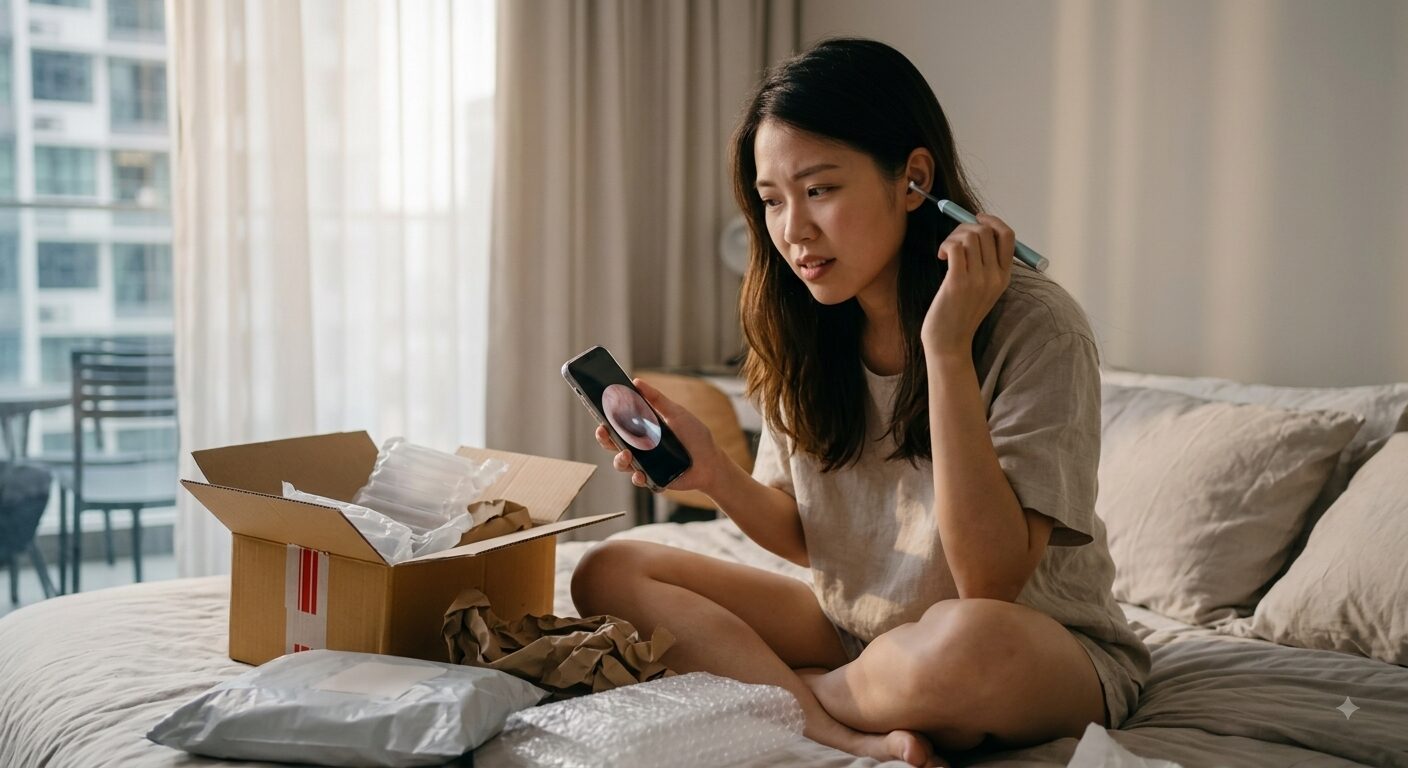
During last month’s TikTok Shop payday sale, a patient in her late twenties came into my clinic in Petaling Jaya holding her phone open to a five-star review she’d left days earlier: “Best RM25 I’ve ever spent — I can finally see my own earwax!” She had bought one of the ear-cleaning tools with a tiny camera on the tip, the kind that has quietly taken over Malaysian TikTok and Shopee feeds this year. Three days after a satisfying unboxing video, she was in my consultation chair instead, wincing from a sharp, throbbing pain, a cotton pad pressed to her ear.
She isn’t an isolated case. If you’ve spent any time on TikTok Shop or Shopee recently, you’ve likely seen it: a slim wand-shaped tool, a live video feed of someone’s own ear canal streamed straight to their phone, and a caption promising a satisfying, “clinic-like” clean from the comfort of home. Clips like hers have racked up millions of views collectively, the reviews are glowing, and the price — often well under RM100 — makes it an easy add-to-cart decision. But as an ENT surgeon who deals with what happens afterward, I want to walk you through what these gadgets actually do, where they genuinely go wrong, and what I would tell my own family before they hit “buy now.”
What Exactly Are These Viral Ear-Cleaning Cameras?
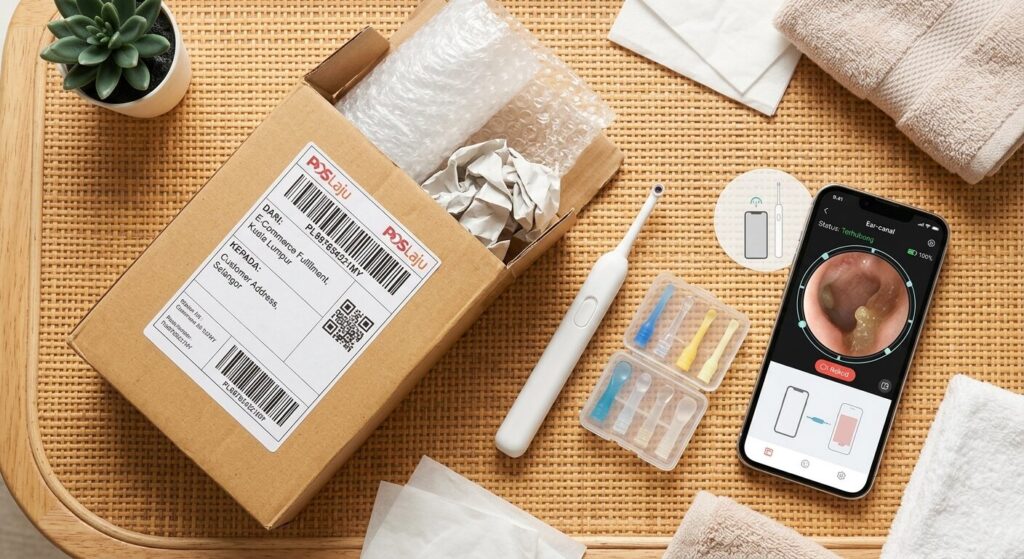
The tools going viral generally fall into two categories. The first is a thin wand tipped with a miniature camera, usually 1080p resolution or higher, sold alongside interchangeable soft silicone scoops or spoons. It connects to an app over WiFi, so instead of guessing where the wax is sitting, you can supposedly watch it on your screen in real time while you dig it out yourself. The second type is a small handheld electric vacuum, sometimes combined with a water-spray function, designed to suction wax out rather than scoop for it. Both are marketed with the same promise: professional-looking results, no clinic visit required, and neither requires a prescription or any proof of training to buy.
Internationally, these devices are typically priced from around USD 15 to USD 50 depending on the brand and features [1]. The same product categories are widely available on Shopee and TikTok Shop Malaysia at similarly accessible price points, frequently bundled as “family sets” so parents can use them on their children too, and pushed further by livestream sellers who demonstrate the camera feed in real time to a shopping audience — a format Malaysian shoppers are especially used to, given how central live commerce has become to TikTok Shop’s popularity here.

None of this is entirely foreign to Malaysians, either. Long before this trend, many of us grew up with the ritual of an ear clean at the barbershop, or at one of the dedicated ear-cleaning spas now common in cities like Kuala Lumpur and Johor Bahru, where a trained practitioner uses a proper headlamp, a fixed instrument, and years of muscle memory to do the job [5]. Malaysians are, in other words, already comfortable with the idea of someone getting up close to the ear canal. What’s new in this trend is the “someone” being replaced by an unsteady hand, a smartphone screen, and zero training — and that substitution matters more than the marketing lets on.
Part of what makes these videos so shareable is the same appeal behind slime and pimple-popping content: a visibly “satisfying” result, delivered in under sixty seconds. That entertainment value is exactly why the trend spread so quickly through Malaysian TikTok Shop live-selling sessions, where hosts often demonstrate the camera feed to viewers mid-broadcast to drive impulse purchases. It’s effective marketing — but a satisfying video and a safe medical procedure are not the same thing. Worth remembering: the person filming themselves clearing wax on camera is, more often than not, an influencer being paid to make the tool look good, not a clinician being paid to keep your ear intact.
Why the Camera Doesn’t Make It Safer
This is the part that surprises most patients: putting a camera in your ear canal does not make a do-it-yourself tool safer. It just makes the mistake easier to watch happen in real time.
Your ear canal isn’t a straight tube — it curves, and the skin lining it is thin and tears easily. Interpreting a flat, two-dimensional video feed while manoeuvring a rigid, three-dimensional tool through that curve is a genuinely difficult skill, one that takes ENT specialists and audiologists years of supervised practice to master using medical-grade equipment with fixed magnification and steady support. Meaghan Reed, Director of Clinical Audiology at Harvard-affiliated Massachusetts Eye and Ear, put it plainly: patients “aren’t trained to use these tools and judge the distance and curves of the ear canal, especially on themselves,” and as a result, they frequently arrive with “scratched and bleeding ear canals or perforated eardrums” [1].
I see the same pattern in my own clinic. A sudden flinch, a sneeze, someone bumping into you at home, or simply misjudging the last centimetre before the eardrum is all it takes. Because you’re holding the device yourself, often at an awkward angle with your non-dominant hand, there’s no second pair of trained hands ready to stop the motion before it goes too far. The official patient guidance from the American Academy of Otolaryngology–Head and Neck Surgery is unambiguous on this point: don’t put cotton swabs, hairpins, or “other things” into the ear canal, because doing so “can all injure your ear and may cause a cut in your ear canal, poke a hole in your eardrum, or hurt the hearing bones, leading to hearing loss, dizziness, ringing, and other symptoms of ear injury” [2]. A camera-tipped scoop is still a hard object being pushed toward your eardrum. It just comes with a livestream attached.
What Malaysia’s Climate Adds to the Risk

There’s a second layer of risk that’s easy to overlook, and it’s a distinctly Malaysian one: our climate. Any break in the skin of the ear canal, even a small scratch too tiny to notice at the time, becomes an easy entry point for infection in our year-round heat and humidity. I regularly treat cases of otomycosis, a stubborn fungal ear infection, in patients whose only mistake was creating a tiny injury in a canal that then stayed warm and damp [4]. Several of the viral vacuum-style tools introduce water into the process, which, combined with a typical Malaysian bathroom’s humidity, comes close to ideal conditions for exactly that kind of infection to take hold. During haze season, when many of my patients already have itchy, irritated ears and noses from poor air quality, the urge to “dig around” for relief is stronger — right when the skin lining the ear canal is least able to tolerate it. It’s a seasonal combination worth knowing about even if you never buy the gadget at all. I tend to see a small, predictable uptick in ear canal infections after haze episodes and during the year-end monsoon months, regardless of what object caused the original scratch.
Warning Signs You’ve Gone Too Far
Most patients who injure themselves with these tools don’t realise it immediately. See an ENT specialist rather than the product’s review section if you notice:
- Sharp or worsening ear pain, especially if it continues after you stop
- Any bleeding or discharge from the ear canal
- Sudden muffled hearing or hearing loss in the treated ear
- Dizziness, vertigo, or a spinning sensation
- New ringing or buzzing (tinnitus)
None of these are symptoms of ordinary earwax. They are signs of possible trauma to the ear canal or eardrum, and the longer they’re left unchecked, the more likely they are to need more than a simple fix.
What Actually Works
The advice I give patients hasn’t changed just because the gadgets have. Earwax is not dirt — it’s a normal, protective substance that clears itself out on its own in the vast majority of people. If it’s genuinely bothering you, a safe softening approach is usually enough:
- Use a few drops of olive oil or a pharmacy earwax-softening solution, tilting your head to the side for a minute so it can seep in
- Repeat once daily for three to five days rather than expecting results in one go
- Let the loosened wax drain out on its own in the shower or while lying down, onto a towel, rather than trying to scoop it out yourself
If that doesn’t resolve it, or you already have symptoms like pain, discharge, or hearing loss, that’s your cue to see a professional rather than reordering the gadget in a different colour. At my clinic, I remove stubborn or impacted wax using microsuction, a procedure performed under a microscope with proper lighting and gentle suction, so I can see exactly what I’m doing and stop precisely where I need to — something no phone screen and unsteady hand can replicate [3]. If you already trust a barber or an ear-cleaning spa for a regular clean, that remains a reasonable middle ground for comfort-driven cleaning of otherwise healthy ears. But if you currently have pain, a known perforation, a history of ear surgery, or you’re cleaning a child’s ear, that’s exactly when it belongs in a clinic, not on a livestream.
The Bottom Line
I understand the appeal. Watching a stubborn plug of wax finally come loose on screen is satisfying in a way that’s hard to explain to anyone who hasn’t seen it themselves. If you already own one of these tools and use it purely to look, without ever attaching the scoop or vacuum tip, the risk drops considerably. But the moment digging enters the picture, you’ve handed a delicate job to an untrained pair of hands — however steady they usually are. The camera is solving the wrong problem. It shows you your eardrum; it does not protect it. Before your next TikTok Shop or Shopee sale, save the ringgit and your ear canal, and bring the itch to someone trained to deal with it instead.
Worried About Your Ears? Let’s Take a Proper Look
If you’ve already tried one of these gadgets and something doesn’t feel right, or you’d simply rather have impacted wax removed safely the first time, We offer ear assessments and microsuction wax removal. Message us directly on WhatsApp with your question or to book a consultation: Chat with us on WhatsApp
Frequently Asked Questions
Are TikTok Shop ear-cleaning cameras completely useless?
Not entirely. The camera does let you see inside your ear canal, which is more information than a blind cotton bud gives you. The problem isn’t the visibility — it’s that seeing the wax doesn’t give you the training or steady control needed to remove it safely so close to the eardrum.
Can I use the camera just to look, without the scoop attachment?
Looking alone is lower risk than digging, but these tools are rarely held perfectly still, and any sudden movement can still cause injury. If you simply want to know whether you have a blockage, that is exactly what an ENT consultation is for.
Is it different for children?
Yes, and the risk is higher. Children move unpredictably, their ear canals are smaller and more delicate, and a startled child can turn a scoop or vacuum tip into an injury in a split second. I would strongly discourage using these tools on children at home.
What should I do if I think I’ve perforated my eardrum?
Stop immediately, avoid putting anything else into the ear, including drops or water, and see an ENT specialist as soon as possible. Most perforations heal well with proper care, but they need to be assessed and monitored by a professional.
Is professional ear cleaning at a barbershop or ear spa safer than a home gadget?
Generally, yes, since it is performed by someone with practice and a fixed, well-lit setup rather than an unsteady selfie angle. But it is still not a substitute for a medical assessment if you have pain, discharge, hearing loss, or a history of ear problems. Those cases belong with an ENT specialist.
References
1. Harvard Health Publishing — “Should You Try These Tools to Clean Your Ears?” — https://www.health.harvard.edu/healthy-aging-and-longevity/should-you-try-these-tools-to-clean-your-ears
2. American Academy of Otolaryngology–Head and Neck Surgery Foundation — “Dos and Don’ts of Earwax (Cerumen)” — https://www.entnet.org/wp-content/uploads/2021/04/earwax_dos-donts_current.pdf
3. The ENT Dr — “Ear Wax vs Ear Infection: How to Tell the Difference and When to See an ENT Specialist” — https://theentdr.com/blog/ear-wax-vs-ear-infection-how-to-tell-the-difference-and-when-to-see-an-ent-specialist/
4. The ENT Dr — “The ‘Danger’ in Your Toilet: Must We Stop Using Cotton Buds?” — https://theentdr.com/blog/the-danger-in-your-toilet-must-we-stop-using-cotton-buds/
5. Yue Ear Cleaning and Spa, Cheras, Kuala Lumpur — example of Malaysia’s established professional ear-cleaning service industry — https://yueear.wixsite.com/yueear
Internal Links
- Ear Specialist Services (Kuala Lumpur & Petaling Jaya) — https://theentdr.com/services/ear-specialist-pj/
- Ear Wax vs Ear Infection: How to Tell the Difference — https://theentdr.com/blog/ear-wax-vs-ear-infection-how-to-tell-the-difference-and-when-to-see-an-ent-specialist/
- The “Danger” in Your Toilet: Must We Stop Using Cotton Buds? — https://theentdr.com/blog/the-danger-in-your-toilet-must-we-stop-using-cotton-buds/
- Contact / Book an Appointment — https://theentdr.com/contact-us/
Comments are closed