White, Pink and Brown Noise for Sleep: What Works, What Is Hype, and When It Can Harm Your Hearing
 A/Prof. Dr Julius GohConsultant ENT surgeon · 22 Nov 2026 · 12 min read
Open any video app on a Malaysian phone and you will find videos promising better sleep with a hiss, a rumble or a hum: white noise, pink noise, brown noise, and now even green noise. Sound machines sell well online, and parents play them to babies, students play them in shared hostels, and city dwellers play them to drown out traffic, neighbours and the air-conditioning compressor next door.
As an ENT , I see both sides of this trend. Used carefully, background sound can be a useful tool for some people. Used carelessly, it can be too loud, too close to a baby, or a way of ignoring a sleep problem that needs a diagnosis. This guide goes through the common beliefs one by one and tells you what the evidence supports, what it does not, and how to use sound safely.
A note on sources. I could not find Malaysian studies on sleep sounds, so the research below is international, and I say so where it matters.
First, what are the different colours of noise?
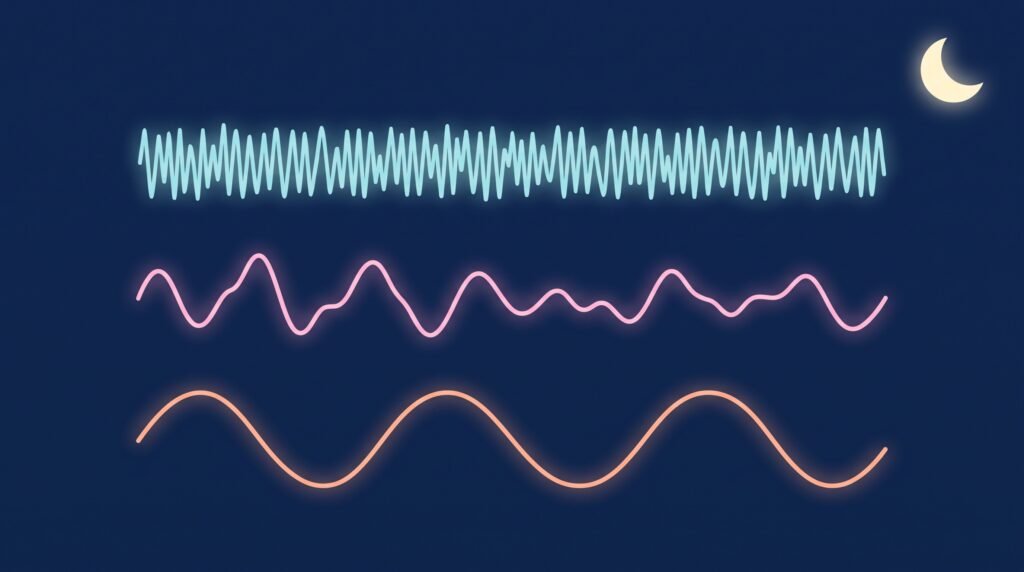
The colour names describe how the sound energy is spread across low and high pitches. White noise has equal energy across all frequencies, so it sounds like a steady hiss, like a television between channels. Pink noise has more energy in the lower pitches, so it sounds softer and deeper, a little like steady rain or rustling leaves. Brown noise is deeper again, closer to a low rumble or a distant waterfall. Green noise and other colours that appear online are mostly marketing labels for variations on these.
The theory is simple. A constant, unchanging sound can mask sudden noises, such as a motorbike passing or a door closing, which are the sounds that tend to wake us. That part makes sense. Whether it improves sleep in real life is a separate question.
Myth 1: Colored noise is proven to improve sleep
This is the most common claim, and it goes further than the evidence. In November 2025 the journal Sleep published a perspective on sonic sleep aids by Vazzaz and colleagues, which described findings on ambient sounds such as white and pink noise as inconclusive. It also noted a shortage of well-designed randomised trials comparing these sounds with properly matched control conditions. It cited an earlier systematic review of mixed sleep sounds which rated the quality of the evidence as very low.
None of this means the sounds never help. Some people clearly feel they sleep better with a fan or a steady sound in the background, and a recent news summary from Axios noted that white noise may help some groups, including hospital patients, infants and people with insomnia, while some studies have found no major benefit. The honest summary is: possibly helpful for some people, particularly in noisy surroundings, but not a proven treatment, and the effect is probably modest.
Myth 2: Brown noise is the new best, and pink noise is better than white
Social media loves a ranking. The reality is that nobody can reliably tell you which colour is best, because the research is thin. Pink noise gets attention because a few small studies have suggested it might deepen sleep, but the Axios report on this topic points out that brown noise in particular has little data behind it. If a particular sound helps you relax, use it. If it does not, there is no scientific reason to keep hunting for a magic colour.
What matters more than the colour is that the sound is steady, comfortable and quiet enough that you could talk over it without raising your voice.
Myth 3: Louder is better, because it covers more of the noise outside
This is the myth I would most like to correct, because it is where harm can happen. People living near traffic, construction or noisy neighbours often turn the volume up to drown out the problem. The ear does not rest while you sleep. A sound played all night at a high level is a long exposure, and long exposures count.
Occupational guidance used by hearing-health bodies treats about 85 decibels over eight hours as the limit for adult workers, and every 3 decibel increase roughly halves the safe time. A comfortable background sound for sleep should be nowhere near that. As a practical rule, keep the volume low enough that it sounds like a quiet office or gentle rain and not a loud one. If you need it much louder than that to mask outside noise, the answer is usually to reduce the noise at its source: heavier curtains, door seals, or moving the bed away from a shared wall.
I wrote about how quickly very loud sound can cause damage in my article on how loud is too loud at fireworks and concerts, and the principle is the same: it is the level and the duration together that matter.
Myth 4: A white noise machine is safe for babies all night
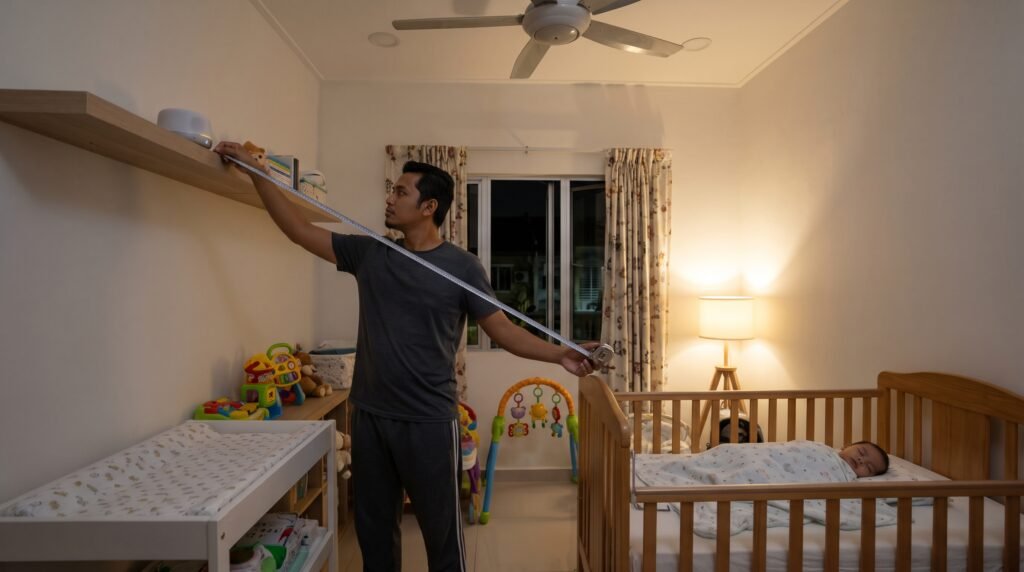
Parents in Malaysia, as elsewhere, often play sound for infants, and many parenting websites tell them to run the machine all night, close to the cot, at a volume as loud as the baby’s cry. The key study on this is from Toronto. Dr Sarah Hugh and colleagues, with Dr Blake Papsin as senior author, from the University of Toronto and the Hospital for Sick Children, bought 14 infant sleep machines that are widely sold in the United States and Canada, and published the results in Pediatrics in April 2014. Between them the machines produced 65 different sounds, including white noise, rain, ocean, heartbeat and traffic sounds.
The team set each machine to maximum volume and measured the sound at three distances: 30 centimetres (a machine on the cot rail), 100 centimetres (beside the cot) and 200 centimetres (across the room). They corrected the readings to account for a six-month-old baby’s smaller ear canal. The results were:
- All 14 machines could produce more than 50 A-weighted decibels (dBA) at both 30 and 100 centimetres. Fifty dBA is the limit recommended for hospital nurseries and neonatal intensive care units.
- At 30 centimetres the average maximum was 79.1 dBA, and the loudest machine reached 92.9 dBA. Three machines produced more than 85 dBA, which is the adult workplace limit for an eight-hour exposure.
- The loudest machine would exceed the adult occupational limit after only about two hours of use.
- Even across the room at 200 centimetres, 13 of the 14 machines could still produce more than 50 dBA.
Two points of fairness matter here. First, these were maximum volume readings; most devices on the market allow a lower setting, and the authors say they do not know how parents use the machines in real life. Second, the study did not follow children to see whether any of them lost hearing, and the authors did not claim that it did. Their conclusion was that the machines can produce levels that may damage an infant’s hearing and may be detrimental to auditory development, and that adult limits may not be conservative enough for babies. They also point to animal research suggesting that continuous white noise early in life can disrupt the normal development of the hearing pathways, and say that nightly use needs further study in children.
The authors recommended three simple steps: place the machine as far from the baby as possible, set the volume as low as possible, and limit the time it plays, for example with a timer or by switching it off once the baby is asleep. They also cautioned that a safe distance, where the sound would stay under the hospital nursery limit, was not worked out in their study. The American Academy of Pediatrics has since published guidance on preventing excessive noise exposure in infants. As reported by Yahoo News, it advises a distance of at least about two metres or seven feet and a volume no higher than 50 decibels, which is about as loud as a quiet office.
My advice to parents is practical and follows the authors. Place the machine across the room, never in the cot or on the cot rail, and remember that distance alone is not a guarantee, so keep the volume low as well. Use a volume that you can easily talk over. Use a timer if possible, and do not leave the baby to depend on the sound every night. If your baby does not settle without it, discuss it with your paediatrician, and read my paediatric ENT guide for the hearing and breathing problems that are worth looking into. If you are worried about your child’s snoring or noisy sleep, that is a different question, and it is covered in my article on child snoring versus noisy breathing.
Myth 5: Sleeping with earphones or a speaker under the pillow is fine
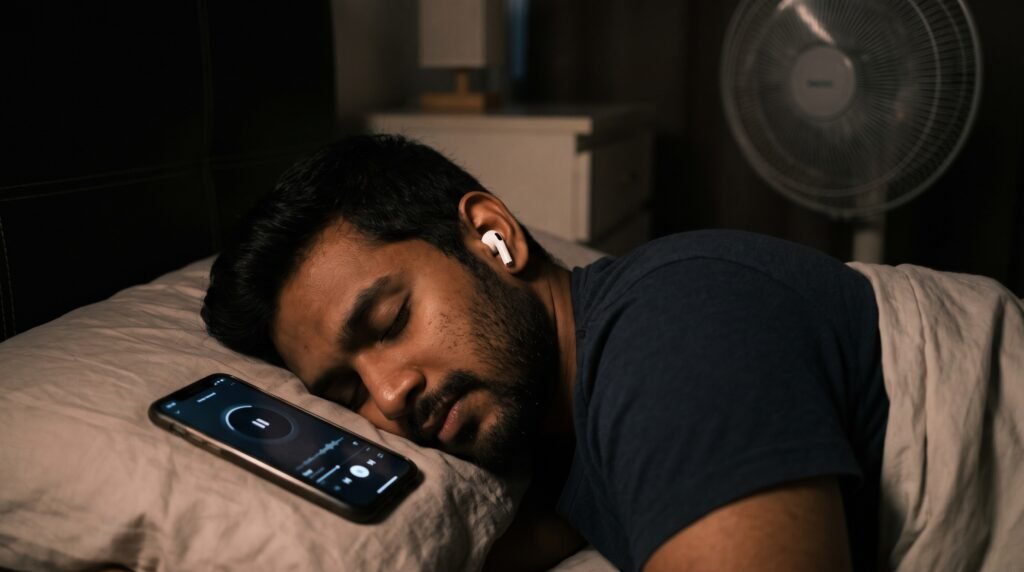
Many people fall asleep with earbuds in because it feels quieter and keeps the sound private. I do not recommend it. Earbuds deliver sound directly into the ear canal, which makes it easier to expose the ear to higher levels than a bedside speaker would. They also trap heat and moisture in a warm, humid climate, which can irritate the ear canal and make infections more likely, and sleeping on them can press the hard bud against the skin.
If you want sound for sleep, a small speaker on a bedside table, a few steps from your head, is a better choice than anything in or under your ear. My article explaining why earphones are not hearing aids covers more of the risks of using consumer audio for the ear.
Myth 6: Leaving the television on is just another form of white noise
Not quite. Dr Jennifer Martin, a professor of medicine at UCLA and a spokesperson for the American Academy of Sleep Medicine, told Axios that the biggest misconception by far is that people sleep better with the television on, because once you fall asleep the variation in sound becomes a problem. Voices, music and sudden changes in volume are exactly what a steady sound is meant to avoid, and the light from a screen works against sleep as well. If you want sound, choose something steady and unchanging.
Myth 7: Masking sounds are safe for everyone, including people with ringing in the ears
Background sound is often suggested for tinnitus, the ringing or buzzing some people hear, because it can make the ringing less noticeable in a quiet room. The Axios report on colored noise cautions that for some people white noise can make tinnitus worse. That may seem to contradict common advice, but it fits with what I see: tinnitus varies from person to person, and a sound that comforts one patient can aggravate another. The safe approach is to use a very low level and stop if the ringing seems louder after using it.
The more important point is that tinnitus is a symptom with causes, and sound is only a way of coping with it. If your ringing is new, only in one ear, or comes with hearing loss or dizziness, it deserves a proper assessment, as I explain in my articles on whether ringing in the ears is a warning sign and on the common causes of tinnitus you should not ignore.
Myth 8: If you need a sound to sleep, you will become dependent on it
The Sleep perspective mentioned above raised a risk of increased dependence on technology and a changed relationship with rest. I do not think a sound machine is dangerous in this sense, but it can become a habit that is hard to break, and a habit is not a diagnosis. What worries me more is the opposite case: someone who has been using sound for months or years to cope with unrefreshing sleep, snoring or tiredness that is really caused by something else.
When the problem is not noise at all
Background sound can help a noisy bedroom. It cannot fix the following, and if you have them, please do not keep trying new sounds:
- Loud snoring, gasping or choking at night, pauses in breathing noticed by a partner, or waking with a dry mouth or headache. These can be signs of sleep apnoea, which needs a proper assessment and is not treated by sound.
- Daytime sleepiness despite spending enough hours in bed.
- Difficulty falling asleep or staying asleep for more than a few weeks. Cognitive behavioural therapy for insomnia is generally recommended as the first treatment, rather than a gadget.
- A child who snores loudly, breathes through the mouth or is restless at night.
My articles on why you need a doctor before getting a sleep study and on the different types of sleep studies explain how sleep apnoea is assessed in Malaysia. If you are unsure who to see, my guide on GP or ENT: which one should you visit explains how to choose.
How to use sleep sounds safely: a checklist
- Keep it low. Quiet enough that you can talk over it without raising your voice.
- Keep it steady. Avoid sounds with voices, music or sudden changes.
- Keep it away from your ears. Use a speaker across the room or on a bedside table, not earbuds or a speaker under the pillow.
- Use a timer if you can. Many people only need it to fall asleep.
- Treat the noise source first. Seal gaps, move the bed, close the window.
- Stop and get checked if the ringing in your ears changes, you notice reduced hearing, or you wake unrefreshed despite enough hours in bed.
- Babies: as far away as possible, as low as possible, for as short a time as possible.
The bottom line
Sleep sounds are not a miracle and not a menace. They are a small tool that may help some people in a noisy room, with very little proof that one colour beats another, and a real risk when they are played too loudly, too close to a baby or inside the ear. If you remember one thing, make it this: use the lowest volume that works, keep the source away from your head, and do not let a sound machine delay the assessment of a sleep or hearing problem.
Talk to us
If you are struggling with sleep, snoring, ringing in your ears or concerns about your child’s hearing and sleep, you do not need to work it out alone. Contact us directly for a consultation on WhatsApp: Message us on WhatsApp.
Frequently Asked Questions
Does white noise really help you sleep?
It may help some people, especially in noisy surroundings, but the evidence is inconclusive. A 2025 perspective in the journal Sleep described findings on white and pink noise as inconclusive, and an earlier systematic review rated the evidence quality as very low.
Is pink noise better than white noise?
There is no reliable proof that either is better. Pink noise has received attention from small studies, but the data are limited, and brown noise has even less behind it.
Is white noise bad for your ears?
Not at a low volume. The risk comes from loud levels played for hours, especially close to the ear. About 85 decibels over eight hours is the limit used for adult workers, and sleep sounds should be far quieter than that.
How loud should a baby’s sound machine be?
The Toronto study found that all 14 machines tested could exceed the 50 dBA limit used in hospital nurseries, so the authors advise placing the machine as far away as possible, keeping the volume as low as possible and limiting the time it plays. The American Academy of Pediatrics advises no more than 50 decibels, about as loud as a quiet office, and at least about two metres or seven feet away.
Can white noise make tinnitus worse?
For some people it can. If you have ringing in your ears, start at a very low level and stop if it seems louder afterwards. New or one-sided ringing needs an ENT assessment.
Is it okay to sleep with earbuds in?
I advise against it. Earbuds put sound directly into the ear canal, can trap heat and moisture, and make it easier to listen at too high a volume. A speaker on a bedside table is a better choice.
Can a sound machine fix snoring or sleep apnoea?
No. Sound can mask outside noise but does not treat the breathing problems behind snoring or sleep apnoea. Loud snoring, pauses in breathing or heavy daytime sleepiness need a proper sleep assessment.
This article is for general education and does not replace a consultation. If you are worried about your symptoms, please see a doctor.
More about Dr Goh →