
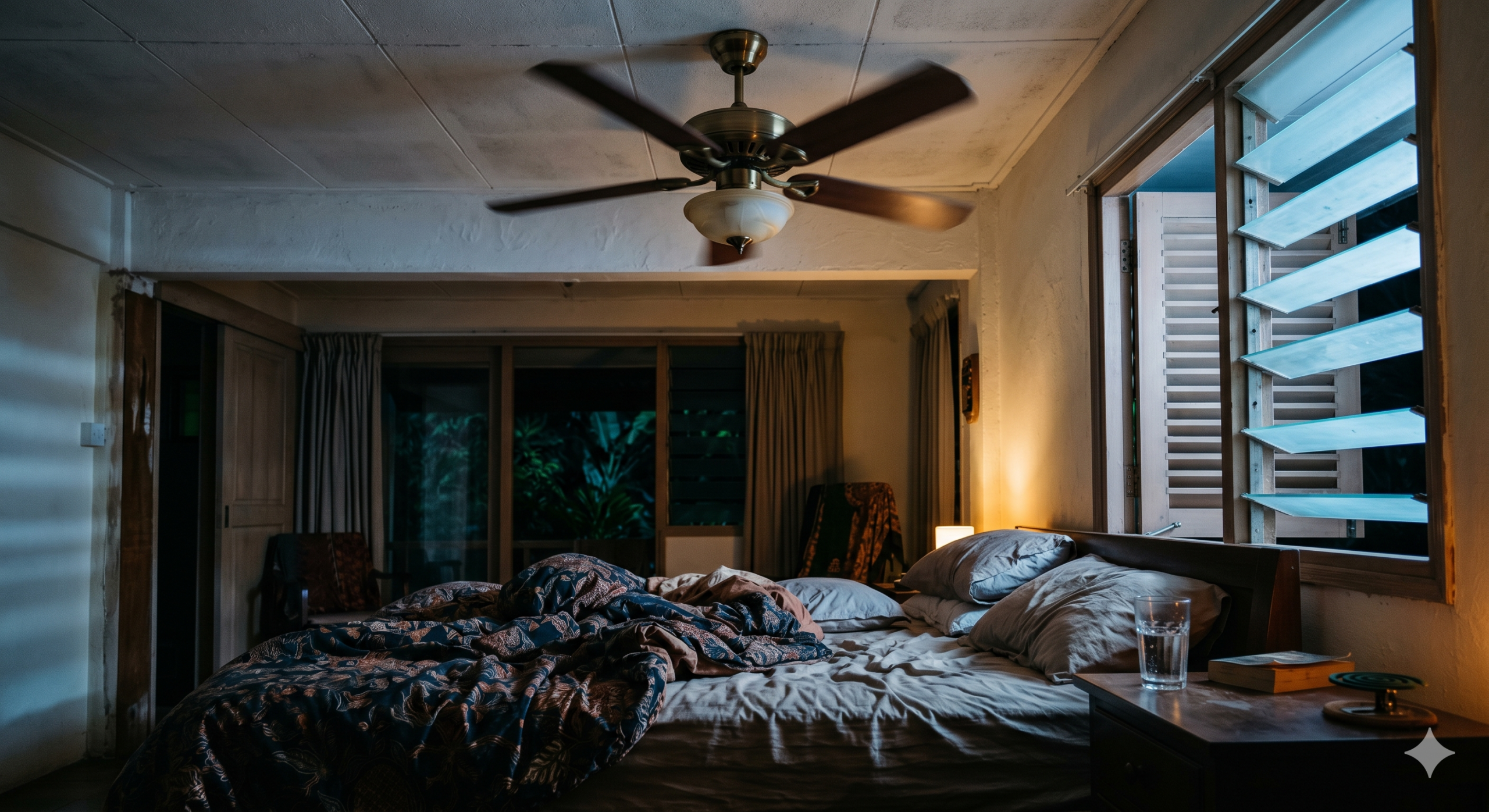
Let me guess. You sleep with either a ceiling fan on full blast or the air-conditioning set somewhere between “mild Genting” and “meat locker.” If you’re Malaysian, this isn’t a choice — it’s a survival strategy. The humidity alone at 11pm in KL is enough to make anyone question their life decisions.
But I get asked about this more often than you’d think in my clinic. Not always directly. It usually comes up sideways: “Doctor, why does my nose feel blocked every morning?” or “I wake up with a dry, scratchy throat even though I’m not sick.” Or my personal favourite: “My husband says I snore, but only when the fan is on.”
So here’s my honest answer, as someone who spends his days looking at the inside of people’s noses, throats, and airways.
What Your Nose Actually Does While You Sleep
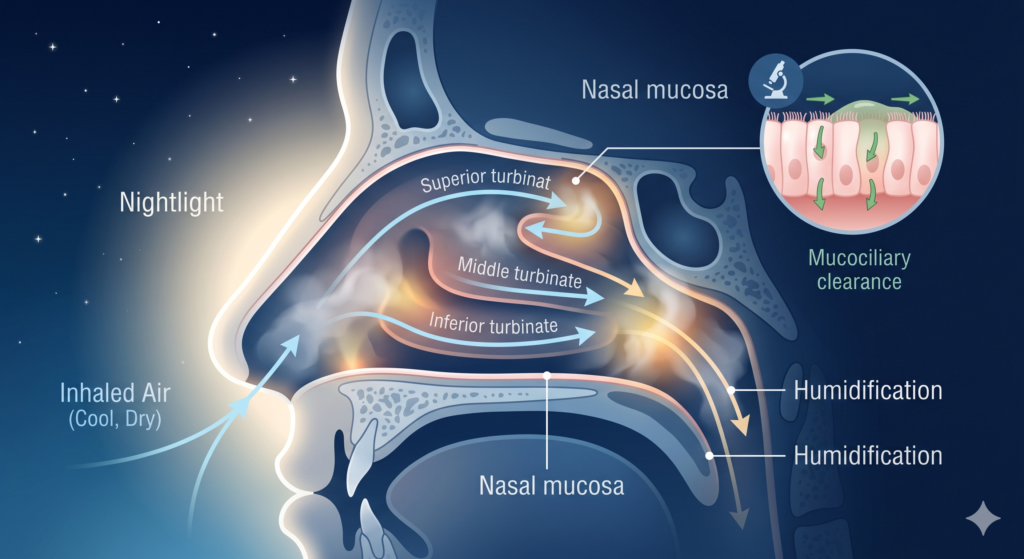
Before I talk about fans, I need to explain something most people don’t know about their nose — because it changes everything.
Your nose is not just a hole in your face for air to pass through. It’s a remarkably sophisticated air-conditioning unit. As air enters, the mucous membranes lining your nasal passages do three things simultaneously: they warm the air to near body temperature, they humidify it to about 95% relative humidity, and they filter out dust, bacteria, and airborne particles. By the time air reaches your lungs, it has been processed.
This system works around the clock, but it works harder at night. Nasal airflow actually alternates between nostrils in a cycle every few hours — a process called the nasal cycle — and your mucous membranes regenerate and rehydrate their lining during sleep. Think of the nighttime as maintenance hours for your upper airway.
A fan doesn’t disrupt this process outright. But it does add a variable your nose wasn’t designed to manage.
What Happens When You Add a Fan to the Equation
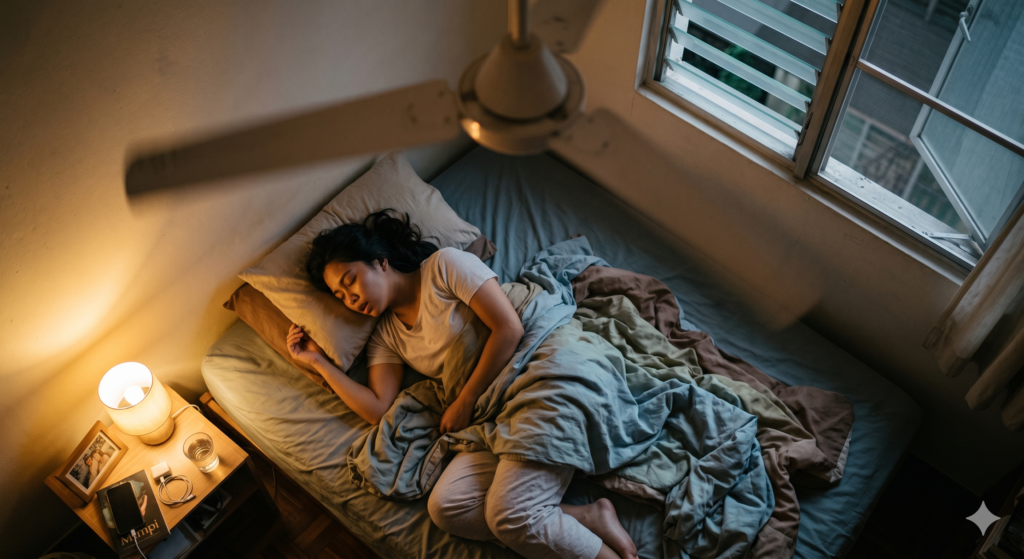
The core issue is evaporative drying. Moving air accelerates the evaporation of moisture from any surface it contacts. Your nasal mucosa, mouth, and throat are mucous-membrane surfaces. A ceiling fan running all night creates a constant airflow environment that draws moisture away faster than your body can replace it.
In practical terms: you wake up with that familiar dry, slightly raw sensation at the back of your throat. Your lips might be slightly chapped. Your nose feels stuffy despite no actual congestion — what you’re feeling is early mucosal swelling, which is your nasal lining’s response to being dried out. It’s a protective mechanism.
For most healthy people without any underlying nasal or throat condition, this is mildly annoying and self-resolving. A glass of water, morning humidity, and your mucosa recovers within an hour or two.
But “most healthy people” is doing a lot of work in that sentence.
The People Who Should Pay Attention
If You Have Allergic Rhinitis
This is where I see real problems. Allergic rhinitis — what Malaysians often call resdung — is already a state of baseline nasal inflammation. Your mucosa is already swollen, already irritable, already working overtime. Introduce a fan that reduces humidity and you compound the issue. The mucociliary clearance system (the microscopic hair-like cilia that sweep mucus and allergens out of your nasal passages) needs moisture to function. Dry it out and you’re essentially paralysing your own nasal immune defence. Allergens sit longer. Symptoms worsen. You wake up sneezing before you’ve even had breakfast.
There is also the matter of what’s in the air your fan is circulating. Malaysian homes — especially older ones — carry house dust mite allergens in bedding, mattresses, and carpets. A ceiling fan set to maximum is, effectively, a dust mite distribution system for the allergic patient.
If You Snore
Pay attention to this part. Snoring happens when airflow through the upper airway becomes turbulent and causes the soft tissues of the palate and throat to vibrate. The drier those tissues are, the more friction there is — and friction worsens vibration. Patients who snore regularly often tell me their snoring is noticeably worse when they sleep under a direct fan. This isn’t placebo. Dehydrated mucosal tissues are less elastic and more prone to the kind of partial collapse that generates snoring.
More importantly: if you snore AND you wake up with a dry mouth, that almost always means you’re mouth-breathing during sleep. And mouth-breathing at night is a flag I take seriously, because it’s one of the consistent features I see in patients with obstructive sleep apnoea (OSA). The fan didn’t give you OSA. But the dry mouth is a clue.
If You Have a Chronic Cough or Laryngopharyngeal Reflux
The larynx (voice box) and the posterior pharynx are highly sensitive to dryness and to changes in mucosal surface temperature. Patients with laryngopharyngeal reflux — silent reflux, where stomach acid reaches the throat without obvious heartburn — already have an inflamed, irritable larynx. A fan drying out that surface through the night is adding insult to injury. I’ve seen patients who controlled their diet perfectly, took their reflux medication consistently, and still had a persistent cough — until they moved the fan.
Children
Children’s nasal passages are narrower, their adenoids are proportionally larger, and their mucosal surfaces are more reactive to environmental changes. A child sleeping directly in front of a strong fan is at higher risk of nasal congestion, mouth-breathing, and interrupted sleep — all of which I would want to know about if I were seeing that child in clinic. It’s not dramatic. But it matters.
Air-conditioning vs. Fan: Is One Better?
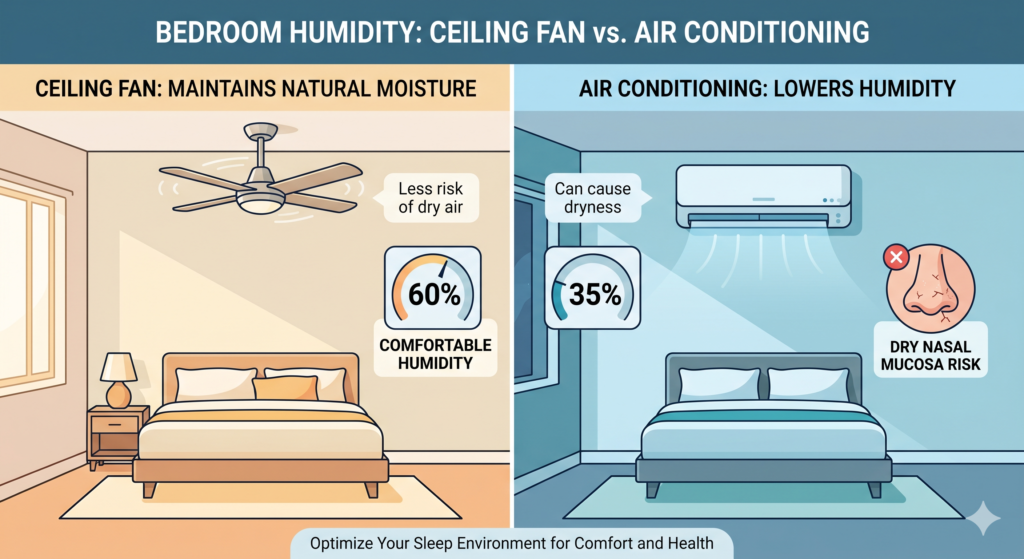
I get this comparison often. The honest answer: air-conditioning introduces an additional variable that fans don’t — it removes humidity from the room air actively, not just through evaporation. A properly serviced air-conditioning unit running all night will drop both temperature and relative humidity. Low humidity environments (below 40% RH) are correlated with increased respiratory symptoms, dry mucosa, and worse sleep quality in people with any baseline nasal condition.
That said, Malaysians sleeping in 30°C heat without any airflow also sleep poorly, and poor sleep has its own health consequences. This is not a binary choice between your airway and your comfort.
The practical middle ground is this: air-conditioning set to 25–26°C (not the coldest setting), with a low-flow ceiling fan to improve air circulation without creating a wind tunnel directed at your face. If you’re prone to nasal dryness, a bedroom humidifier maintaining 50–60% relative humidity makes a noticeable difference. I have patients who have done this one thing and come back to tell me their morning congestion cleared.
The “Kipas vs. No Kipas” Debate in Malaysian Families
There’s a generational argument that plays out in many Malaysian households — the older family member who insists the fan causes sickness and the younger one who cannot sleep without it. As with most long-running family arguments, both sides have a partial point.
The fan itself is not causing illness in the way traditional thinking imagined (you cannot “catch a cold” from cold air directly). But it does create the conditions — dry mucosa, reduced mucociliary clearance, airborne allergens — that make your upper airway less able to defend against viruses and irritants. So: the fan doesn’t give you the infection. But it may reduce your ability to resist one.
Practical Changes Worth Making
These are the things I actually tell patients, not just general advice:
1. Don’t aim the fan directly at your head and face. Point the ceiling fan towards the centre of the room or angle it away from where you sleep. Circulation matters; a direct stream of air on your face all night does not.
2. Drink a glass of water before bed. Sounds too simple. It works. Hydrated mucosa is more resilient mucosa.
3. If you use air-conditioning, try not to go below 24°C. The temperature difference between your body and the room air matters for mucosal integrity.
4. Keep your bedroom door slightly open. Sealed rooms with air-conditioning lose humidity fast. A little air exchange helps.
5. Consider saline nasal spray before sleep. Particularly for patients with allergic rhinitis or recurrent morning congestion. A simple isotonic saline spray moisturises the nasal lining before it has to fight all night.
6. Get your unit serviced. A ceiling fan that hasn’t been cleaned in two years is blowing dust, mould spores, and accumulated particulates into your breathing space every night. This is genuinely worth fixing.
When Should You See an ENT?
Morning nasal dryness alone is not an ENT emergency. But come and see me — or any ENT surgeon — if you have:
- Waking up with a dry mouth consistently (possible mouth-breathing / OSA)
- Morning congestion that takes more than an hour to clear
- Recurrent sore throats that seem to follow nights with the fan on
- A partner who tells you that you snore loudly, stop breathing, or gasp during sleep
- Chronic post-nasal drip that worsens in air-conditioned environments
The last two especially. Snoring that stops and restarts — with gasping — is not normal. That pattern needs a sleep study, not a lifestyle blog post.
The Bottom Line
The fan is not your enemy. For most Malaysians in good health, sleeping with a ceiling fan is harmless and necessary. But it does dry out mucosal surfaces, it does worsen symptoms in patients with allergic rhinitis, and it does create conditions that aggravate snoring and mouth-breathing.
The people I worry about are not the ones sleeping comfortably with a fan and waking up fine. I worry about the ones who have been waking up with a blocked nose, a dry throat, and their spouse nudging them all night for years — and writing it off as just “Malaysia weather lah.”
Sometimes it really is just the fan. And sometimes the fan is covering up something that deserves a proper look.
Dr. Julius Goh is a Consultant Otorhinolaryngologist at Universiti Malaya Medical Centre and UM Specialist Center, with a special interest in obstructive sleep apnoea and sleep surgery.
If you’re concerned about your sleep quality, nasal symptoms, or snoring, book a consultation here or read more about OSA assessment at UMMC.
Comments are closed