
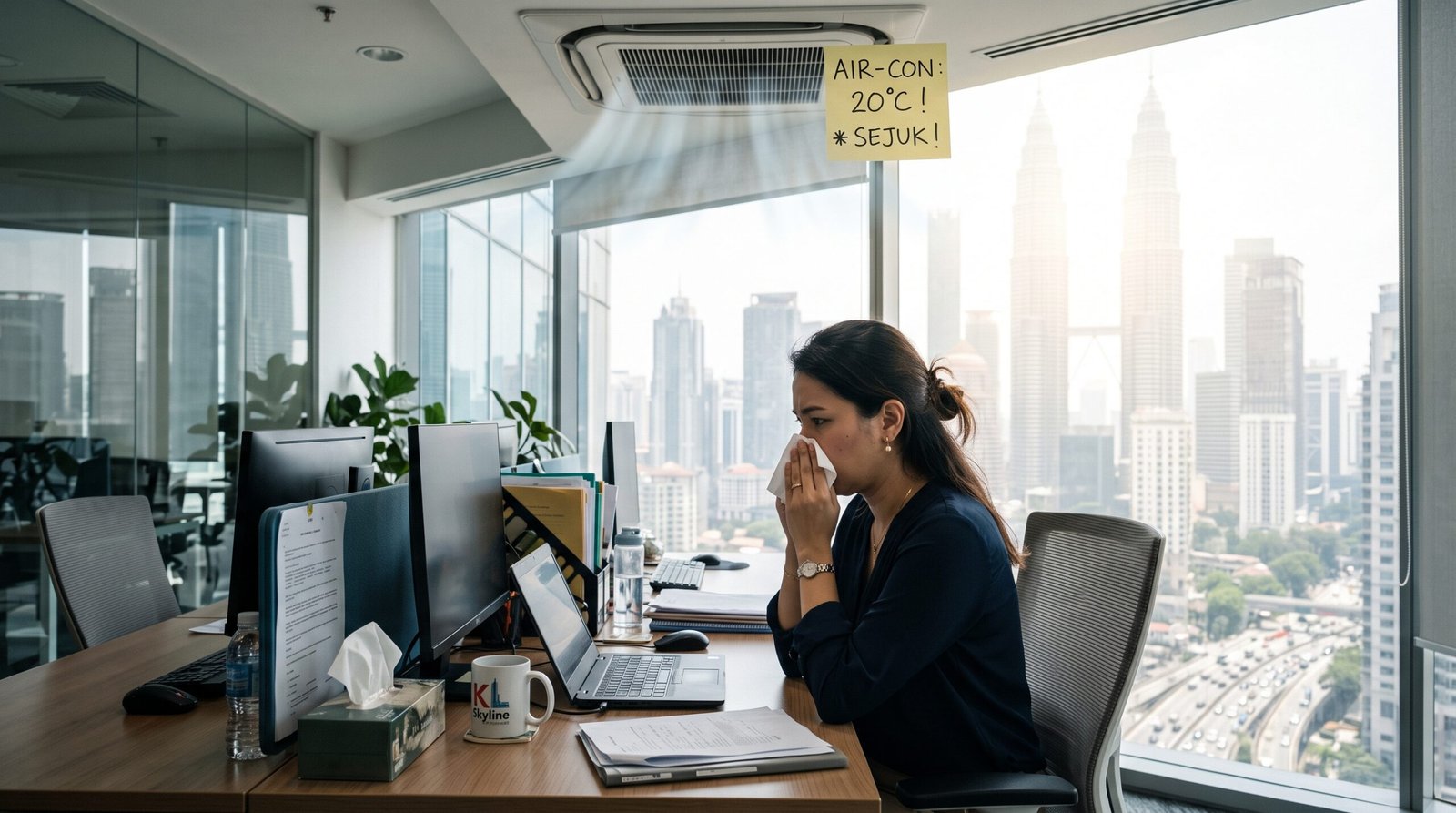
A 38-year-old bank officer from Petaling Jaya came to my clinic last week. She was holding a tissue folded into a tight square, the way people do when they have been caught out more than once. She had had three nosebleeds in ten days. The first came in the shower, the second at her desk, and the third at 3 a.m. It woke her up with blood on her pillow. “I don’t even have a cold,” she said. “It’s just so hot lately, and my nose feels like sandpaper.”
When I looked inside with an endoscope, I saw what I have been seeing more of in recent weeks. The front of her septum, the wall dividing the two nostrils, was dry and cracked. It was covered in hard crusts, and a small blood vessel sat exposed underneath. There was no tumour and no bleeding disorder. It was a nose that had dried out, cracked and bled.
She worked eight hours a day in a heavily air-conditioned office and slept with the air-conditioner on all night. She drank about two glasses of water a day because, in her words, “the office is cold, so I never feel thirsty.” With Malaysia heading into what forecasters call a possible “super El Niño”, her story is worth unpacking. Many Malaysians are about to run into the same problem.
What Is Happening to Malaysia’s Weather Right Now?
In June 2026, the Malaysian Meteorological Department (MetMalaysia) warned that El Niño could bring hotter and drier conditions into early 2027. It said the risks include reduced rainfall, water shortages, forest and peatland fires, and haze. Universiti Malaya meteorologist Prof Emeritus Datuk Dr Azizan Abu Samah told Bernama that rainfall could fall by 10 to 20 percent below normal. The risk of drought and heatwaves is highest in northern Peninsular Malaysia (The Star).
The Ministry of Health (KKM) has already urged the public to drink plenty of water, limit strenuous outdoor activity and rest in the shade. Between January and early May 2026, it recorded 56 heat-related illnesses and two deaths. You can check the current heat alert level for your district on MetMalaysia’s heat wave status page.
El Niño does not mean it will never rain. Klang Valley residents will still get the odd afternoon thunderstorm. What changes is the overall pattern: more hot, dry days, more hours with the air-conditioner running, and more days when we forget to drink. Your nose notices all three.
“But Malaysia Is So Humid. How Can My Nose Be Dry?”
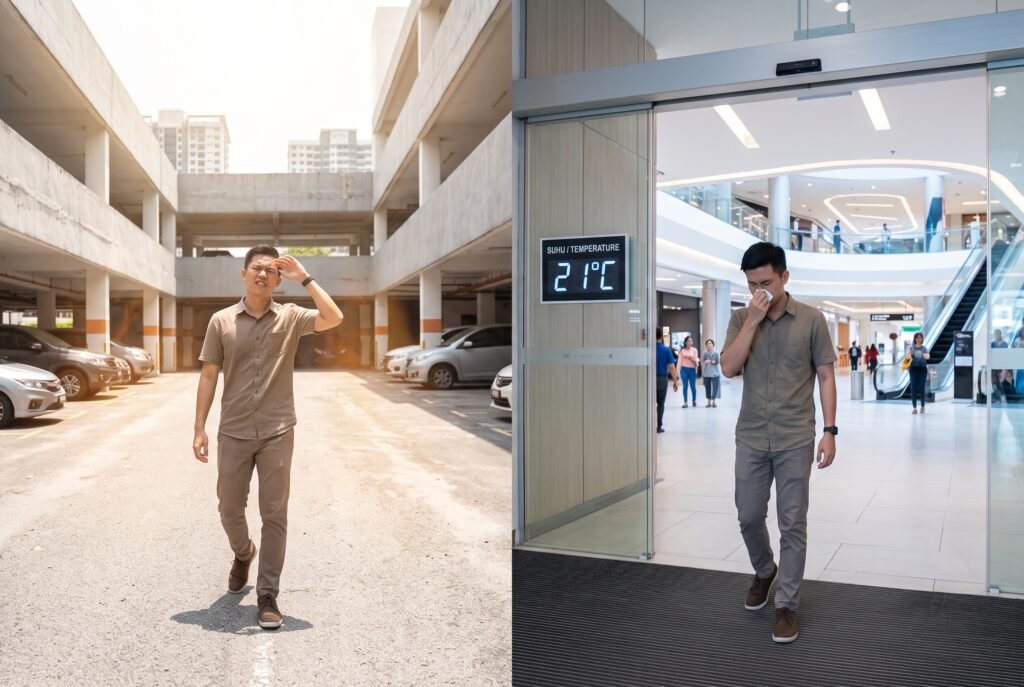
This is the question I get most often, and it is a fair one. Outdoors, Malaysian air is usually humid. But most of us spend most of our time indoors, and indoor air is a different climate altogether.
An air-conditioner cools the air and pulls moisture out of it at the same time. That is why water drips from the outdoor unit. In a small, closed bedroom or a sealed office running at 20 to 22 degrees Celsius for hours, the air can end up much drier than the air outside. An office study in Finland compared humidified and non-humidified wings of the same building. Workers in the drier air reported noticeably more dryness of the skin, eyes and nose. A later Cochrane reviewfound the evidence on humidifiers is still limited in quality, but dryness symptoms are consistently reported in dry indoor air.
Your nose normally warms and moistens every breath you take, about 10,000 to 20,000 of them a day. Each time you walk from a 34-degree car park into a 21-degree mall, it has to adjust. When the air is dry, the thin layer of mucus that protects the lining gets thicker and stickier. It stops flowing and hardens into crusts. Three other things make this worse in El Niño weather:
- Dehydration. Mucus is mostly water. If you are not drinking enough in the heat, your nose is one of the first places to show it.
- Fans pointed at the face all night. I have written before about sleeping with the fan on every night. A constant stream of air across the nostrils dries the front of the nose even further.
- Haze particles. Hot, dry weather raises the risk of peatland fires. Fine particles irritate a lining that is already dry. I covered the haze itself in Malaysia’s Haze Emergency, so I will not repeat it here.
How a Dry Nose Turns Into a Nosebleed
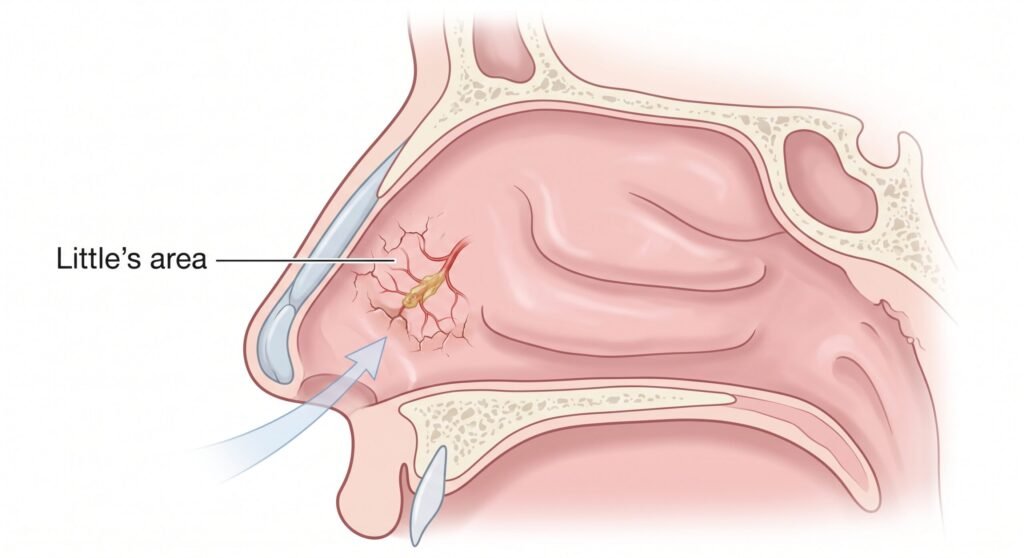
About nine in ten everyday nosebleeds come from one small patch at the front of the septum. It sits about one centimetre inside the nostril, and ENT surgeons call it Little’s area. Several tiny arteries meet there just under a very thin lining. It is also the spot your fingertip reaches, and the spot that dry air hits first.
The sequence goes like this. The lining dries, a crust forms, and the crust sticks to the fragile vessels underneath. Then you sneeze, blow your nose hard, rub it or pick at the crust, and the crust tears away with the top of a vessel attached. The nose bleeds, a new scab forms, the scab dries, and the cycle repeats. This is why dry-air nosebleeds often come in clusters over a week or two, as they did for my patient.
Research from other countries supports the link between dry air and nosebleeds, although Malaysian data are not yet available. A 12-year study from Changshu, China found that each rise in average humidity was linked to about 17 percent fewer spontaneous nosebleeds. The effect of dry air built up over one to four days. A study from Hazara, Pakistan also linked weather conditions to nosebleed rates. Those studies were about outdoor air in cooler climates. In Malaysia, the main source of dry air is the air-conditioner in your bedroom and office.
Who Is Most at Risk This El Niño?
- Children, who pick their noses (all of them do) and are less likely to drink water unprompted in hot school compounds.
- Older adults, whose nasal lining is thinner and who often feel less thirsty.
- Anyone on blood thinners such as aspirin, clopidogrel, warfarin or the newer anticoagulants. Never stop these on your own, but tell your doctor if you are bleeding.
- People with allergic rhinitis who use steroid nasal sprays with poor technique. Aiming the spray at the septum instead of towards the ear on the same side can dry out and irritate Little’s area.
- Heavy users of decongestant sprays, which I explained in Can You Really Get “Addicted” to Nasal Spray?
- CPAP users without a heated humidifier, and anyone recovering from nasal or sinus surgery.
- Outdoor workers such as riders, construction crews and security guards, who move between heat and air-conditioned spaces and often cannot drink regularly.
What Actually Helps: An ENT’s Practical Plan
Most heat-season nose problems can be managed at home once you understand the cause. This is the plan I gave my patient.
1. Drink before you are thirsty
KKM’s advice to drink plain water regularly, even when you do not feel thirsty, applies to your nose as much as your kidneys. Air-conditioned offices are the trap: you feel cool, so you forget. Keep a water bottle on your desk and finish it by lunch.
2. Moisturise the front of the nose
Saline nasal sprays, available at any Malaysian pharmacy, rehydrate the lining during the day. At night, a small amount of a nasal gel or a plain petroleum-based ointment applied just inside each nostril with a cotton bud (no deeper than the tip) keeps crusts soft. For babies and young children, check with your doctor first.
3. Fix the bedroom air
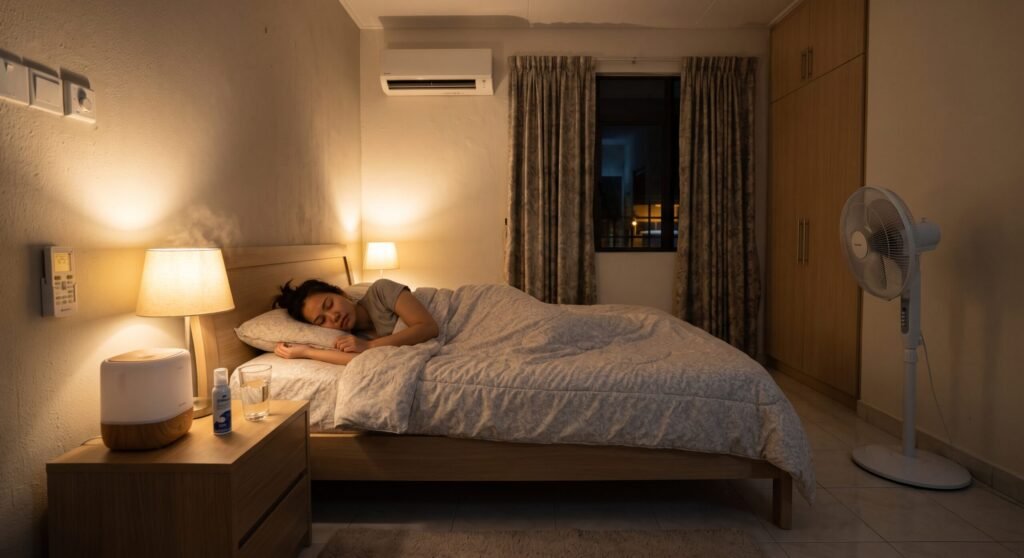
Set the air-conditioner to 24 or 25 degrees instead of 18, use the timer so it switches off in the early morning, and point fans away from your face. A small humidifier can help, but only if you clean it and change the water every day, because dirty humidifiers spread mould and bacteria. If you rinse your nose, use safe water. I explained why in Is Tap Water Safe for Nasal Rinsing?
4. Hands off
Do not pick the crusts. Let them soften and come away on their own. Blow gently, one nostril at a time, and sneeze with your mouth open.
5. Use your steroid spray correctly
Hold the bottle in the opposite hand (right hand for the left nostril), angle it slightly outwards towards the ear, and sniff gently rather than hard. If your nose keeps bleeding, stop for a few days and see your doctor rather than pushing through.
How to Stop a Nosebleed Properly
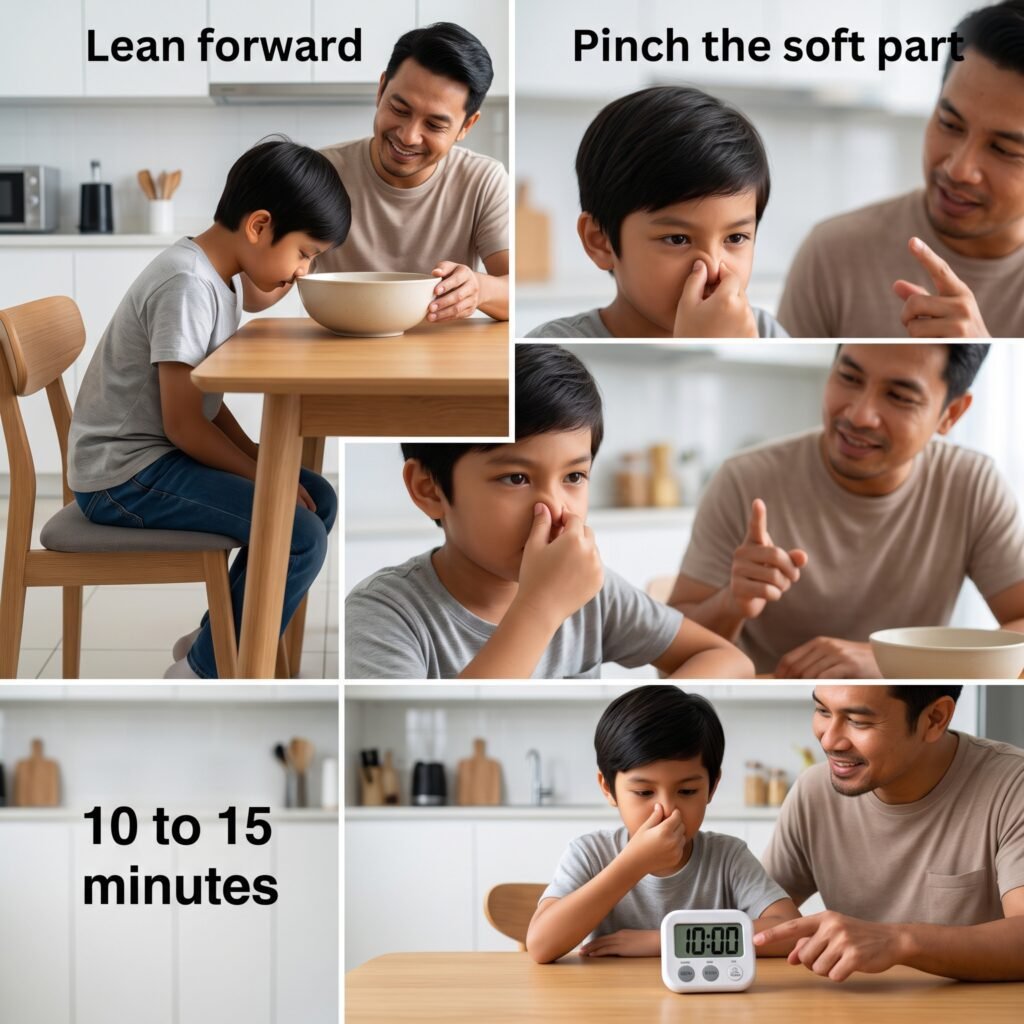
Many of us learned the wrong method as children. Here is what the NHS recommends, and what I teach every patient:
- Sit up and lean forward. Do not tilt your head back. Swallowed blood causes nausea and vomiting and hides how much you are losing.
- Pinch the soft part of the nose, just below the bony bridge, firmly with your thumb and finger. Pinching the hard bridge does nothing.
- Hold for a full 10 to 15 minutes by the clock without letting go to check. Breathe through your mouth.
- Spit out any blood that reaches your throat. A cold pack on the bridge of the nose or sucking on ice can help a little.
- After it stops, avoid blowing your nose, bending, heavy lifting and hot drinks for 24 hours.
Stuffing tissue deep into the nostril, pressing a cold key on the back of the neck or pouring water on your head does not help. Firm, patient pressure is what works.
When a Heat-Season Nosebleed Is Not Just the Heat
Dry air is the most common cause, but it is not the only one. Go to an emergency department if a nosebleed does not stop after 20 minutes of proper pressure, if you are losing a lot of blood, or if you feel faint or breathless. See a doctor promptly if:
- You have a fever, body aches and nosebleeds, or bleeding gums, easy bruising or tiny red spots on the skin. With dengue cases high this year, this needs a blood test. I covered the warning signs in Nosebleeds During Dengue Season.
- Bleeding always comes from the same side and keeps returning despite good home care.
- You are an adult with one-sided blockage, blood-stained mucus, a blocked ear or a lump in the neck. In Malaysia, nasopharyngeal carcinoma must be ruled out. Read why Malaysians are more prone to NPC.
- You take blood thinners, have high blood pressure that is not under control, or have a known bleeding disorder.
What Happens at the ENT Clinic
A proper assessment takes about 15 minutes. After numbing the nose with a spray, I use a thin endoscope to look at the whole nasal cavity and the back of the nose. That lets me find the exact bleeding vessel and rule out anything more serious. If a vessel keeps bleeding, I can seal it with chemical cautery. This is quick, done in the clinic under local anaesthetic, and usually settles the problem. I rarely need nasal packing for this type of bleed. If there is an underlying cause, such as a deviated septum that directs airflow onto one spot or poorly controlled rhinitis, we treat that too. You can read more in my earlier guide, Nosebleed: What to Do Now, When to Worry, and What Happens at the ENT Clinic.
My patient needed a quick cautery to one vessel, a saline spray by day, ointment at night and a water bottle on her desk. Her air-conditioner now runs at 25 degrees on a timer. Two weeks later, she had had no more bleeds, and her nose, in her words, “finally feels like a nose again.”
Worried About Your Nose This El Niño? Talk to us
If you are getting repeated nosebleeds, a nose that feels painfully dry and crusty, or a one-sided problem that will not go away, you do not have to wait it out. At UM Specialist Centre, Kuala Lumpur, and he sees these problems every week. Message Dr. Julius directly on WhatsApp to arrange a consultation. You can also read GP or ENT: Which One Should You Visit? if you are not sure where to start.
Frequently Asked Questions
Can hot weather really cause nosebleeds in a humid country like Malaysia?
Yes, but usually indirectly. The outdoor heat drives us into air-conditioned rooms that dry the air, and it makes us more likely to be dehydrated. Both dry out the front of the nose, where most nosebleeds start.
Should I tilt my head back to stop a nosebleed?
No. Sit up, lean forward and pinch the soft part of your nose firmly for 10 to 15 minutes without letting go.
Is it safe to put ointment inside my nose every night?
A small amount just inside the nostril is safe for most adults for short periods. Do not push it deep into the nose. Ask your doctor before using it on babies or for long-term use.
Does sleeping with the air-conditioner on cause nosebleeds?
Not by itself. But a very cold setting running all night in a closed room, especially with a fan blowing at your face, can dry your nose enough to crack and bleed. Raise the temperature, use the timer and keep the airflow off your face.
When should I see an ENT specialist for nosebleeds?
See one if the bleeds keep coming back, always come from one side, last more than 20 minutes, or come with one-sided blockage, blood-stained mucus, ear symptoms or a neck lump. Also see one if you take blood thinners.
References
- Malay Mail: El Niño could bring heat, haze and water shortages into 2027, MetMalaysia warns (14 Jun 2026)
- The Star: Stronger El Niño may bring drier weather, health risks to Malaysia around year end (13 Jun 2026)
- The Star: Take precautions during hot weather, urges Health Ministry (25 Mar 2026)
- Malay Mail: Health Ministry says 56 heat-related illnesses, two deaths reported since January (3 May 2026)
- MetMalaysia: Heat Wave Status
- Meteorological factors modulate idiopathic epistaxis risk: a 12-year retrospective study in Changshu (PMC)
- Effect of temperature and humidity on epistaxis in Hazara division (PubMed)
- The effect of air humidification on symptoms in office workers (PubMed)
- Cochrane: Humidification of indoor air for preventing or reducing dryness symptoms (2021)
- NHS: Nosebleed
No responses yet