
The Viral No-Burp Syndrome and the Botox Fix people Are Asking About
In September 2026, a British woman named Gemma Renwick went on national breakfast television to talk about something most of us never think twice about: burping. She had never been able to do it. Not once in 43 years. What she described was not a quirky party fact but daily pain, bloating, and a constant pressure in her chest and throat that she said made it feel like she “couldn’t breathe” after a fizzy drink. Her relief came from an injection of botulinum toxin, better known as Botox, into a small muscle at the top of her food pipe. Her story, reported widely after the broadcast, picked up even more attention when a well-known British pop singer commented on her TikTok video that she had the same problem and was worried the treatment might affect her singing voice.
Within days, the same question started appearing in comment sections here at home: “Wait, I can’t burp either. Is that a disease?” If you are a Malaysian who has quietly lived with this, you are not imagining it, and you are not alone. The condition has a name, a clear explanation, and an effective treatment. It is called retrograde cricopharyngeus dysfunction, or R-CPD, and it sits squarely in the territory of the ENT and throat surgeon.
What Is No-Burp Syndrome (R-CPD)?
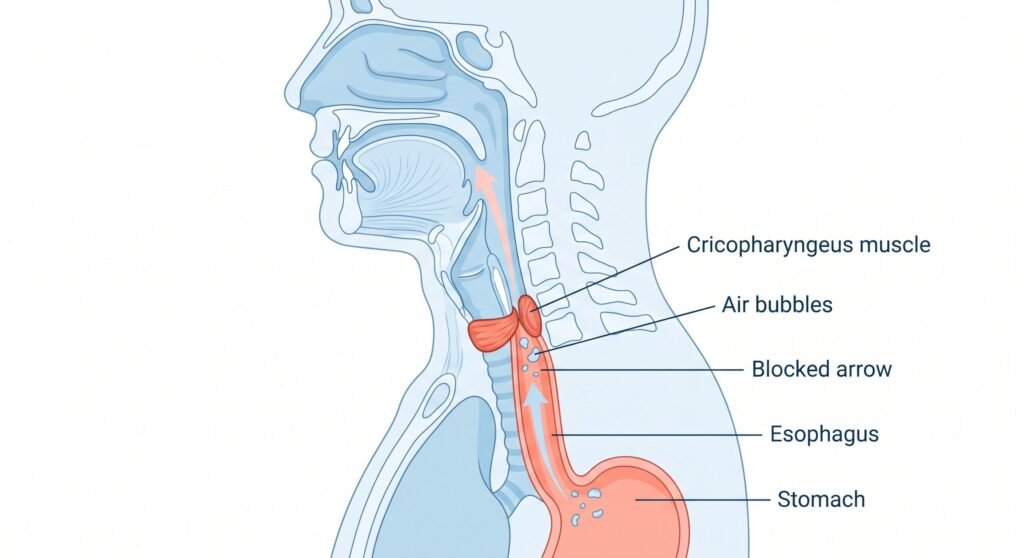
At the very top of your oesophagus (food pipe), just behind the voice box, is a ring of muscle called the cricopharyngeus. Think of it as a gatekeeper. Most of the time it stays tightly closed, which stops air from rushing into your stomach every time you breathe and stops stomach contents from coming back up into your throat. When you swallow, it relaxes to let food through. And when your stomach and oesophagus are stretched with swallowed air, it is supposed to relax briefly in the other direction, letting that air escape upwards as a burp.
In R-CPD, that second job fails. The muscle opens for swallowing, but it does not open in reverse. The air you swallow while eating, drinking, talking and even swallowing saliva has nowhere to go but down. As the Cleveland Clinic explains, doctors believe this is a problem with how the muscle functions rather than a structural abnormality, and the exact reason it happens is still not fully understood.
The condition was only formally described in 2019, when American laryngologist Dr Robert Bastian and colleagues published a series of 51 patients who could not burp and who improved after treatment. Before that, many of these people had been told for years that they had “gastric,” irritable bowel syndrome, or simply anxiety.
The Four Tell-Tale Symptoms


Doctors recognise R-CPD mainly through a very characteristic cluster of symptoms. The more of these you have, the more likely the diagnosis:
- You cannot burp at all, or almost never. Many patients say they have never been able to, even as children. Some can produce a weak, partial burp only by forcing it.
- Bloating and pressure, especially after eating or drinking. The upper abdomen or lower chest feels tight and swollen. Carbonated drinks are often the worst trigger.
- Gurgling or croaking noises from the lower neck or chest. This is air trying, and failing, to get out through the closed muscle. Patients often describe it as embarrassing “frog sounds” in meetings or on dates.
- Excessive wind from the other end. If air cannot go up, it has to go down. Many people with R-CPD pass a lot of gas, which they find socially distressing.
Some people also report difficulty vomiting, chest discomfort after meals, and nausea. Research cited by Yale Medicineand the Cleveland Clinic notes that many patients change their behaviour to cope, for example fasting before important events or avoiding eating with others.
Why Malaysians Are Only Hearing About This Now
Let me be clear about what we do and do not know. There is currently no published data on how common R-CPD is in Malaysia. It is not tracked by the Ministry of Health, and to my knowledge there are no Malaysian case series in the medical literature yet. Everything we know about the condition so far comes from studies in the United States, Canada, Europe and a few Asian centres. So when I describe how R-CPD tends to show up for Malaysian patients, I am speaking from the clinical context we work in, not quoting a local statistic.
What is well documented internationally is that social media is driving the diagnosis. A 2025 study of R-CPD content on TikTok found 103 videos with over 32 million views, and 94% of them were made by patients or members of the public rather than doctors. A 2024 review noted the same pattern: more people are now walking into clinics having diagnosed themselves after watching someone else describe their exact symptoms online. The topic is also on the programme at the American Academy of Otolaryngology annual meeting in Los Angeles this October, a sign of how quickly the field is paying attention.
There are a few reasons why the condition can easily hide in plain sight in Malaysia:
- “Gastric” is the default label. Bloating, chest pressure and wind after meals are so often put down to gastritis or acid reflux that many people spend years on antacids before anyone asks the simple question, “Can you actually burp?”
- Our eating culture involves a lot of swallowed air. Long, social meals, talking while eating, late-night suppers with friends, iced fizzy drinks to cope with the heat, and drinking through straws all increase the amount of air we swallow. For someone with a working cricopharyngeus, this is harmless. For someone with R-CPD, it means more trapped air and more discomfort.
- Embarrassment keeps people quiet. Gurgling noises and excessive wind are not things most people want to raise with their family doctor, so the problem goes unmentioned.
If you have been through rounds of reflux medication without much relief, it is worth reading my earlier article on silent reflux and chronic cough as well. Reflux and R-CPD can coexist, but they are not the same condition, and treating one does not fix the other.
Myth vs Fact: What TikTok Gets Right and Wrong
Myth 1: “It’s just gastric. Take an antacid.”
Fact: Antacids and acid-suppressing medicines reduce stomach acid. They do nothing to relax the cricopharyngeus muscle. Some patients do have reflux as well, but if your main complaint is that you cannot burp, acid medicine alone is unlikely to solve it.
Myth 2: “Gas-relief tablets and charcoal will sort it out.”
Fact: Over-the-counter gas remedies may ease bloating slightly for some people, but they do not address the underlying problem. The air is still trapped above and below a muscle that will not open in reverse.
Myth 3: “Just make yourself gag to force a burp.”
Fact: Some people with R-CPD teach themselves to trigger their gag reflex to vent air, and Gemma Renwick described doing exactly this. It can bring temporary relief, but it is unpleasant, can be distressing, and is not a long-term solution. Please do not put objects down your throat to provoke gagging. If you have been doing this for years, it is a strong sign that you should get properly assessed.
Myth 4: “Botox is a beauty treatment, so any aesthetic clinic can do it.”
Fact: This is the one that worries me most. The Botox used for R-CPD is injected into a muscle deep in the throat, right next to the voice box and the airway, and it has nothing to do with cosmetic facial injections. In Malaysia, botulinum toxin is a controlled medicine, and the Ministry of Health has made clear that injections like Botox may only be performed by qualified, registered medical practitioners. The Ministry raided 30 premises in 2025 for illegal aesthetic services, many of them promoted on social media. A throat injection is a medical procedure that belongs with an ENT surgeon, a laryngologist or a gastroenterologist working in a proper clinical setting.
How R-CPD Is Diagnosed
There is no single blood test or scan that confirms R-CPD. The diagnosis is mainly clinical, based on your story and on ruling out other causes. When you see an ENT surgeon, the assessment usually includes:
- A detailed history. When did the symptoms start? Have you ever been able to burp? What happens after a fizzy drink? Do you have trouble swallowing food, weight loss or vomiting?
- A flexible scope examination in the clinic. A thin camera passed through the nose lets us look at the throat, voice box and the area around the upper oesophagus. This is quick, done while you are awake, and helps exclude other problems such as a pouch in the throat or a mass.
- Excluding conditions that can look similar. Depending on your symptoms, this may involve a barium swallow, an upper endoscopy (gastroscopy), or tests for acid reflux and oesophageal motility disorders. These are especially important if you have any red-flag symptoms (see below).
The strongest confirmation is often the response to treatment itself: if you can burp after the muscle is relaxed, the diagnosis was right.
The Botox Fix: What Actually Happens
The standard treatment is an injection of botulinum toxin directly into the cricopharyngeus muscle. The toxin temporarily weakens the muscle so that it can open enough to let air escape upwards. Depending on the centre and the patient, it can be done in one of two ways:
- Under general anaesthesia, using a rigid scope through the mouth to see and inject the muscle directly. This is the most common approach worldwide and usually takes a short day-case procedure.
- In the clinic while awake, through the skin of the neck with electrical or ultrasound guidance, in selected patients and centres with experience in this technique.
How well does it work?
The largest long-term study so far, published in 2020 by Hoesli, Wingo and Bastian, followed 200 patients. After a single injection, 99.5% were able to burp and 95% had relief of their main symptoms. Even more interestingly, about 80% still had lasting relief at six months and beyond, well after the toxin itself should have worn off. The theory is that once the muscle is “unlocked,” the body learns to burp and keeps the ability. A minority of patients need a second injection, and a very small number go on to have a minor operation that partially divides the muscle.
What are the side effects?
The most common side effect is temporary difficulty swallowing, which the Cleveland Clinic notes usually settles within one to four weeks. Some patients notice mild reflux or a feeling of food sitting in the throat during this period. You may be advised to eat softer food for a short time, similar to the advice in my guide on eating and drinking comfortably after throat procedures.
What about the voice? This was the singer’s concern, and it is a fair question. The cricopharyngeus is close to, but separate from, the vocal cords. Lasting voice change is not a typical outcome in the published series, although any procedure in this area carries a small risk of temporary hoarseness. If you use your voice professionally, as a teacher, singer, lawyer or call centre worker, tell your surgeon, and read my article on voice problems and hoarseness for what to watch out for afterwards.
When It Is NOT No-Burp Syndrome: Red Flags
R-CPD is a benign condition, but some of its symptoms overlap with problems that are much more serious. Please do not self-diagnose from a video and stop there. See a doctor promptly if you have any of the following:
- Difficulty swallowing solid food, or food getting stuck, that is getting worse
- Unintentional weight loss
- Vomiting blood or passing black stools
- Persistent hoarseness lasting more than three weeks, or a lump in the neck
- Chest pain that comes on with exertion or spreads to the arm or jaw (this needs urgent heart assessment, not a throat check)
- Symptoms that only started recently in middle age or later, rather than being lifelong
Some of these overlap with the warning signs I discuss in 7 early throat cancer symptoms you shouldn’t ignore and in my article on that constant “lump in your throat” feeling. If you are unsure whether to see your GP or go straight to an ENT surgeon, this guide on GP or ENT: which one to visit may help.
The Bottom Line
Being unable to burp is not a personality quirk, and it is not something you simply have to live with. If you recognise yourself in the bloating, the gurgling and the years of being told it is “just gastric,” R-CPD is worth considering. It is uncommon, it is still under-recognised in Malaysia, and there is no local data yet on how many of us have it, but it is real, it is diagnosable, and for most patients it is very treatable. As with other throat conditions that go viral on TikTok, social media can be a great starting point for recognising a problem. The next step is a proper medical assessment.
Think You Might Have No-Burp Syndrome? Let’s Talk
If you have never been able to burp, or you live with constant bloating, throat gurgling and chest pressure after meals that reflux medicine has not fixed, I would be happy to see you. In a consultation we can go through your symptoms properly, examine your throat with a scope, rule out more serious causes, and discuss whether R-CPD fits and what your treatment options are.
Message me directly on WhatsApp to book a consultation: Chat with Dr. Julius on WhatsApp
Frequently Asked Questions
Is it normal not to be able to burp?
Most people can burp without thinking about it. Being completely unable to burp, especially if it comes with bloating, gurgling in the neck or chest, and excessive wind, is not normal and may be retrograde cricopharyngeus dysfunction (R-CPD). It is worth having it assessed by an ENT surgeon.
Is no-burp syndrome dangerous?
R-CPD itself is not life-threatening, but it can significantly affect quality of life. The bigger risk is assuming your symptoms are R-CPD when they are caused by something else. Swallowing difficulty, weight loss or vomiting blood need prompt medical review.
Can R-CPD be treated in Malaysia?
Botulinum toxin is a registered medicine in Malaysia and can be used by qualified doctors. The injection into the cricopharyngeus muscle is a specialist throat procedure, so it should be performed by an ENT surgeon or another appropriately trained specialist in a licensed healthcare facility, never in a beauty salon or aesthetic outlet.
Does the Botox injection last forever?
The toxin itself wears off over a few months, but in the largest published study about 80% of patients kept the ability to burp beyond six months after a single injection. Some people need a repeat injection.
Will the treatment affect my voice?
Lasting voice change is not a typical outcome, because the muscle being treated is separate from the vocal cords. Temporary hoarseness or swallowing difficulty can occur in the first few weeks. Professional voice users should discuss this with their surgeon beforehand.
No responses yet