
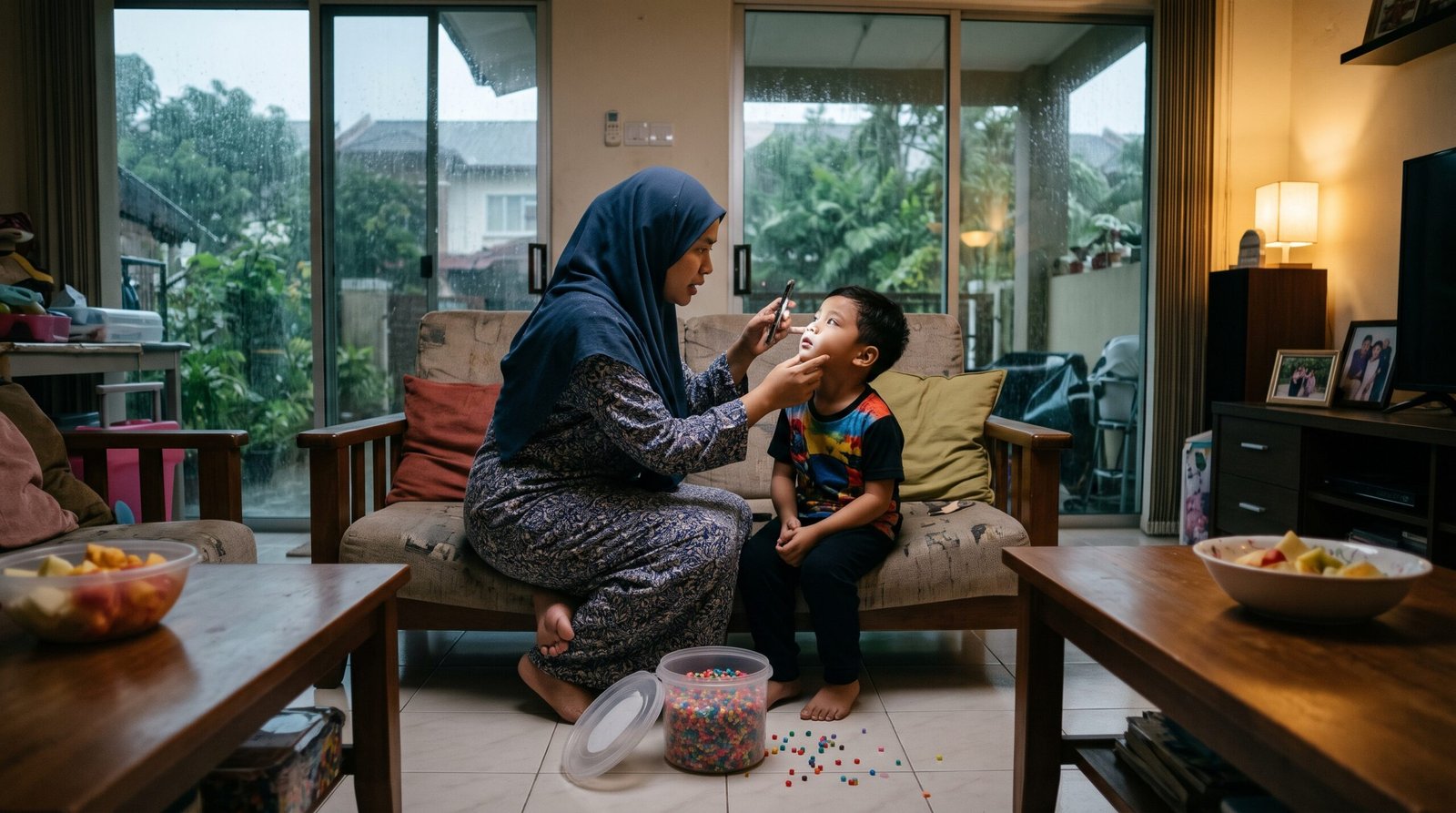
Picture a five-year-old in Shah Alam on the second day of the year-end school holidays. It is raining, his cousins are over, and a tub of coloured craft beads has come out onto the living room floor. A game of hide-and-seek turns quiet. A few minutes later his mother notices he is breathing through his mouth, and one nostril looks different from the other. He will not say what happened. (This is an illustrative scenario, not a specific patient.)
Every year, scenes like this reach ENT clinics and emergency departments across Malaysia. Most end well, with a small object removed in minutes. A few do not, and the difference often comes down to what the parent did in the first ten minutes and whether the object was a bead or a button battery.
| The short answer Most things stuck in a child’s nose or ear are not emergencies, but three are: a button battery, magnets, and a live insect in the ear. Do not poke, flush or use tweezers or cotton buds. If a battery or magnet is even possible, go to the nearest emergency department straight away. For anything else, see an ENT doctor the same day rather than waiting to see if it comes out. |
Why the year-end school holidays matter
The Ministry of Education’s 2026 calendar puts the year-end break at 4 to 31 December for Group A states (Johor, Kedah, Kelantan and Terengganu) and 5 to 31 December for Group B states, which include Selangor, Kuala Lumpur, Penang and Sarawak. That is 27 to 28 days with children at home. The Northeast Monsoon, which began on 27 October and is expected to run until March 2027 according to the Ministry of Health, also means many of those days will be spent indoors.
No national figure tells us whether these injuries rise in December, so I will not claim they do. The reasoning is simpler: more hours at home with small objects within reach means more chances for a toddler or preschooler to put something where it does not belong. Christmas gifts, new toys, craft kits and a drawer full of spare batteries all add to that.
What Malaysian hospital data show
Malaysian research on this is older than I would like, but it is consistent. A five-year review of 1,084 foreign body cases at the Sarawak General Hospital ENT department (2005 to 2009), published in the Medical Journal of Malaysia, found:
- Young children dominate. 60.1% of patients were aged 10 or under, and 45.4% were aged 5 or under.
- Ears and noses are the commonest sites. The ear accounted for 44.3% of cases and the nose for 24.9%.
- The objects are ordinary. In both ear and nose, seeds or nuts and plastic toys or beads were the top two categories. In the ear, seeds or nuts made up 47.1% and plastic toys or beads 34.8%. In the nose the figures were 36.7% and 35.2%.
- Most are removed in clinic. 76.1% of cases were removed in the outpatient setting, and the difficult ones went to general anaesthesia.
The same paper reports septal perforation caused by a battery in the nose and states that disc batteries in the nose should be treated as an emergency. A separate one-year audit of ear foreign bodies at Hospital Universiti Sains Malaysia (2010, 72 patients) found insects were the most common ear foreign body at 54%, and its authors warned that repeated attempts at removal by untrained people should be avoided, with timely referral being the key to preventing complications.
These are hospital-based figures from more than a decade ago, so they show patterns, not today’s rates. I could not find a current national statistic.
The three real emergencies
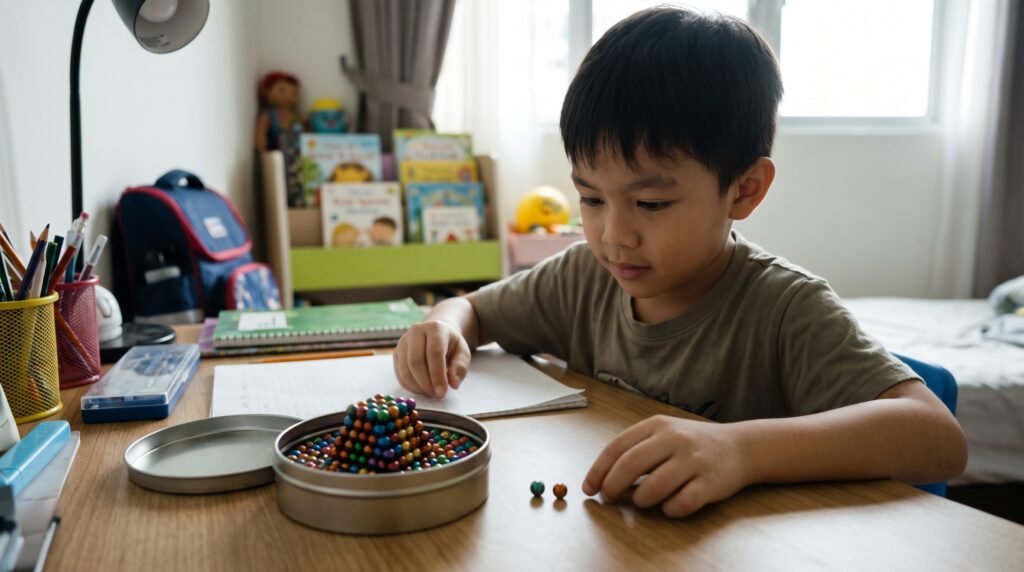
1. Button batteries and coin cells
A button battery in moist tissue does not behave like an inert bead. It sets up a small electrical current that produces a caustic chemical injury, and the damage can start quickly. Clinical references describe septal perforation, scarring between the nasal walls and even collapse of the nose bridge after a battery lodges in the nose. In the ear canal, the Perth Children’s Hospital emergency guideline calls it the most serious retained foreign body because it can damage the canal lining and cause tissue death.
Malaysian guidance on the swallowed version of this problem shows how fast the clock runs. The Ministry of Health’s 2025 quick reference on foreign body ingestion in children says a battery lodged in the oesophagus should be removed within two hours. The Star reported the case of a six-year-old girl, described by the ENT department at Shah Alam Hospital, who had a cough and trouble swallowing for five days and was diagnosed with a respiratory infection twice before an X-ray found a 20 mm lithium battery in her oesophagus. That child was swallowing, not sniffing, but the lesson carries over: symptoms can be vague, and the child often cannot tell you what happened.
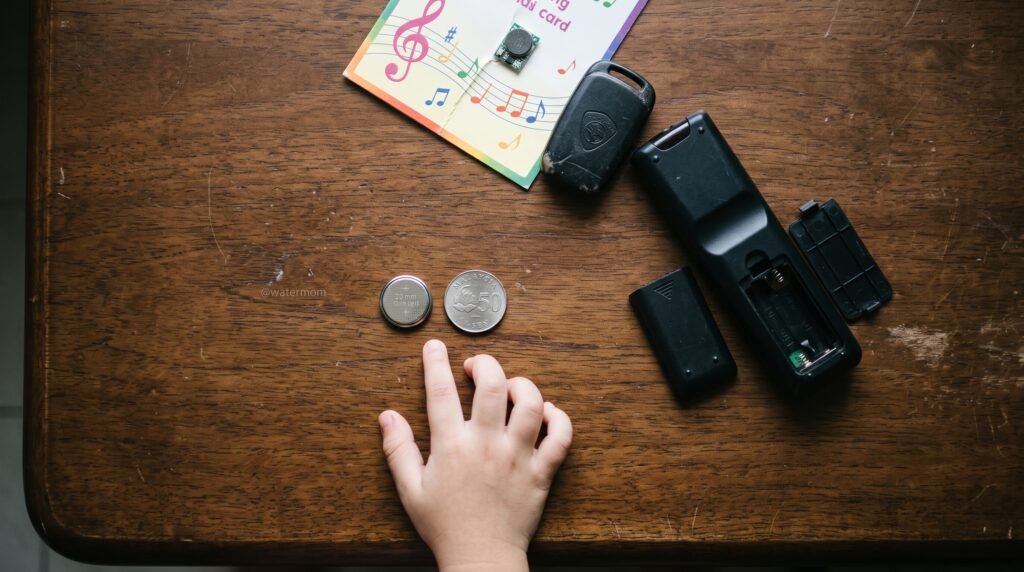
Common household items that hold button cells include TV and air-conditioner remote controls, car key fobs, kitchen and bathroom scales, light-up toys, musical greeting cards and hearing aids. If your child has been near one of these and a battery is missing, treat it as a battery until proven otherwise.
A note on honey. You may have seen advice to give honey after a battery is swallowed. The US National Capital Poison Center guideline recommends 10 mL (two teaspoons) of commercial honey every 10 minutes, up to six doses, for children aged 12 months and older, within 12 hours of a swallowed coin cell. It also says honey slows injury but does not replace immediate removal. That guidance covers swallowing. It does not address batteries in the nose or ear, so do not put honey or anything else into a child’s nose or ear. Go to hospital.
2. Magnets
Small, strong magnets are in many desk toys and building sets. If a child puts one magnet in each nostril, or one in the nose and another nearby, they can snap together through the thin partition between the nostrils (the nasal septum) and squeeze it. That pressure can kill tissue and leave a hole. A clinical reference lists magnets alongside batteries as objects needing emergency removal. Do not try to pull them apart or out yourself.
3. A live insect in the ear
This is rarely dangerous to the eardrum but is very distressing. The Perth Children’s Hospital guideline describes a live insect in the ear as an ENT emergency because the movement and noise can cause severe distress. Doctors typically kill the insect first, using oil or water in the canal and a light, then remove it. At home, keep your child calm and still and go to a clinic. Do not pour liquids into the ear if your child has ear discharge, grommets or a known hole in the eardrum, and when in doubt, let a doctor decide.
How to tell something is in the nose
Sometimes you see it happen. Often you do not. These signs should make you think of a foreign body, especially in a child aged one to five:
- Sudden sneezing, gagging or crying during play, followed by a blocked nostril.
- One-sided blockage that does not improve.
- One-sided discharge that is thick, blood-stained or foul-smelling. A forgotten object can sit for days or weeks and present only as this smell.
- Noisy breathing, coughing or wheeze, which can mean the object has slipped backwards towards the airway.
A young child with one bad-smelling nostril, especially after a cold that never quite clears, should be treated as having a foreign body until an ENT doctor has looked and proved otherwise.
What to do in the first ten minutes
- Stay calm and keep your child calm. Panic makes children cry and sniff in hard, which can pull an object deeper.
- Find out what it was. Count the beads, check which toy or remote is missing a battery, and look for a missing magnet. Take the matching item or packaging with you.
- Check breathing. If your child is coughing, choking, wheezing, drooling or turning blue, call 999 now.
- Decide the route. A battery, a magnet, a swallowed object or any breathing difficulty means the nearest emergency department. Anything else means an ENT doctor the same day.
- Hold off on food and drink. A few children need sedation or a general anaesthetic for removal, so ask the doctor before giving a meal.
What not to do
- Do not use tweezers, cotton buds, hairpins or toothpicks. They push objects deeper and scratch the canal or eardrum.
- Do not flush the ear or nose with water or drops, particularly if the object could be a seed or bean, which may swell when wet.
- Do not tell your child to sniff in hard. Gently breathing through the mouth is safer.
- Do not wait to see if it comes out when a battery or magnet is possible.
If a cooperative older child has a soft object in one nostril and you are certain it is not a battery or magnet, one or two gentle nose blows with the other nostril pressed closed is reasonable. If it does not come out, stop. Clinicians also use a technique called the parent’s kiss, where air is puffed gently into the mouth while the other nostril is blocked. A clinical reference reports it works in up to 60% of cases, but it needs a gentle puff, not a hard blow, so I would leave it to a doctor unless you have been shown how.
What happens at the ENT clinic

We examine the nose or ear with a headlight or a small camera so the object can be seen clearly and its shape, size and position judged before anything is touched. Removal uses fine instruments chosen for the object: a hook or loop for a round bead, forceps for soft material, gentle suction for a smooth object that seals well, or a small balloon catheter passed behind an object in the nose. For an insect, the first step is to stop it moving.
Most children cope with a short clinic procedure and a parent holding them close. If the object is deep, sharp, a battery that has started to injure tissue, or the child cannot stay still, removal under sedation or general anaesthesia is safer, and this was needed for a minority of children in the Sarawak series. Afterwards we check for scratches or burns, look at the other nostril or ear, and sometimes prescribe drops. Batteries need a careful follow-up check of the nasal septum or ear canal.
Where to go: a quick guide
| Situation | How urgent | What to do |
| Possible button battery or magnet in the nose or ear | Emergency now | Nearest emergency department. Do not give honey or put anything in the nose or ear. |
| Battery or magnet possibly swallowed | Emergency now | Nearest emergency department. Honey may be given only as advised by poison guidance and never replaces removal. |
| Choking, wheeze, drooling, blue lips | Call 999 | Keep your child upright and calm until help arrives. |
| Live insect in the ear | Urgent, same hour | ENT clinic or emergency department. No tweezers or cotton buds. |
| Bead, seed, toy part or paper in nose or ear, child comfortable | Same day | ENT clinic. Do not try to flush or dig. |
| One-sided foul nasal discharge for days, no known cause | Within 1 to 2 days | ENT review, since a forgotten object is likely. |
Make the home safer before the holidays begin
- Screw battery compartments shut on remotes, toys and key fobs, as paediatricians advise. Store spare and used batteries high up and out of sight.
- Keep hearing aid batteries where a toddler cannot reach them, including when a grandparent is visiting.
- Avoid magnetic desk toys and building sets around young children, and count the pieces whenever they are used.
- Keep craft beads, small toy parts and loose coins in a closed container and supervise craft kits, especially with mixed ages of cousins at the table.
- Keep nuts and seeds out of play. They were the leading objects in both the ear and nose in the Sarawak data.
- Teach a simple rule from age two: nothing goes in noses, ears or mouths except food and what the doctor gives.
- Do not clean small children’s ears with cotton buds. For why, see our post on cotton buds and ear cleaning.
If a child complains of ear pain after the school holidays begin, it is not always an object. Swimmer’s ear, a chronic ear infection or noisy breathing and snoring can look similar to a parent, and an ENT examination sorts these out quickly.
Worried about something in your child’s nose or ear?
If your child has had an object in the nose or ear and you want a specialist to check that nothing has been left behind, or you are not sure what is causing a blocked nostril or a smelly one-sided discharge, you are welcome to contact me directly for a consultation. You can see our paediatric ENT services and contact page for more details.
WhatsApp is for appointments and non-urgent questions. If you think your child has swallowed or inserted a battery or magnet, or is struggling to breathe, go to the nearest emergency department now.
Frequently asked questions
Can something stuck in my child’s nose come out on its own?
Sometimes it does, usually with a sneeze or a gentle blow. But you cannot predict which objects will, and a bead or seed can slip backwards towards the airway. A same-day ENT visit is safer than waiting. A battery or magnet is never something to wait on.
How long can an object stay in the nose before it causes harm?
It depends on the object. A button battery can injure tissue within hours. A seed or bean may swell and cause infection over days. A small plastic piece may sit for weeks and show up only as one-sided foul-smelling discharge.
Is it safe to put oil in my child’s ear to kill an insect?
Clinicians use oil or water to kill insects before removal, but I would rather you do not try it first at home, because oil is unsuitable if there is ear discharge, grommets or a hole in the eardrum, which you may not know about. Keep your child calm and come in.
Does my child need general anaesthesia to remove it?
Usually not. In the Sarawak General Hospital series, 76.1% of foreign bodies were removed in clinic. General anaesthesia is kept for deep, sharp or difficult objects and for children who cannot stay still safely.
What if my child swallowed a button battery?
Go to the nearest emergency department immediately and take the battery packaging or a matching battery. The Ministry of Health guidance treats a battery lodged in the oesophagus as urgent, with removal advised within two hours. If your child is 12 months or older and it was within 12 hours, poison-centre guidance describes giving honey on the way, but this never replaces removal.
This article is general education and does not replace an examination by a doctor. If you are worried about your child, seek medical care.
Production notes (not for publication)
Internal links used
- Cotton buds and ear cleaning
- Swimmer’s ear in children (school holidays)
- Chronic ear infections in children
- Child snoring vs noisy breathing
- Paediatrics specialist page
- Contact page
External sources used
- Medical Journal of Malaysia: Ear, Nose and Throat Foreign Bodies (Sarawak General Hospital, 2005 to 2009)
- Annual audit of ear foreign bodies, Hospital Universiti Sains Malaysia (2010)
- Ministry of Health Malaysia: Quick Reference, Foreign Body Ingestion in Children 2025
- The Star: Tiny but deadly, why parents must keep button batteries away from kids (21 May 2025)
- US National Capital Poison Center: Button battery ingestion guideline (international)
- Perth Children’s Hospital: Foreign body, ear (international)
- FPnotebook: Nasal foreign body (clinical reference, international)
- Ministry of Education 2026 school holiday calendar (as reported by SAYS)
- Ministry of Health Northeast Monsoon advisory, 9 November 2026 (as reported by Human Resources Online)
No responses yet