
A 42-year-old operations manager came to see me two weeks ago, still a little embarrassed about how she’d ended up in my clinic. She’d gone for her usual Friday evening massage in Bangsar, the kind she books after a rough week, deep pressure on the shoulders and neck to work out the knots from hours hunched over a laptop. Nothing unusual happened during the session. But when she sat up afterward, the room kept moving for a good ten seconds after she’d already stopped. She put it down to standing up too fast and went home. Over the next few days the spinning kept coming back, always when she rolled over in bed or tipped her head back to wash her hair, each episode lasting less than a minute but leaving her nauseated and rattled. By the time she called my clinic, she’d convinced herself the massage therapist had done something to her neck.
She hadn’t. What she had was a textbook case of benign paroxysmal positional vertigo, and the massage was the trigger, not the cause. That distinction matters, and I find myself explaining it more often these days.
Why I’m Being Asked About This More Often
Malaysians are spending more on massage, reflexology and chiropractic care than they used to, and it shows in my clinic. The government has been actively promoting traditional Malay massage as part of the country’s wellness tourism push, with standardised training now available for practitioners who used to learn purely by apprenticeship. Chiropractic is in a similar position. It became a formally regulated profession here under the Traditional and Complementary Medicine Act 2016, with practitioner registration phased in from 2017 onward. Regulation is one thing and public awareness is another, though: a 2023 survey of 440 adults across clinics in the Klang Valley found that only 4.8% had ever heard the law existed.
Then there’s TikTok. Neck-cracking videos, the satisfying kind and the cautionary kind, get millions of views, and a few of my own patients have told me they specifically asked their therapist or chiropractor for a firmer neck adjustment because they’d seen one online. Between the two trends, more Malaysians are getting more forceful neck work done, and a small number of them are going to feel dizzy afterward. Most of the time it’s nothing serious. Occasionally it isn’t, and that difference is worth understanding.
The Most Likely Explanation: Loose Crystals in Your Inner Ear
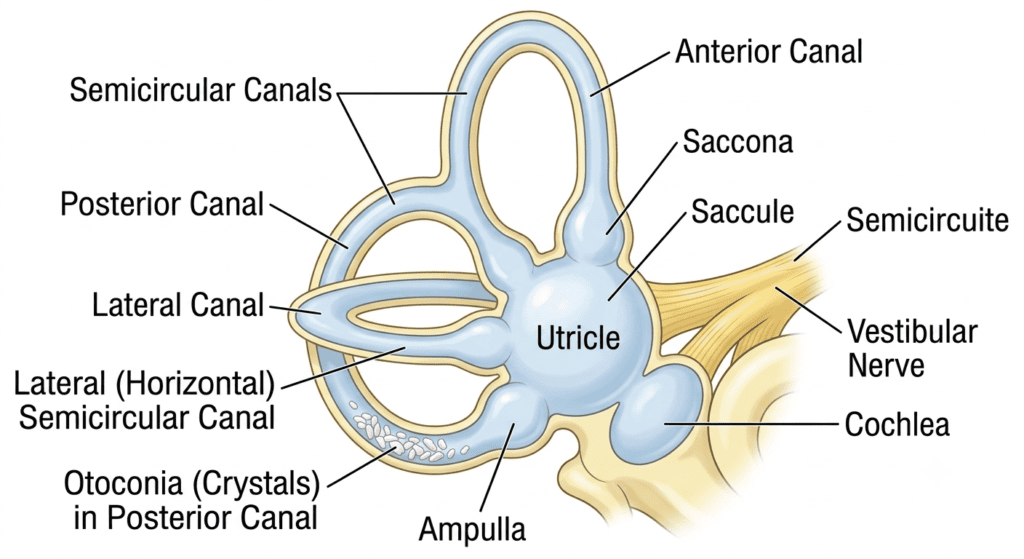
What my patient had, benign paroxysmal positional vertigo or BPPV, is by far the most common reason someone feels the room spin after a massage or neck adjustment. Deep inside your inner ear sits a structure called the utricle, which contains tiny crystals of calcium carbonate. Their normal job is to help you sense gravity and straight-line movement. Sometimes these crystals come loose and drift into one of the nearby semicircular canals, the fluid-filled loops that sense rotation. Once they’re in the wrong place, any sudden change in head position sets the fluid moving in a way it shouldn’t, and your brain reads that as spinning even though you’re standing still.
Firm pressure on the neck, a fast rotational adjustment, or lying back with your head tipped for a scalp massage can all be enough to dislodge crystals that were already sitting loosely, particularly in people over 40 or anyone who’s had a minor head knock in the past. It isn’t dangerous. It’s mechanical, and once you know what’s happening, it’s genuinely one of the more satisfying problems to fix in ENT, because the treatment works almost immediately in most cases.
I’ve written before about the broader list of ear problems that can cause vertigo, including inner ear infections and Meniere’s disease. This piece is narrower on purpose. It’s specifically about what happens when a massage or a chiropractic adjustment is the trigger, which I didn’t cover there.
Or the Problem Could Be Coming From Your Neck Itself

Not every case is BPPV. Some patients describe something less like spinning and more like a vague unsteadiness that starts or worsens specifically when they turn or extend their neck, then settles again once they hold still. This pattern points toward cervicogenic dizziness, where the problem originates in the neck’s joints and muscles rather than the inner ear.
Your neck is packed with proprioceptors, small sensors that tell your brain exactly where your head is in space. That information gets combined with signals from your inner ear and your eyes to keep you balanced. An aggressive adjustment, an old whiplash injury, or a masseuse working unusually hard on a stiff trapezius can irritate this system enough that it starts sending confused signals. Your brain ends up with conflicting reports about where your head actually is, and the result feels like dizziness.
Cervicogenic dizziness is frustrating to diagnose because there’s no scan or blood test that confirms it outright. Cleveland Clinic describes it as a diagnosis reached mostly by ruling out everything else first, which is exactly how I approach it in clinic too.
The Rare but Serious Possibility Worth Knowing About
There’s a third possibility, and it’s the one that makes me take every case of dizziness after neck treatment seriously rather than assuming BPPV by default. Very rarely, forceful rotation of the neck can injure the vertebral artery, one of the blood vessels running up through the bones of the neck to supply the back of the brain. A tear in the artery wall, called a dissection, can trigger a blood clot that leads to a stroke.
This is where the research gets more reassuring than it first sounds. A large 2015 case-control study covering close to 1,800 stroke cases in the United States found no significant association between chiropractic visits and this type of stroke once the numbers were properly analysed. What the researchers did find was a strong link between stroke and visits to a regular doctor beforehand, and their explanation was that people in the early, silent stages of an arterial dissection often develop headache and neck pain as their first symptoms. That’s exactly the kind of pain that sends someone looking for a doctor, a massage, or a chiropractic adjustment in the first place. When a stroke follows shortly after, it’s tempting to assume the treatment caused it, when the more likely explanation is that the injury was already underway and the pain from it was what brought the person in.
None of this makes forceful neck rotation entirely risk-free. Case reports of dissection after vigorous manipulation do exist elsewhere in the literature. I’m not telling you this to scare you off getting a massage. I’m telling you because the difference between ordinary BPPV and this rare complication comes down to a specific set of symptoms, and knowing them is what actually keeps you safe.
Symptoms That Mean This Isn’t Just Positional Vertigo
Get emergency care immediately, rather than booking a routine clinic visit, if dizziness after a massage or neck adjustment comes with a sudden, severe headache unlike any you’ve had before, double vision or trouble focusing your eyes, slurred speech, difficulty swallowing, numbness or weakness down one side of your body or face, or unsteadiness on your feet that seems out of proportion to how dizzy you feel. Vertigo that starts immediately after a forceful neck movement and keeps getting worse over the following hours, rather than settling, also belongs in this category.
None of these belong to ordinary BPPV or cervicogenic dizziness. If you notice any of them, the nearest emergency department, not my clinic, is where you need to be.
What Actually Happens When You Come to My Clinic
When a patient comes in with dizziness after a massage or adjustment, I start with questions about timing. Did the spinning happen during the treatment, right after standing up, or only the next morning? Does it last seconds or hours? Does turning over in bed or looking up trigger it?
If the pattern fits BPPV, I can usually confirm it on the spot with a positional test called the Dix-Hallpike maneuver, where I move your head and body through specific positions while watching your eyes for a particular pattern of involuntary movement called nystagmus. It looks dramatic, but it’s quick and not painful. Most patients are surprised by how simple the fix is: a repositioning maneuver, most often the Epley maneuver, guides the displaced crystals back to where they belong using a set sequence of head movements. Many people feel significantly better within minutes, and nearly all improve within a few days.
If the story doesn’t fit neatly, or if I pick up on any of the red flag symptoms above during the history or examination, the plan changes completely. That means urgent imaging and, depending on what it shows, a referral to a neurologist rather than a repositioning maneuver. This is really the point of seeing an ENT doctor rather than guessing at home. BPPV, cervicogenic dizziness and a vascular injury need three different responses, and getting the wrong one delays the right one. My head and neck clinic sees this combination of symptoms often enough that working out which of the three it is has become a fairly routine part of a Monday morning.
If You Still Want Your Regular Massage or Adjustment

None of this means you need to give up massage, reflexology or chiropractic care. For the vast majority of people, these are safe, ordinary parts of staying comfortable in a city that keeps everyone hunched over a screen or a steering wheel. A few adjustments make it safer.
Tell your therapist or chiropractor if you’ve had positional vertigo before, even once. Ask for slower, gentler movement around the neck rather than a fast rotational thrust, especially on a first visit with someone new. Sit up slowly at the end of any session that involved neck work, and give yourself a moment before standing. If you do feel dizzy afterward, resist the urge to immediately search for what went wrong online. Note when it started, what triggers it, and how long each episode lasts instead. That information is exactly what I need to work out which of the three explanations above applies to you.
If unusual vertigo triggers interest you beyond this one, I’ve also written about why vertigo can feel worse in an electric car than a petrol one, a completely different mechanism, but a good example of how much context matters when working out what’s actually going on.
Got Dizzy After a Massage or Adjustment and It’s Not Settling?
If you’re also experiencing a severe new headache, double vision, slurred speech, weakness on one side, or trouble swallowing, go to your nearest emergency department now rather than reading further. For everyday positional vertigo that’s sticking around, or if you just want to know which of the explanations above fits your case, message Dr. Julius Goh directly on WhatsApp to arrange a review.
Frequently Asked Questions
Is it normal to feel dizzy after a massage? A brief, momentary lightheaded feeling when you sit up quickly after lying down is common and usually just a drop in blood pressure. True spinning vertigo that lasts seconds to minutes, especially if it keeps recurring over the following days, is different and worth getting checked.
Can a chiropractic neck adjustment actually cause vertigo? Yes, though rarely in a dangerous way. The most common reason is that a fast neck movement dislodges crystals in the inner ear, a condition called BPPV, which is easily treated. Far more rarely, forceful rotation can injure a blood vessel in the neck, which is why persistent or worsening symptoms need urgent assessment rather than assumption.
How long does vertigo from BPPV usually last? Individual episodes typically last under a minute, triggered by a specific head movement like rolling over in bed. Left untreated, the condition itself can linger for days or weeks, though a same-visit repositioning maneuver usually resolves it much faster.
Should I stop getting massages if this has happened to me before? Not necessarily. Most people who’ve had one episode of BPPV can safely continue getting massages. It helps to mention your history to your therapist beforehand and ask them to go gently around your neck.
What’s the difference between vertigo and general dizziness? Vertigo is a specific sensation that you or your surroundings are spinning or moving. Dizziness is a broader term that covers lightheadedness, faintness or general unsteadiness without any spinning at all. The distinction matters because it helps point toward the underlying cause.
When should I go to the emergency department instead of booking a clinic appointment? If dizziness comes with a severe new headache, double vision, slurred speech, facial or limb weakness, difficulty swallowing, or trouble walking, go to the nearest emergency department right away rather than waiting for a clinic appointment.
Sources referenced
- StatPearls (NCBI Bookshelf) — Benign Paroxysmal Positional Vertigo
- Cleveland Clinic — Cervical Vertigo (Cervicogenic Dizziness)
- Chiropractic & Manual Therapies — Kosloff et al., Chiropractic Care and the Risk of Vertebrobasilar Stroke (2015)
- PMC — The Potential Dangers of Neck Manipulation & Risk for Dissection and Devastating Stroke
- Pharmacy Times — Neck-Cracking: Can It Increase Your Risk of Having a Stroke?
- Journal of Chiropractic Humanities — Wong, Haneline & Tan, Public Awareness of the Traditional and Complementary Medicine Act Governing Chiropractic in Malaysia (2023)
- Official Portal of the Traditional and Complementary Medicine Division, Ministry of Health Malaysia
Discover more from The ENT Doctor
Subscribe to get the latest posts sent to your email.
No responses yet