
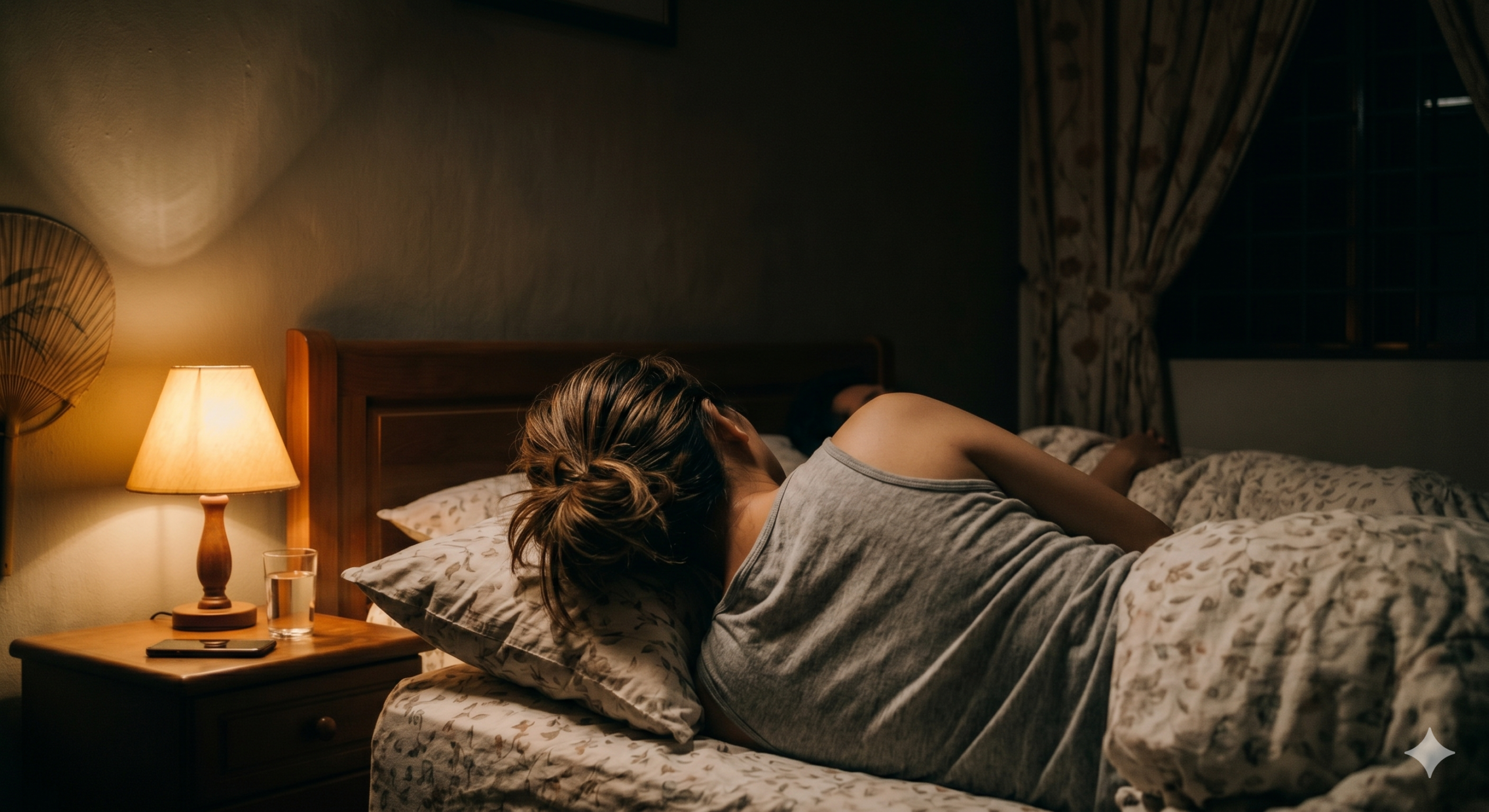
She didn’t book an appointment for herself.
She booked it for her husband — but she was the one who walked in looking exhausted. He sat beside her, slightly defensive, the way men do when they’ve been dragged somewhere by someone who loves them enough to drag them.
“I can’t sleep next to him anymore,” she said. “I’ve moved to the other room. We barely see each other. I don’t know what to do.”
He shrugged. “It’s just snoring lah.”
It is never just snoring.
The thing about snoring that most people get wrong
Snoring is loud. That part, everyone agrees on. What gets missed is what it means.
When someone snores, their airway is narrowing during sleep. The sound you hear — that low rumble, or that strangled gasp, or that freight-train roar that woke you at 2am — is air forcing its way through a passage that shouldn’t be that narrow. Sometimes the airway narrows. Sometimes it collapses completely.
When it collapses, breathing stops. For ten seconds. For thirty. Sometimes longer.
The brain panics, jolts the body awake just enough to restore muscle tone, and the person gasps or snorts — then falls back to sleep without ever knowing it happened. This can occur five times a night. It can occur fifty. In severe cases, hundreds.
This is obstructive sleep apnoea (OSA), and in Malaysia, we estimate that 4 in 5 people who have it don’t know they have it.
Not because the symptoms are subtle. Because the person experiencing them is asleep.
What it’s doing to him (even though he feels “fine”)
Here’s what I tell patients who insist they sleep fine and feel fine.
You are not sleeping. You are losing consciousness, repeatedly, for hours, and being jolted back to a lighter state every time your brain registers danger. What you call “sleeping” is a long series of micro-awakenings that your conscious mind never records.
The body keeps score, though.
Every episode of apnoea triggers a surge of adrenaline. Blood pressure spikes. Heart rate climbs. The cardiovascular system treats each stop-and-start like a mini-emergency. Do this a hundred times a night, every night, for years — and you are not just tired. You are running your heart ragged in the dark.
Untreated OSA is associated with:
- High blood pressure (in up to 50% of OSA patients)
- A 2–3 times higher risk of heart attack
- Significantly elevated stroke risk
- Type 2 diabetes
- Depression
- Cognitive decline — the kind that creeps up slowly and looks, at first, like stress
So when your husband says “it’s just snoring,” what he means is: I don’t feel the consequences right now. And he’s right — he often won’t feel them until much later, when much later means a cardiologist’s office, or a hospital ward, or worse.
What it’s doing to you
Sleep deprivation from a partner’s snoring is not a minor inconvenience. It is a genuine health problem for the person lying awake.
Chronic poor sleep affects mood, immunity, weight regulation, cognitive function, and emotional resilience. It shortens your fuse. It makes everything harder. And the particular cruelty of partner-snoring is that you can’t do anything about it — you’re just lying there, listening, getting angrier, watching the minutes tick past.
A study in the journal SLEEP found that women whose partners have untreated OSA scored significantly higher on measures of daytime sleepiness — even though they were the healthy sleepers. Their sleep was being disrupted, night after night, without anyone formally diagnosing them with anything.
Nobody gets a clinic referral for “my husband snores.” But maybe they should.
Sleep divorce: when the spare room becomes the solution
In Malaysia, there is still some reluctance around the idea of couples sleeping apart. In a culture where marital harmony is often quietly measured by proximity — multigenerational homes, shared rooms, the assumption that husband and wife always share a bed — sleeping separately can feel like an admission of something.
It isn’t.
Sleep divorce, as it’s been called, is simply the practical decision that two people sleeping in the same space are doing each other more harm than good. Among couples dealing with one partner’s snoring, more than half who try sleeping separately report better sleep quality. Many report better relationships, because they’re finally rested enough to be kind to each other.
But I want to be honest about the limits of this solution.
Sleeping apart treats the symptom — your broken nights — while leaving the disease entirely untreated. The snorer continues stopping breathing in the spare room, alone, where no one hears it, where no one notices the gasping, where a cardiac event in the night might not be discovered until morning.
The spare room is not a fix. It is a pause.
“He refuses to go to the doctor.” Sound familiar?

I hear this constantly. More often than almost any other complaint in my clinic.
There is a particular dynamic that plays out in households with a snoring husband. The wife cannot sleep. She raises it. He minimises it. She raises it again. He says he’s fine. She moves to the other room. He thinks the problem is solved. She lies awake in the other room wondering if he just stopped breathing.
Part of this is cultural. Malaysian men — and this is not unique to Malaysia — often equate seeking help with admitting weakness. Snoring, in particular, gets filed under “harmless quirk” rather than “medical condition.” There is no pain. No visible symptoms. Just a sound he doesn’t even hear.
What sometimes works, in my experience: reframe it.
Not: “You snore and it keeps me awake.”
But: “I’m worried about you. I’ve been reading about what snoring can mean. I want to know you’re okay.”
The second version is not manipulation. It is accurate. And it often lands differently.
What actually happens at a sleep assessment
If your husband does agree to come in — or if you finally get him here, as that wife did — here’s what to expect.
The first appointment is a conversation and a clinical examination. I want to understand the snoring pattern, whether there are witnessed apnoeas (gasping, stopping), how he feels on waking, whether he’s tired during the day, whether he falls asleep easily in passive situations. I look at his nose, throat, palate, and tongue base.
From there, most patients will be referred for a sleep study. This can be done at home with a portable device that records your breathing, oxygen levels, and heart rate overnight. You sleep in your own bed. No wires attached to your face. Results usually come back within a week.
If the sleep study confirms OSA, we discuss treatment options — and there are more of them than most people realise.
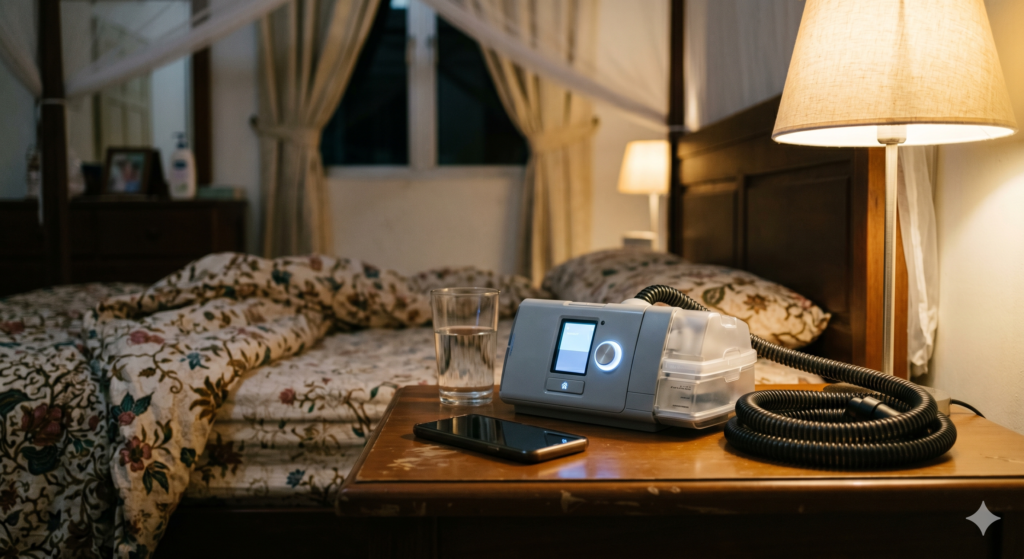
CPAP (Continuous Positive Airway Pressure) is the most well-known. A mask worn during sleep delivers pressurised air that holds the airway open. It works very well for most people. It is not, as commonly feared, a death sentence of noise and discomfort — modern machines are quiet and the masks have improved enormously.
Oral appliances — custom-made mouthguards that reposition the jaw — work well for mild to moderate OSA and for patients who cannot tolerate CPAP.
Surgery is an option for patients where the anatomy of the airway is contributing to obstruction. This might involve the nose (a deviated septum, nasal polyps), the palate, the tonsils, or the tongue base. Surgery is not a first-line treatment for everyone, but for the right patient it can be transformative — and as a sleep surgeon, assessing who is that right patient is something I spend considerable time on.
The important point: snoring and OSA are treatable. Not managed, not coped with. Treated.
When treatment changes everything
I want to come back to that couple I mentioned at the start.
They did come back. He had severe OSA — over 40 apnoea events per hour. He started CPAP. Within three weeks, his wife told me she had moved back into their bedroom.
“He’s a different person,” she said. “He has energy. He’s less irritable. He actually wakes up and makes breakfast now.”
He looked mildly embarrassed but mostly relieved.
What I see, in cases like this, is not just a treated medical condition. It is a marriage that was quietly fraying — from exhaustion, from resentment, from two people lying awake (or not lying awake) in different ways — and was given back some of what it had been losing.
That is not a small thing.
The bottom line
If your husband’s snoring is keeping you up at night, it is not a personality flaw or a bad habit or something you should simply accept. It is a symptom. It may be a symptom of a serious, treatable medical condition.
The conversation is worth having. The appointment is worth making.
And if he won’t come on his own — well, some of my most grateful patients are the ones who were dragged here by someone who loved them enough to drag them.
Dr. Julius Goh Liang Chye is a Consultant Otorhinolaryngologist, Head & Neck and Sleep Surgeon at Universiti Malaya Specialist Center (UMSC). He has a special interest in obstructive sleep apnoea and sleep surgery.
To book a consultation, visit theentdr.com or contact UMSC.
Discover more from The ENT Doctor
Subscribe to get the latest posts sent to your email.
Comments are closed