

A few weeks ago, a mother sat across from me in my clinic holding her phone, open to a video that had been circulating in her family WhatsApp group. Her son, now three, was born profoundly deaf. He has worn a cochlear implant since he was fourteen months old, and he is doing wonderfully — chatty, cheeky, and thoroughly uninterested in sitting still during consultations. The video she showed me described American scientists using a “one-time injection” to restore hearing in deaf children. “Doctor,” she asked, “could this have helped him instead of the implant? Could it still help him now?”
I expect to be asked this a lot more over the coming months, so I want to walk through what actually happened, what it means medically, and — just as importantly — what it does and doesn’t mean for families here in Malaysia right now.
What Actually Happened
On 23 April 2026, the United States Food and Drug Administration (FDA) approved Otarmeni (chemical name: lunsotogene parvec-cwha), the first gene therapy ever approved anywhere for a form of genetic deafness. It was developed by Regeneron Pharmaceuticals, and it moved through the FDA in just 61 days after the company filed its application — one of the fastest reviews in the agency’s modern history, granted through a newer accelerated pathway called the Commissioner’s National Priority Voucher programme. FDA Commissioner Dr Marty Makary called it “a significant milestone in the treatment of genetic hearing loss.”
That speed matters because of what came before it: nothing. Prior to this approval, there was no treatment anywhere that addressed the underlying cause of this specific type of deafness — only ways to work around it, such as hearing aids or cochlear implants.
Not All Genetic Deafness — a Specific Gene, a Specific Group
This is the part that tends to get lost when this kind of news travels through WhatsApp and TikTok: Otarmeni is not a cure for deafness in general, or even for genetic deafness in general. It is designed for one specific cause.
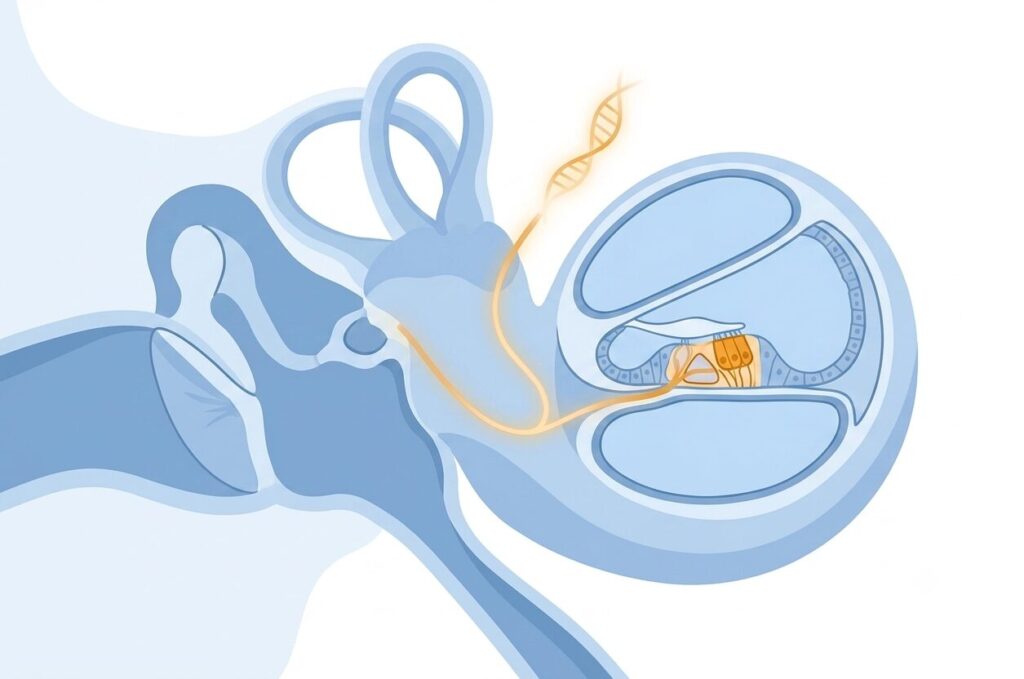
Genetic mutations are responsible for roughly half of all congenital hearing loss worldwide. Within that group, mutations in a single gene called OTOF account for an estimated 2% to 8% of inherited, non-syndromic cases (meaning hearing loss that isn’t part of a broader genetic syndrome). The OTOF gene carries the instructions for a protein called otoferlin, which the inner ear’s hair cells rely on to pass sound signals along to the hearing nerve. Children who inherit two non-working copies of this gene — one from each parent — cannot produce otoferlin, so the signal never gets through, even though the structures of the inner ear are otherwise intact.
That last detail is exactly why OTOF-related deafness became the first target for this kind of therapy. The “hardware” — the delicate hair cells of the cochlea — is usually still there and undamaged. What’s missing is a single piece of genetic “software.” In principle, replace the faulty instructions, and the existing hardware can start working again. That is a very different proposition from most other causes of hearing loss, where the hair cells themselves have been damaged or lost — by noise, ageing, infection, or physical trauma — and simply cannot be repaired by adding back one gene.
Otarmeni is a one-time treatment. It is administered as a single dose per ear, delivered surgically into the cochlea through a fine catheter connected to an infusion pump, under the same kind of controlled surgical conditions used for cochlear implant surgery. It delivers a working copy of the OTOF gene directly to the inner hair cells, aiming to restore otoferlin production — and with it, the ear’s ability to send sound signals to the brain using its own biology, rather than an electronic substitute.
What the Clinical Trial Actually Showed
I think it’s worth being precise here, because headlines about “cured deafness” invite more optimism than the data currently supports.
The FDA’s approval was based on a single ongoing clinical trial of 24 children between 10 months and 16 years old, all with severe-to-profound OTOF-related hearing loss. Of the 20 patients who could be fully evaluated for effectiveness, 80% experienced measurably improved hearing — a result that would not be expected from the natural course of this condition without treatment. Reported side effects included middle ear infection, nausea, dizziness, and pain related to the procedure itself, all broadly in line with what we would expect from inner ear surgery.
Two eligibility details matter enormously for how this applies in the real world. First, children need preserved outer hair cell function — the “hardware” I mentioned above genuinely has to still be intact. Second, and this is the one I suspect will surprise a lot of parents, Otarmeni is not recommended for an ear that has already received a cochlear implant. In other words, the child in my clinic with an implant fitted at fourteen months would not currently be a candidate for this therapy in that ear. This is not a reason for regret — his implant has given him spoken language, school-readiness, and a normal childhood, all real and immediate benefits that a still-experimental therapy could not have offered him two years ago. But it is a genuinely important, practical consideration for any family facing this decision today, which I’ll come back to below.
It’s also worth noting this is an accelerated approval, not the FDA’s final word. Continued approval depends on further data confirming that the hearing improvements are durable over time, and that they translate into real gains in speech development and quality of life — the things that actually matter to a growing child.
Where This Fits Into How Malaysia Already Handles Congenital Deafness
Here’s what I want Malaysian parents to understand: the infrastructure to catch OTOF-related deafness early already exists here, and has for some time.
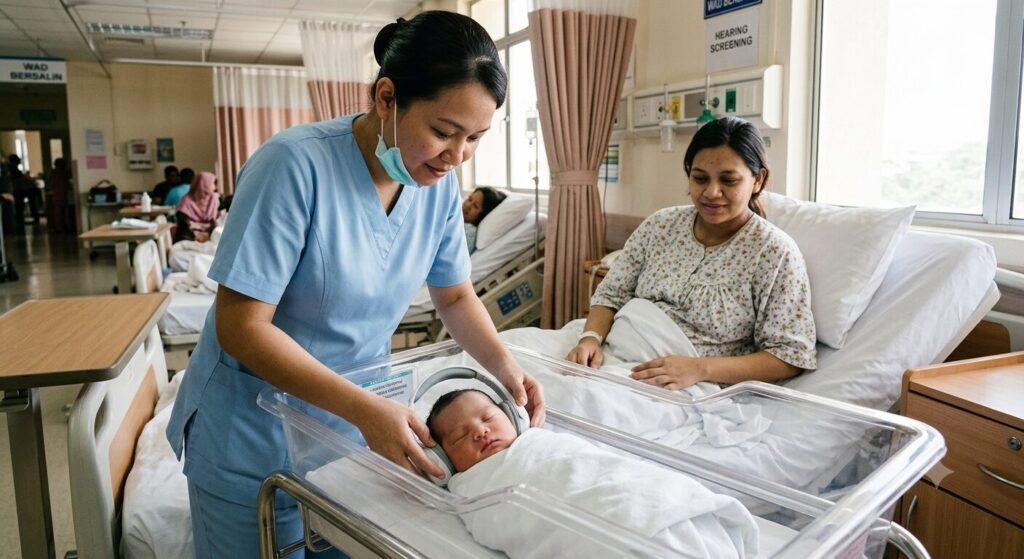
Universal Newborn Hearing Screening (UNHS) has been running in Malaysian public hospitals for more than a decade, screening infants before they leave hospital using automated tests that pick up almost all forms of congenital hearing loss, genetic or otherwise. Coverage across the public system has consistently run at or above 95% in most recent years, across roughly 300,000 live births annually. In 2023 alone, close to 69,000 newborns were screened through this programme nationally, with 987 newborns confirmed with hearing issues and referred on for further management, according to the Ministry of Health. If a baby in Malaysia is born with OTOF-related deafness, the system is already well placed to pick this up in the first weeks of life — the screening step is not the gap.
What happens after diagnosis, in Malaysia today, is early referral for hearing aids where useful, and — for children with severe-to-profound loss — subsidised cochlear implantation, prioritised for children under four years old, through the Ministry of Health’s Cochlear Implant Service Operational Policy and the Medical Assistance Fund. Between 2019 and 2023, the Ministry funded 272 cochlear implants at a cost of roughly RM21 million. It’s a real, working pathway, and I’ve watched it change children’s lives directly in my own practice. It is also not without its burdens — Malaysian research following implant recipients has found that ongoing costs to families, for processor upgrades, batteries, and rehabilitation, roughly triple by four years after surgery and double again by eight years, and the majority of parents describe this long-term cost as a genuine strain.
This is exactly why the eligibility detail above matters so much here. Malaysia’s current default pathway for a baby diagnosed young with severe genetic hearing loss is to move toward cochlear implantation relatively early, which is absolutely the right call today, given that gene therapy access does not yet exist here and a child’s early years for language development cannot be paused while we wait. But it does mean that as gene therapy pathways mature globally over the next several years, the sequencing of decisions — genetic testing, then implant timing, then which ear is chosen if only one side is implanted — may start to carry more long-term weight than it used to. This is a conversation worth having explicitly with your child’s ENT team, not assumed.
Is This Available in Malaysia? Being Honest About Where Things Stand
Not yet, and I don’t want to overstate how close that might be. Otarmeni’s approval is a US FDA decision. It has no bearing on availability in Malaysia, where any new biologic therapy would need its own evaluation and registration through Malaysia’s National Pharmaceutical Regulatory Agency (NPRA) before it could be prescribed here — a process that, for a novel one-time surgical gene therapy of this complexity, typically takes years, not months. I have not seen any announcement of a Malaysian or regional access pathway, clinical trial site, or distribution plan for Otarmeni at this time, and I would be cautious of anyone claiming otherwise. Regeneron has stated it will provide the therapy free of charge in the US market specifically; nothing has been said publicly about other markets.
What I would say to Malaysian families is this: this news is a genuine and important signal of where the field is heading, and a reasonable basis for hope for a currently very narrow group of children. It is not, today, an alternative to the care pathway that already exists here.
What This Actually Means for Malaysian Families Today
If you have a child with confirmed or suspected congenital hearing loss, here is what I’d suggest, practically:
- Ask about genetic testing. If your child’s hearing loss hasn’t been genetically characterised, ask your ENT or clinical geneticist whether testing for causes like OTOF is appropriate. Even without a therapy available locally yet, knowing the cause matters for prognosis, for family planning, and for staying informed as treatment options expand.
- Don’t delay proven care while waiting for future options. Hearing aids and cochlear implants remain the standard of care for a reason — the early years of a child’s life are the most critical window for language development, and that window does not wait for regulatory approvals elsewhere in the world.
- Ask your ENT team about sequencing, if your child is a borderline or bilateral candidate. This is a nuanced, individual conversation, not a blanket recommendation — but it is now a reasonable one to have.
I’ve written before about how AI-powered hearing aids are being marketed and about what to do if you’re struggling with hearing loss — both worth a read if hearing loss, at any age, is something your family is navigating. For parents specifically, our paediatric ENT service is where these conversations usually start.

Have Questions About Your Child’s Hearing?
If your child has recently been diagnosed with hearing loss, or you’re unsure what your newborn screening results mean, I’d rather you ask directly than guess from a video online. You can reach my clinic directly on WhatsApp to arrange a consultation, and we can talk through what’s actually relevant to your child’s specific situation.
Frequently Asked Questions
Is Otarmeni (this gene therapy) available in Malaysia?
No. It is currently approved only in the United States. It would need separate evaluation and approval by Malaysia’s National Pharmaceutical Regulatory Agency before it could be offered here, and no timeline for that has been announced.
How do I know if my child’s hearing loss is caused by the OTOF gene?
This can only be confirmed through genetic testing, typically arranged through an ENT specialist or clinical geneticist after a diagnosis of sensorineural hearing loss. It is not something that can be determined from screening results alone.
Does this replace the need for a cochlear implant?
Not currently, and not for most children. This therapy is approved for a narrow group of patients with a specific confirmed genetic cause and preserved inner ear structures who have not already received a cochlear implant in that ear. Cochlear implants remain the established, available standard of care in Malaysia today.
My child already has a cochlear implant. Does this news apply to them?
Current eligibility criteria exclude ears that have already received a cochlear implant, so this specific therapy would not apply to that ear. This may change as the field develops, but there’s no indication of that yet.
Should I ask for genetic testing even if gene therapy isn’t available here?
Yes, it’s worth discussing with your ENT. Identifying the genetic cause of hearing loss can inform prognosis and family planning, and keeps your child’s records ready should access to newer treatments expand in future.
Sources & Links Used
FDA press release (primary source): fda.gov — FDA Approves First-Ever Gene Therapy for Genetic Hearing Loss
Ministry of Health Malaysia — Cochlear Implant Service Operational Policy: moh.gov.my
Free Malaysia Today — RM21mil spent on cochlear implants in last 5 years: freemalaysiatoday.com
Malay Mail — More than 900 infants diagnosed with hearing problems nationwide in 2023: malaymail.com
Comments are closed