

A patient came to see me a few weeks ago holding a small nasal spray bottle, almost empty, looking faintly embarrassed about it. She had been using it three, sometimes four times a day for the past eight months. It started during a bad haze episode, when her nose was so blocked she couldn’t sleep, and a friend recommended the spray from a pharmacy near her office in Petaling Jaya. It worked almost instantly. The trouble was that every time the effect wore off, her nose felt more blocked than before, not less. So she sprayed again. And then again. By the time she sat across from me, she wasn’t using the bottle to breathe more easily. She was using it just to breathe at all.

She isn’t an unusual case anymore. Over the past year, a steady stream of videos on TikTok and Instagram has shown people, mostly in their twenties and thirties, admitting – half-joking, half-serious – that they cannot leave the house without a nasal spray or a menthol nasal inhaler stick tucked in their bag. Unlike a lot of viral health claims that land on my clinic desk, this particular trend has real, well-documented medicine behind it. It has a name: rhinitis medicamentosa, more plainly known as rebound congestion.
What’s Actually Happening Inside Your Nose
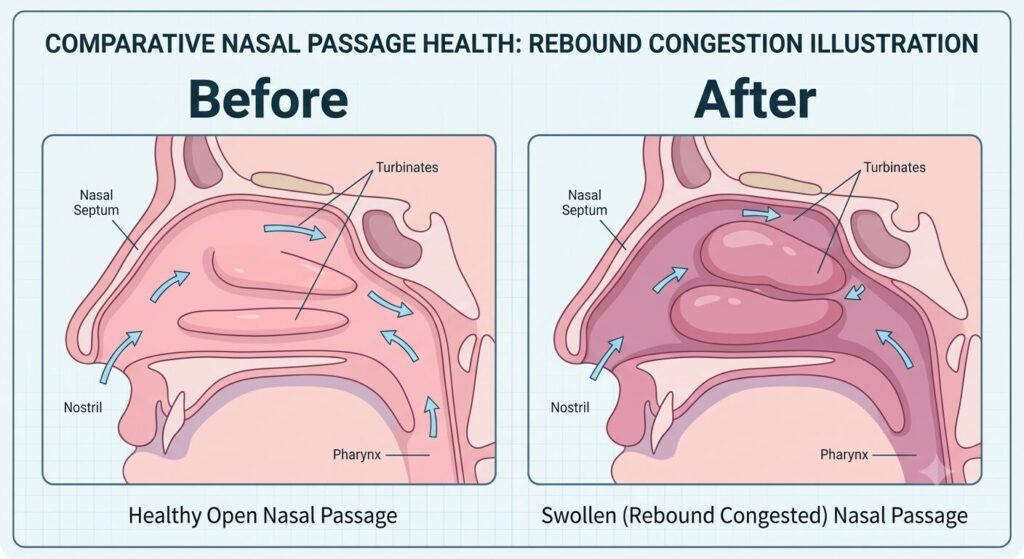
Most over-the-counter nasal decongestant sprays sold in Malaysia contain a vasoconstrictor such as oxymetazoline or xylometazoline – the active ingredients behind common brand names like Iliadin and Otrivin, both widely stocked in pharmacies across the Klang Valley and beyond. These ingredients work by narrowing the blood vessels lining your nasal passages. Less blood flow means less swelling, and within minutes, a blocked nose opens up. It is genuinely one of the most effective quick fixes available without a prescription.
The catch is what happens next. Malaysia’s own Ministry of Health addresses this directly on its MyHealth patient portal, warning that decongestant nasal drops should not be used continuously beyond the period stated on the packet, because prolonged use both reduces the medicine’s effectiveness and causes rebound nasal blockage once you stop. Clinically, this is called tachyphylaxis: the blood vessels become less responsive to the drug, so the same dose achieves less each time. Some patients respond by using the spray more often, or in larger amounts, chasing the same relief they felt on day one. Within days to a couple of weeks of daily use, many people are caught in a loop where the nose barely functions without the bottle, and swells dramatically for hours whenever a dose is missed.
This isn’t the same mechanism as an opioid or nicotine addiction – there is no direct chemical hook into the brain’s reward pathways. But researchers who have studied this condition have documented genuine behavioural features of dependence in long-term users: compulsive use, anxiety at the thought of running out, and continued use despite knowing it is causing harm. This is medically known as rhinitis medicamentosa. Functionally, for the patient sitting across from me clutching an empty bottle, it feels exactly like an addiction, because in every practical sense, it is one.
Why Malaysians Reach for This Bottle More Than Most

This is not simply an imported TikTok trend that happens to have reached Malaysian phones. Malaysia’s climate and health landscape make rebound congestion a genuinely local problem, not an occasional import from somewhere else.
Consider what a nose in Kuala Lumpur or Petaling Jaya has to cope with in an ordinary year. Malaysia sits in near-permanent heat and humidity, punctuated by haze episodes when the Air Pollutant Index climbs into unhealthy territory in parts of the Klang Valley – a reading of 152 was recorded in Johan Setia, Selangor, as recently as this week. Add to that the near-universal use of air conditioning indoors, which dries and irritates the nasal lining the moment you step from humid outdoor air into a cold office or shopping mall, and you have a population whose noses are triggered constantly.
Malaysian clinics have reported rising rates of allergic rhinitis in recent years, driven by a combination of haze particulates, house dust mites thriving in our humidity, and vehicle emissions in built-up urban areas. The Malaysian Society of Allergy and Immunology’s own consensus guidelines on treating the condition reflect just how common it has become in everyday practice.
At any given time, an estimated three million Malaysians are living with sinusitis, with roughly eighteen million individual episodes occurring nationwide every year. For a population dealing with this much nasal misery, a spray that clears a blocked nose in under a minute is almost irresistible – and used correctly, for a few days at a time, it is genuinely useful, exactly as intended. The problem is that ‘a few days’ quietly turns into ‘every day for eight months’ for a meaningful number of my patients, especially when the underlying trigger – haze, allergy, untreated sinusitis – is never actually addressed. Malaysia’s drug safety regulator has even issued a specific alert about xylometazoline’s cardiac risk in patients with certain heart rhythm conditions, a reminder that these are genuine medicines, not harmless household items.
There is also a structural reason this happens so easily here. Products like Iliadin and Otrivin are readily available over the counter, or with a quick word to the pharmacist, at community pharmacies throughout Malaysia, without the friction of a doctor’s visit. That accessibility is a genuine public health convenience – but it also means many Malaysians self-medicate for months without ever being told the five-to-seven-day limit that the packet insert, and the Ministry of Health’s own guidance, actually recommends.
The Myths I Hear in Clinic
“It’s just a spray, how can it be addictive?” Not every nasal spray carries this risk. Plain saline sprays and rinses do not cause rebound congestion, because they contain no vasoconstrictor at all – they simply rinse the nasal lining. It is specifically the medicated decongestant sprays, and to a lesser extent some menthol or camphor inhaler sticks used compulsively, that create this cycle. Knowing which bottle in your drawer is which matters more than most people realise.
“I only use it at night, so it doesn’t count.” Frequency matters less than most people assume. Even once-nightly use, sustained for more than about a week, is often enough to establish rebound congestion. It is the duration of use, not simply how many times a day you spray, that drives the problem.
“I’ll just stop cold turkey and push through it.” This is possible, but very few patients manage it without support, because the rebound swelling in the first few days after stopping can be severe enough to disrupt sleep and work. I typically recommend weaning off one nostril at a time, often with a short course of a steroid nasal spray or antihistamine to bridge the gap, rather than stopping abruptly with nothing else in place.
“If I switch to a natural nasal inhaler stick, I’m safe.” Menthol and camphor inhaler sticks don’t cause the same vascular rebound effect as oxymetazoline or xylometazoline sprays, so in that narrow sense they carry less physical risk. But I have seen patients develop a different kind of dependency on the sensation itself, reaching for the stick dozens of times a day, while an underlying sinus or allergy problem goes undiagnosed underneath the menthol relief. It joins a long list of home fixes for a blocked nose that I have had to myth-bust before.
Breaking the Cycle Safely
If you recognise yourself in this article – using a decongestant spray daily for more than one to two weeks, or feeling anxious at the thought of leaving home without it – the first step is not to panic, and not necessarily to quit overnight without a plan.
In clinic, I usually take three steps. First, confirm what is actually driving the congestion in the first place: allergic rhinitis, chronic sinusitis, a deviated septum, or something else, because treating the rebound without treating the underlying cause simply sets up a repeat cycle later. Second, start a steroid nasal spray, which works on inflammation rather than blood vessels and does not cause rebound congestion, to control symptoms while weaning off the decongestant. Third, use a plain saline rinse as a supportive, non-medicated way to keep the nose comfortable during the transition, though it is worth understanding which water is actually safe to use for nasal rinsing at home before you start, since not all tap water in Malaysia is appropriate to use directly.
If your congestion has lasted more than a few weeks despite trying these steps, or comes with facial pain, one-sided blockage, nosebleeds, or a reduced sense of smell, it is worth having an ENT specialist examine your nose properly rather than continuing to self-treat with an over-the-counter bottle.
A Global Reckoning With Decongestants
Malaysia is not alone in re-examining these medicines. In the United States, the FDA has proposed removing oral phenylephrine – a different, swallowed form of decongestant found in some cough-and-cold tablets, not the nasal sprays discussed in this article – from its list of approved over-the-counter ingredients, after an advisory panel concluded it works no better than a placebo when taken by mouth. This is an American regulatory process, not a Malaysian one, and it concerns tablets rather than nasal sprays, but it reflects a broader global reassessment of how casually decongestants get reached for without much thought to their limits. The lesson for Malaysian readers is the same one already sitting inside the Ministry of Health’s own nasal drop instructions: these medicines are excellent for a few days, and genuinely risky as a long-term habit.
Struggling to Put the Bottle Down?

If you have been relying on a nasal spray for weeks or months and cannot imagine your day without it, you do not need to just push through it, or quit alone. This pattern is very treatable once the underlying cause is properly diagnosed, and Dr. Julius Goh and the team see it regularly in clinic.
Message us directly on WhatsApp to arrange a consultation with Dr. Julius Goh.
You can also reach us through our contact page or learn more about our nose specialist services in Petaling Jaya and Kuala Lumpur.
Frequently Asked Questions
Is it safe to use Otrivin or Iliadin every day?
No. Malaysia’s Ministry of Health specifically advises against continuous use of decongestant nasal drops beyond the period directed on the packet, generally no more than five to seven days, because longer use causes rebound congestion when you stop.
What is rhinitis medicamentosa?
It is the medical term for nasal congestion caused by overusing decongestant nasal sprays, where the nasal lining becomes dependent on the medication to stay open and swells up whenever the drug is not used.
Can children use decongestant nasal sprays?
Only under medical guidance and generally for the shortest possible course. Children are more sensitive to systemic side effects, and parents should check with a pharmacist or doctor before giving any decongestant spray to a child.
Is saline nasal spray or rinse a safer alternative?
Yes. Plain saline contains no vasoconstrictor and does not cause rebound congestion, making it a safe long-term option, though it’s worth using appropriately treated water rather than untreated tap water for home rinsing.
How long does it take to recover from rebound congestion?
With proper weaning, often using a steroid nasal spray as a bridge, most patients see meaningful improvement within two to four weeks, though the first several days after stopping the decongestant can feel uncomfortable.
When should I see an ENT specialist instead of self-treating?
If your congestion persists beyond two to three weeks, you’ve been using decongestant spray daily for longer than that, or you have facial pain, one-sided blockage, nosebleeds, or loss of smell.
Discover more from The ENT Doctor
Subscribe to get the latest posts sent to your email.
Comments are closed