A patient walked into my clinic a few weeks ago holding up his phone before he had even sat down. He had seen a video about robotic surgery on Instagram the night before and wanted to know if it was safe, and whether it would cost him extra. He was not there about a tumour. He was there about his snoring. And he was genuinely surprised when I told him that robotic surgery in Malaysia is, statistically, more likely to be used on someone exactly like him than on a cancer patient.
That surprises most people. When Malaysians hear “robotic surgery,” the image that usually comes to mind is dramatic: a machine cutting out a tumour as a last resort. In reality, the small but growing body of Malaysian experience with robotic throat and neck surgery tells a different story — one that has more to do with snoring and sleep than with cancer. Let’s go through what transoral robotic surgery actually is, what it is realistically being used for here right now, and — just as importantly — what it still cannot do.
What Is Transoral Robotic Surgery, Exactly?
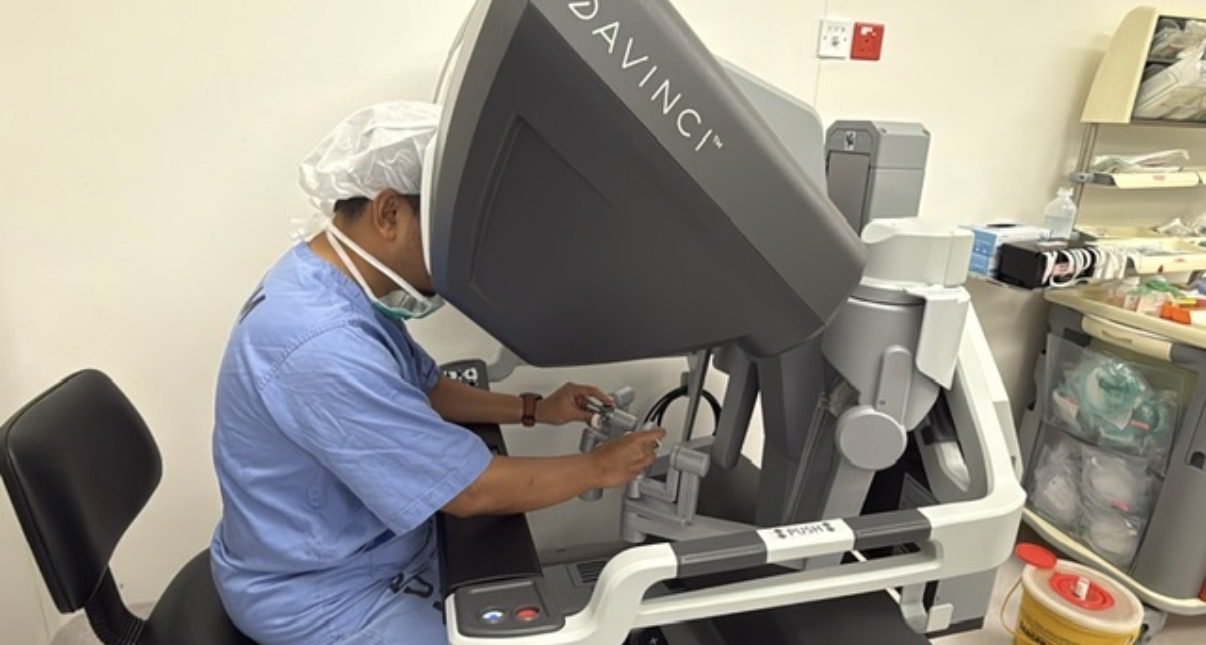
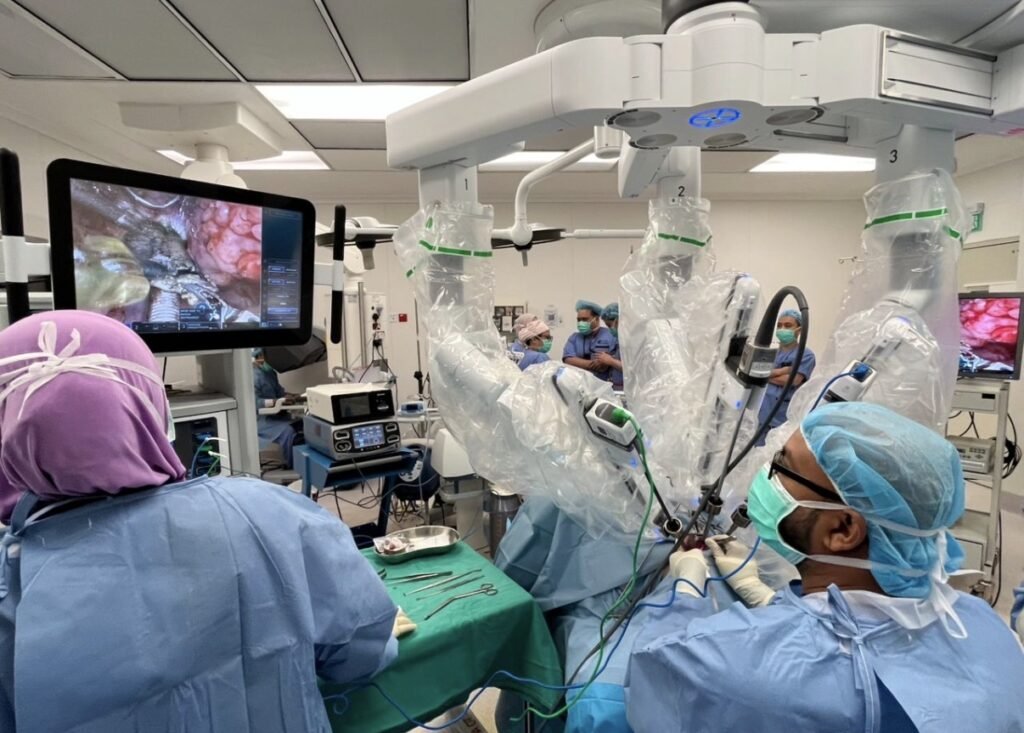
The clue is in the name. “Transoral” means through the mouth, and that is the whole point of the technique. Instead of cutting through the neck or splitting the jaw open to reach a growth or blockage at the back of the throat, the surgeon sits at a console a short distance from the operating table and guides slim robotic arms in through the patient’s open mouth. A camera provides a magnified, three-dimensional view, and the instruments can bend and rotate in ways a human wrist cannot quite manage, reaching around the base of the tongue or into the voice box in a way that would otherwise require opening the jaw or neck from the outside.
It is worth being precise about what “robotic” does and does not mean here, because the word tends to conjure up something more autonomous than reality. The system has no independent decision-making and cannot move on its own. Every motion is a direct, real-time translation of the surgeon’s own hands at the console, scaled down and filtered to remove natural hand tremor. “Remote-controlled, wristed instruments attached to a very good camera” is a more accurate description, if a considerably less exciting one.
Transoral robotic surgery, or TORS, was first cleared by the US FDA in December 2009 for early-stage cancer of the oropharynx — the part of the throat just behind the mouth that includes the tonsils and the base of the tongue — according to Mayo Clinic. Its approved uses have since expanded to the hypopharynx, the parapharyngeal space, and the supraglottic larynx — the upper part of the voice box — as outlined by Cleveland Clinic.
Why Malaysia’s Robotic Throat Surgery Story Doesn’t Start With Cancer
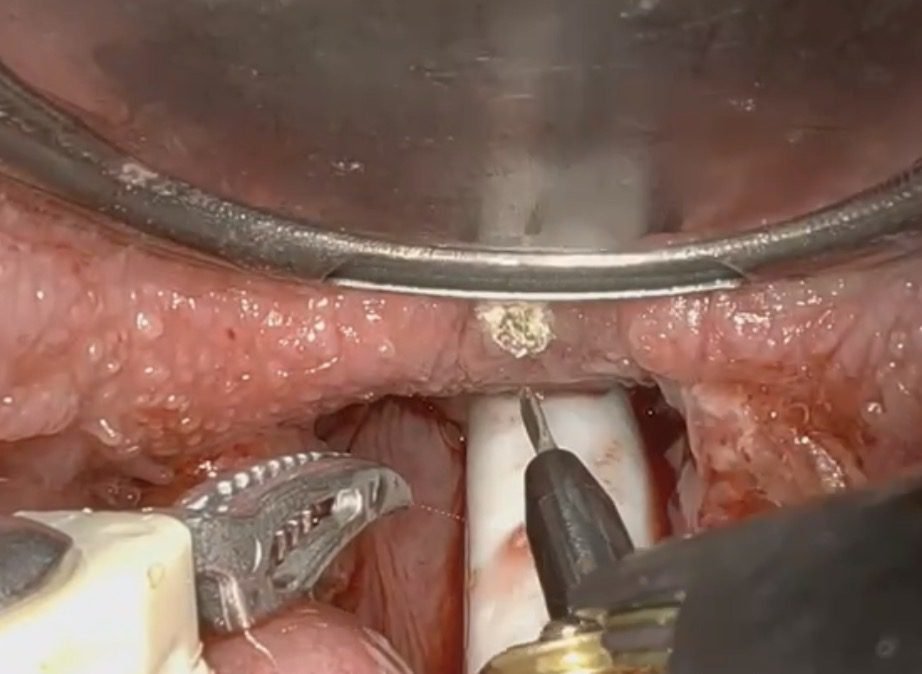
TORS is still a young field here, and the published local data reflects that. One of the few case series from a Malaysian hospital team, published in the Journal of Robotic Surgery, followed 25 patients who underwent TORS (Mahmud et al., 2023). The single biggest reason patients ended up on the operating table was not a tumour — 76% of cases were for obstructive sleep apnea (OSA), specifically a procedure called robotic tongue base reduction. Cancer of the base of tongue accounted for 16%, and the remainder were recurrent tonsillitis and a salivary gland cyst. Every patient’s surgical margins came back clear, and of the small number treated for cancer, only one recurrence occurred; that patient went on to have a second, successful round of TORS and remained disease-free a year later.
Why the tilt toward sleep apnea rather than cancer? Partly because Malaysia already has a large population of people with moderate-to-severe OSA who cannot tolerate a CPAP machine long-term, and partly because the tongue base is exactly the kind of hard-to-reach, awkward-angle anatomy that TORS was designed for in the first place.
Robotic platforms for ENT use are also no longer confined to a single teaching hospital. da Vinci Xi and Si systems capable of head and neck procedures are now installed at several private Malaysian hospitals and teaching hospitals. I hold certification as a da Vinci Xi console surgeon myself, a technology I follow closely.
TORS for Snoring and Sleep Apnea: Who Actually Qualifies
Not every loud snorer is a candidate for robotic surgery, and it is never offered as a first step. CPAP remains the first-line treatment for OSA, full stop. TORS tongue base reduction, with or without a related procedure called epiglottoplasty, is reserved for a specific group: patients with confirmed moderate-to-severe OSA who have genuinely tried and failed CPAP, or who cannot tolerate it for medical or practical reasons, and whose airway assessment — typically a scope done while awake, or during drug-induced sleep endoscopy — points specifically to the base of the tongue as the site of collapse. Patients often ask me about this after reading our earlier post on surgical options when CPAP doesn’t work.
The published outcomes are genuinely encouraging for well-selected patients. Pooled data across multiple studies show the average apnea-hypopnea index (AHI) — a measure of how many times breathing stops or nearly stops per hour of sleep — dropping from around 44 events per hour before surgery to around 18 afterward. Daytime sleepiness scores roughly halve, and the lowest overnight oxygen saturation improves from around 79% to 84%, according to a systematic review of the evidence. A separate study from a Singapore sleep centre, looking specifically at Asian patients, reported similarly encouraging results — relevant to us partly because Asian airway anatomy, with a proportionally smaller jaw and airway relative to soft tissue bulk, does not always respond to surgery the same way as the Western populations most sleep surgery research is built on.
In practical terms, patients who undergo robotic tongue base reduction typically stay in hospital for a day or two for airway monitoring, since operating near the base of the tongue carries a small risk of swelling in the hours immediately afterward. Most return to a normal diet within one to two weeks, and while throat discomfort is real, it is generally shorter-lived than patients expect going in.
If you are not sure whether what you are dealing with is simple snoring or something that needs a proper workup, our overview on sleep apnea, our piece on sleep apnea without loud snoring, and “My Husband’s Snoring Is Destroying Our Marriage”” are all good starting points before a robotic option is ever on the table.
TORS for Head and Neck Cancer: Organ Preservation, Not Just a Smaller Scar
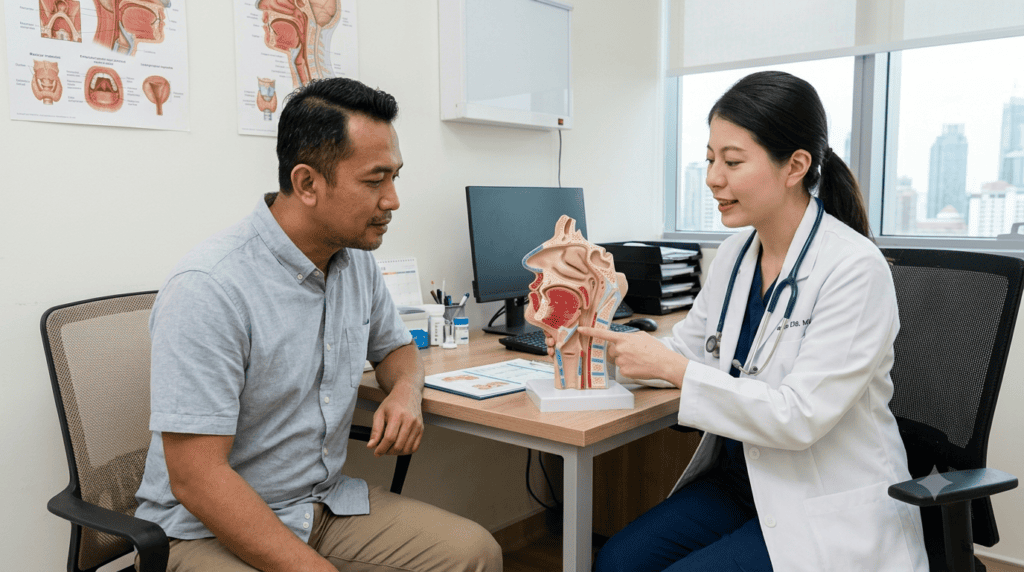
For appropriately selected head and neck cancers, TORS’s biggest advantage is not cosmetic, even though avoiding a visible neck scar is a welcome side effect. The real benefit is preserving function. Traditional open surgery for tumours at the back of the throat can require splitting the lower lip and jawbone, or a large neck incision, simply to get a clear line of sight and reach. TORS avoids that entirely by going in through the mouth, which generally means better preservation of swallowing function, a shorter hospital stay, and a faster return to a normal diet and speech compared with the open equivalent. It is used for carefully selected early-stage cancers of the oropharynx, and in some cases the hypopharynx and supraglottic larynx.
It is worth being precise about what TORS is not used for, because “head and neck cancer” covers a wide range of very different diseases. Nasopharyngeal carcinoma (NPC), which is disproportionately common among Malaysians, particularly those of southern Chinese descent, is generally not treated with TORS. The nasopharynx sits in a location, and NPC behaves in a way, that makes radiotherapy or chemoradiotherapy the standard first-line treatment rather than surgery. It is genuinely a different disease with a different treatment pathway, and the two should not be conflated just because both sit under the “head and neck” umbrella.
If you have noticed a persistent lump in the neck or ongoing hoarseness and are trying to work out what kind of assessment you need, our guides on neck swelling and early throat cancer symptoms are a reasonable place to start, and our head and neck service page explains the full range of conditions we assess.
What Robotic Surgery Can’t Do
I would be doing you a disservice if I only described the upside, so here is the honest limitations list. Not every hospital has the equipment or a trained robotic ENT team; access is currently concentrated in a handful of private centres rather than being widely available across the country. Cost is a genuine factor — robotic procedures generally cost more than the open or endoscopic equivalent, and the exact difference depends heavily on the hospital, the specific procedure, and length of stay, so it is worth asking for a written quotation during consultation rather than assuming a figure from what you have read online. Not every patient’s anatomy or tumour location is actually suitable for a transoral approach, regardless of how advanced the technology is.
This is also still a relatively young field in Malaysia. The published local data so far comes from small case series rather than large randomised trials, which means surgeon experience and careful patient selection matter enormously to the outcome. The robot does not replace clinical judgement. It is a very good tool for reaching difficult anatomy, not a decision-maker, and whether it is the right tool for your specific case is something worth working through with a surgeon who treats the underlying condition and, ideally, has hands-on experience with the platform itself.
Not Sure If This Applies to You?
If CPAP has not worked for you, or you or a family member has been told there is a growth in the throat or base of tongue and you want to understand whether a minimally invasive, robotic-assisted approach is appropriate for your specific case, We are happy to go through it with you directly. Message us on WhatsApp to arrange a consultation.
Frequently Asked Questions
Q: Is robotic throat and neck surgery available in government hospitals in Malaysia, or only private ones?
A: Yes there are Robotic surgery services available in government based hospitals like Universiti Malaya Medical Center. Other private Centers also have these services available
Q: Does robotic surgery mean a shorter hospital stay than traditional surgery?
A: For the procedures TORS is suited to, generally yes, because there is no external incision through the neck or jaw that needs to heal. Patients typically return to eating and speaking sooner and often go home earlier than with the equivalent open approach, though exact recovery time still depends on the specific procedure and individual healing.
Q: If I snore loudly, does that mean I need robotic surgery?
A: No. Most snoring does not need surgery of any kind, and even for patients with confirmed obstructive sleep apnea, CPAP remains the first recommended treatment. Robotic tongue base reduction is reserved for patients with a confirmed diagnosis who have genuinely tried and failed, or cannot tolerate, CPAP, and whose airway assessment specifically points to the tongue base as the problem.
Q: Is a robotic operation riskier than traditional surgery because a machine is involved?
A: The robotic arms have no independent movement or decision-making ability of their own; every motion mirrors the surgeon’s own hands in real time, with the benefit of a magnified 3D view and a wrist range of motion beyond what a human hand alone can achieve inside a small space. The relevant risks are similar in nature to those of any throat or neck procedure and are worth discussing individually with your surgeon.
Q: Is TORS suitable for nasopharyngeal cancer (NPC)?
A: Generally, no. NPC is usually treated with radiotherapy or chemoradiotherapy rather than surgery, due to both its location and how it typically responds to treatment. TORS is more relevant to cancers of the oropharynx, hypopharynx, and voice box. If NPC is your specific concern, our separate article on its warning signs goes into more depth.
Comments are closed