
A 31-year-old content creator from Petaling Jaya sat in my clinic two weeks ago with her rose quartz gua sha tool still sitting in her handbag. She had been using it on her cheeks and under her eyes almost every night for a month, ever since the haze rolled back into the Klang Valley in August. “It does feel like something is moving,” she told me, pressing two fingers beside her nose. “But I still wake up blocked every morning. I don’t know if I’ve just been wasting twenty minutes a night, or if I’ve actually been doing something to my sinuses.”
She had discovered gua sha the way most of my patients discover a new remedy these days: through her own For You page. Videos claiming that a few strokes of a smooth stone tool along the cheekbones and jawline can “drain your sinuses instantly,” and that it “works better than any sinus medication,” have racked up hundreds of millions of views globally, and Malaysian TikTok and Instagram accounts have been just as enthusiastic, especially through the haze episodes we have had this year. So I want to walk through what gua sha actually is, what the real evidence says once you look past the filtered video, and where the line sits between a pleasant nightly ritual and a false sense of security.
What “Gua Sha for Sinus Congestion” Actually Involves
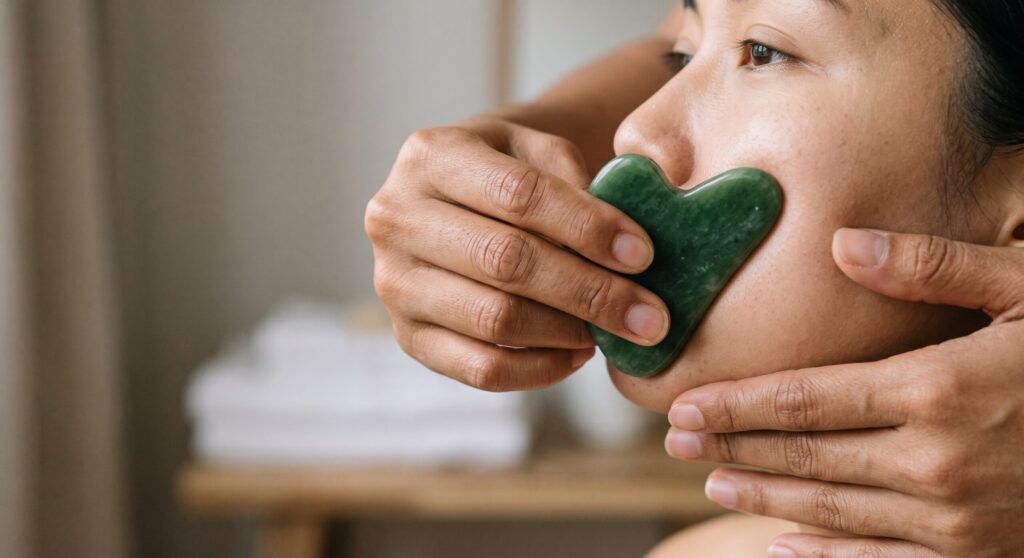
Gua sha did not start on TikTok. It is a traditional Chinese medicine technique in which a smooth-edged tool, traditionally horn, jade, or stone, is used to scrape the skin with light to firm pressure, and it became part of Western beauty routines as far back as the 1970s. In its classic form, gua sha was applied to the back, neck, and limbs to treat what TCM describes as stagnation, and it is still practised this way in TCM halls and sinseh clinics across Malaysia, from the shophouses of Petaling Street to neighbourhood wellness centres in Klang and Ipoh. What has changed in the last few years is the target area: social media has popularised a gentler, facial version, using flat jade or rose quartz tools along the cheeks, under the eyes, and beside the nose, marketed specifically as a fix for a blocked or puffy-feeling nose.
The technique itself is simple. A cosmetic oil is applied to the face, and the tool is drawn in short strokes from beside the nose out toward the ears, and from under the eyes down toward the jaw, loosely following the direction of the lymphatic vessels that drain that part of the face.
What the Videos Actually Claim
The claims are fairly consistent across creators: gua sha will “drain” your sinuses, reduce the puffiness that comes with a blocked nose, ease sinus pressure headaches, and, in the more dramatic captions, outperform medication entirely. It is not the first sinus home remedy I have had to fact-check this year; a few months ago it was garlic for sinusitis. Some creators now pair gua sha with the viral nostril pull test I wrote about earlier, suggesting you can diagnose and treat a genuine nasal problem entirely at home with nothing more than your hands and a stone tool.
What the Evidence Actually Shows

Here is where I have to separate the mechanism from the marketing. The underlying theory is not unreasonable: firm, repeated strokes across the cheeks and under the eyes do stimulate local blood flow and can encourage the movement of fluid through the superficial lymphatic channels of the skin. Short sessions of this kind of facial massage have genuinely been shown to produce a brief increase in surface blood flow and lymphatic movement. That much is real physiology.
What is far shakier is the leap from “this moves fluid under your skin” to “this treats your sinuses.” In 2022, a group of dermatology researchers in the United States reviewed the top ten search results for gua sha, jade rollers, and facial massage and published their findings as a letter in the Journal of Cosmetic Dermatology. They found no shortage of confident claims across those websites: reduced inflammation, reduced puffiness, better circulation, lymphatic drainage, even migraine relief. What they did not find was much research behind any of it. Only five of the ten sites they reviewed cited a study of any kind, and the authors concluded plainly that gua sha, jade rollers, and facial massage “carry many proposed benefits, few of which have been illustrated in the literature.” Fewer than a third of the sites they reviewed even mentioned the well-documented risks, such as bruising, skin irritation, and infection.
I could not find a single published clinical trial testing gua sha specifically against sinus congestion, chronic sinusitis, or a blocked nose from haze exposure. Your sinuses are air-filled cavities inside the bones of your skull, lined with mucosa that a tool running across the surface of your skin cannot physically reach, drain, or treat. Whatever gua sha is doing, and the honest answer is that it is moving fluid around in the skin and soft tissue of your face, it is not doing it inside your sinuses.
Why It Can Still Feel Like It Is Working
I do not think my patient in Petaling Jaya was imagining things. There is a real, if temporary and largely cosmetic, sensation of lightness that can come from moving surface fluid around the face, and the ritual itself, the warm oil, the slow pressure, a few quiet minutes before bed, has a genuinely calming effect that can make breathing feel easier even when nothing inside the nose has changed. That is worth taking seriously rather than dismissing outright. The problem is that this feeling of relief is easy to confuse with actual treatment, especially when the underlying cause of a blocked nose, whether that is haze-irritated mucosa, a lingering viral infection, allergic rhinitis, or a structural issue like a deviated septum, is something a stone tool cannot touch.
Why This Trend Has Extra Traction in Malaysia Right Now
Two things are converging to make this a particularly Malaysian moment for gua sha. The first is the calendar. As I write this, parts of the Klang Valley and Sarawak are once again recording Unhealthy Air Pollutant Index readings, only weeks after Sarawak declared an emergency when API crossed 500, which I wrote about in Malaysia’s Haze Emergency. Every haze episode brings a wave of patients describing the same thing: a nose that feels perpetually blocked, heavy, and under pressure. That is exactly the kind of discomfort that makes a quick, drug-free, at-home remedy appealing, which is likely why searches and posts about gua sha for sinuses tend to spike right alongside the API.
The second factor is cultural familiarity. Unlike markets where gua sha arrived purely as a beauty-industry import, Malaysia already has a deep, longstanding relationship with traditional Chinese medicine. Gua sha tools, cupping sets, and herbal remedies for what TCM calls “wind-heat” or “damp” congestion have been sold in neighbourhood sinseh shops for decades, long before a stone tool went viral. That existing familiarity means the TikTok version of this trend is landing on ground that was already prepared for it, which is part of why I am hearing it raised unprompted in consultations far more often this year.
When Gua Sha Can Actually Cause Harm
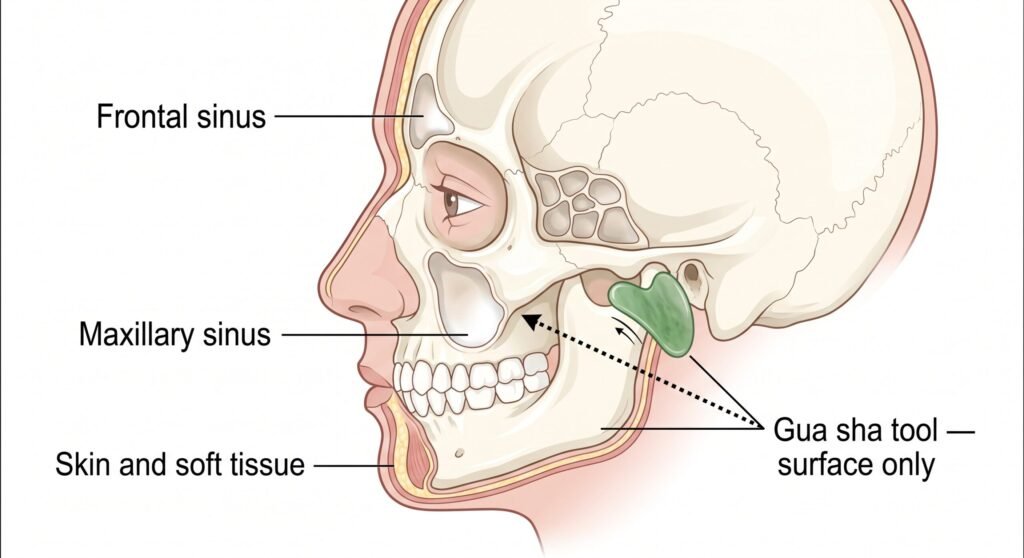
Used gently, with a clean tool, on intact skin, gua sha is a low-risk practice. But low-risk is not the same as risk-free, and I want to be specific about where it goes wrong.
The most common problem is simple over-enthusiasm: pressing too hard, or scraping the same spot too many times, can bruise the skin or break small blood vessels, leaving marks that take days to fade. That is a cosmetic problem rather than a dangerous one, and it is avoidable with lighter pressure.
The more serious risk is infection, and it has nothing to do with the sinuses and everything to do with hygiene. Any tool that scrapes the skin can create micro-abrasions, and a tool that is not cleaned between uses, whether that is a shared tool at a wellness studio, one passed between family members, or simply one that never gets wiped down, can introduce bacteria into broken skin or trigger flare-ups in people prone to acne, rosacea, or cold sores. These are well-documented risks, not rare exceptions, and they matter more, not less, on skin that is already irritated by haze.
The risk I worry about most, though, never shows up as a bruise: false reassurance. If a blocked nose is actually acute bacterial sinusitis, the twenty minutes spent scraping the cheeks each night is twenty minutes not spent noticing that the problem is getting worse. I have written before about how not every sinus-feeling headache is actually a sinus problem, and about what it means when a blocked nose needs a CT scan rather than another home remedy. Gua sha does not change any of the red flags that should send you to a doctor instead of a stone tool.
Red Flags That Mean You Need an ENT, Not a Stone Tool
See a doctor rather than reaching for a gua sha tool if your blocked nose comes with fever, one-sided facial pain or swelling, pain around or behind one eye, any change in vision, thick green or blood-stained discharge, or symptoms that are still getting worse after seven to ten days instead of improving. The same applies if this is a “sinus problem” that keeps recurring every few weeks, or one that was already treated but never fully resolved. None of these are situations where facial massage, however pleasant, is an adequate substitute for an actual diagnosis at a nose specialist.
My Verdict
As a treatment for sinusitis, gua sha does not hold up; there is no evidence it reaches or treats the sinuses at all. As a gentle, low-cost addition to how you look after a haze-irritated or mildly congested face, alongside measures that do have real evidence behind them, such as saline nasal rinsing with properly boiled or sterile water, it is reasonable, provided you keep the tool clean, keep the pressure light, and keep your expectations realistic. The moment it becomes a reason to delay seeing someone about a nose that is genuinely unwell, rather than just uncomfortable, it has stopped being a harmless ritual.
Call to Action
If your blocked nose has lasted longer than ten days, keeps coming back, or comes with facial pain, fever, or pressure that a nightly gua sha routine simply is not touching, it is worth having it properly examined rather than guessed at.
Message us on WhatsApp to arrange a consultation →
FAQ
Q: Can gua sha cure sinusitis?
A: No. There is no published clinical evidence that gua sha treats sinusitis. The technique can temporarily move fluid in the skin and soft tissue of the face, but it cannot reach the sinuses themselves, which sit inside the bones of the skull.
Q: Is it safe to do gua sha on my face every day?
A: For most people with healthy, intact skin, light daily gua sha is low-risk. Use gentle pressure, clean your tool before and after every use, and stop immediately over broken skin, active acne, or a rash.
Q: Can gua sha make a sinus infection worse?
A: Gua sha does not spread infection from inside the sinuses. The real danger is indirect: leaning on it as your main response to a worsening infection can delay proper treatment, and a poorly cleaned tool can cause a separate skin infection on already haze-irritated skin.
Q: Is gua sha reasonable to try during haze season?
A: As a comfort measure alongside real haze precautions, such as staying indoors when the API is unhealthy, using an air purifier, and rinsing the nose with clean saline, it is reasonable. It should not replace those measures, or a doctor’s visit if symptoms are significant.
Q: What actually works for a blocked nose, if not gua sha?
A: Saline nasal irrigation with cooled boiled or sterile water has real evidence behind it, alongside treating the underlying cause, whether that is allergy, viral infection, or bacterial sinusitis, once it has been properly diagnosed.
Q: How do I know if I need to see an ENT instead of continuing my routine?
A: Book an appointment if you have fever, one-sided facial pain, swelling around the eye, vision changes, symptoms lasting more than seven to ten days, or a problem that keeps recurring, rather than waiting to see if the next session helps.
Discover more from The ENT Doctor
Subscribe to get the latest posts sent to your email.
No responses yet