

Picture a 28-year-old office worker in Petaling Jaya scrolling through her feed during lunch. A video shows a smooth, lifted nose bridge created in a single quarter-hour appointment, with no cutting, no stitches and no time off work. The caption calls it a “liquid nose job”. The price looks friendly and the booking link is one tap away. (This is an illustrative scenario, not a real patient.)
As an ENT surgeon who spends every working week inside noses, I understand the appeal. I also know what the video leaves out. This article explains what liquid rhinoplasty actually is, which popular beliefs about it are wrong, what the medical literature warns about, and how to check who is treating you in Malaysia before anyone places a needle near your face.
One note before we start. This article deliberately does not name any product brand, clinic or device. Whether a procedure is safe depends on the practitioner, the premises, the anatomy and the technique, and a brand name on a box tells you none of those things.
What Is Liquid Rhinoplasty, Exactly?
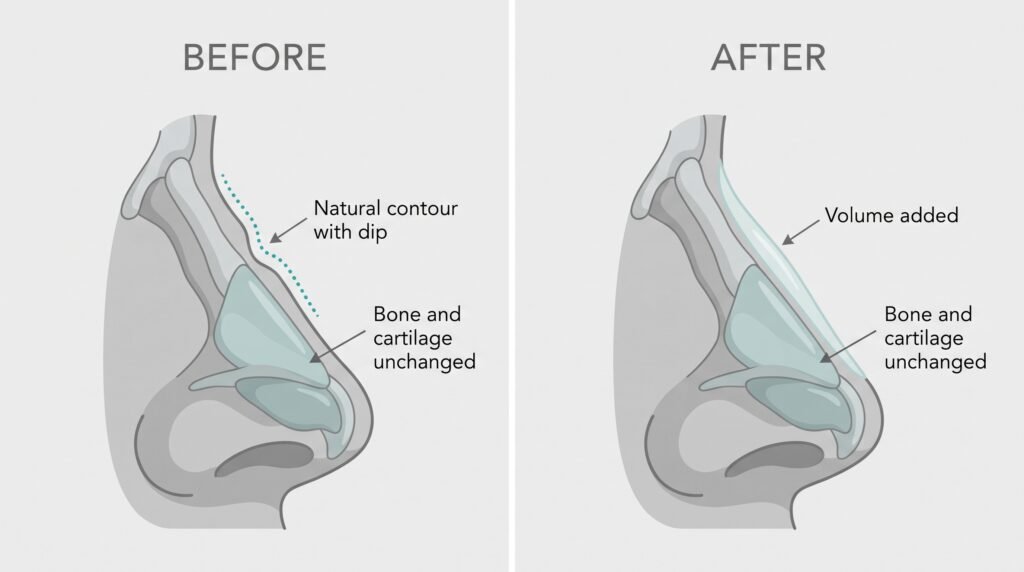
“Liquid rhinoplasty” is a popular name for non-surgical nose reshaping, usually done by injecting a hyaluronic acid filler into selected points of the nose. It is promoted as quick, with immediate results and a return to normal activity straight away. An ENT Today report on the trend notes that interest has grown in part because social media presents it as an easy way to get the nose people want, and also states plainly that the technique cannot minimise or substantially alter the nose and that its effects are temporary (1).
In other words, the filler adds volume. It does not remove cartilage, straighten a bent septum, narrow a wide tip or change the structure of the nose. It can disguise some contour issues for a limited time. That is a very different promise from “a nose job without surgery”.
Myth 1: “It’s Only an Injection, So It Must Be Minor”
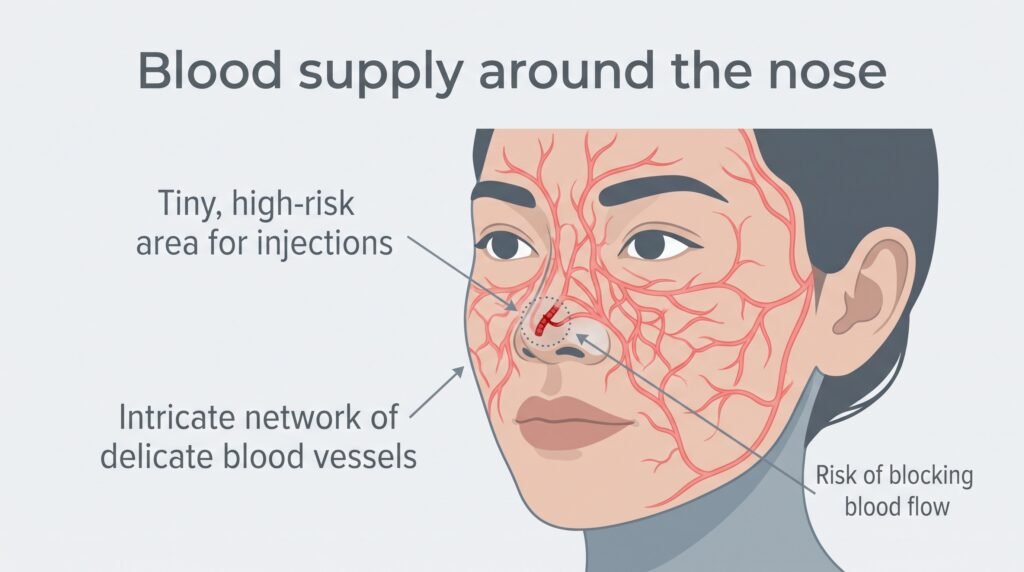
A small needle does not make a small risk. The nose is a compact area with thin overlying skin, and its blood supply is rich and closely interconnected with the blood supply of surrounding facial tissues. If filler is placed into, or presses on, a small blood vessel, the blood flow can be blocked. Doctors call this vascular occlusion.
When that happens in the nose, the skin supplied by the blocked vessel can be starved of blood. The published literature on non-surgical rhinoplasty with hyaluronic acid includes a narrative review dedicated specifically to its complications (2), and a separate world-literature review exists on avoiding and treating blindness from fillers (3). The existence of a review with that title tells us something important on its own: vision loss is a recognised, reported complication of facial filler treatment, even though it is uncommon.
I want to be careful here. Serious problems are not the typical outcome, and I am not claiming a number for how often they occur in Malaysia, because I am not aware of any verified local figure. The point is that the downside is not just a lumpy result. It can include skin damage and, rarely, loss of vision, which is why the person holding the syringe needs thorough anatomical knowledge and a plan for emergencies.
Warning signs that need urgent attention
After any filler injection near the nose, contact the treating doctor immediately or go to an emergency department if you notice any of the following: severe or escalating pain that seems out of proportion, skin that turns unusually pale, white, blotchy or dusky, a sudden change in vision, or a sudden severe headache. Do not wait to see whether it settles overnight. Time matters in these situations.
Myth 2: “Filler Can Fix Any Nose”
Filler works best on a narrow set of concerns, such as a small dip on the bridge. It cannot make a large nose smaller, because it only adds. Placing more filler to compensate for an oversized nose can make the nose look broader or more projected, which is the opposite of what many patients want.
Cosmetic injections and structural problems are different conversations. I explained how nose surgery can improve both breathing and appearance in Rhinoplasty Is Not Just a Nose Job, and why a blocked nose can persist for reasons injections cannot touch in I Had Surgery for My Blocked Nose, So Why Is It Blocked Again?. If you are curious whether your own nose is structurally crooked, read The Viral TikTok Nostril Pull Test before assuming the answer is a cosmetic one.
Another point worth knowing: because filler is placed in an area that is part of the airway’s entrance, anyone with existing nasal obstruction should discuss with a doctor, ideally an ENT surgeon, whether adding bulk is wise for them. A conversation like this should happen before the injection, not after.
Myth 3: “If It Goes Wrong, It Simply Dissolves”
It is true that hyaluronic acid fillers can be dissolved by an enzyme called hyaluronidase, and this is an important safety tool. But the reassurance is often oversold. Dissolving filler only helps if the right enzyme is available immediately, if the practitioner recognises the problem quickly, and if the product used is actually hyaluronic acid. A clinic that cannot tell you exactly what was injected, or that has no emergency plan on the premises, cannot offer that safety net.
Ask one simple question before treatment: “If a blood vessel is blocked, what will you do in the first few minutes, and where is that medication kept?” A properly prepared doctor will answer without hesitation. If the answer is vague, walk out.
Myth 4: “A Home or Hotel Appointment Is Just a Cheaper Version of the Same Thing”
This is where the Malaysian context matters most. In September 2025, a Medical Practice Division officer from the Ministry of Health, Dr Najmi Ismail, advised the public to check the “3Ps” before any aesthetic treatment: the procedure, the practitioner and the premises. He stated that only registered medical practitioners may perform aesthetic procedures, that their status can be verified with the Malaysian Medical Council, and that treatment premises must be registered with the Ministry and authorised to provide aesthetic services. He also warned people never to seek unlicensed procedures such as filler or botulinum toxin injections carried out at homes or hotels, because of the risk of serious complications, including death (4).
An earlier statement from the Ministry in February 2022, reported from Kuching, said the same thing from a regulatory angle. Aesthetic medical procedures should be performed only by qualified registered medical practitioners at licensed or registered facilities. Practitioners must hold a Letter of Credentialing and Privileging for Aesthetic Medical Practice, which lists the procedures they are permitted to perform, and premises must be registered or licensed under the Private Healthcare Facilities and Services Act 1998 (Act 586). The Ministry advised the public to avoid door-to-door services, spas, beauty salons, hotels and other doubtful premises, and listed rhinoplasty and filler injections among the procedures that can lead to complications, disability and even death when handled by unqualified people (5).
A cheap price in a salon is not a discount. It is the removal of every safety layer that the registration system exists to provide.
How to Check Your Provider in Malaysia

The Ministry’s own guidance gives a practical route. Before you book, work through this checklist:
- Confirm the practitioner is a registered medical practitioner and check the name against the National Registry of Registered Medical Practitioners Practising Aesthetic Medical Practice on the Ministry of Health portal (5).
- Ask whether the doctor holds the Letter of Credentialing and Privileging for aesthetic practice and whether it covers the exact procedure you want (5).
- Check that the premises appear on the Ministry’s list of registered facilities (5).
- Ask what product will be used, and ask to see the packaging and batch details in front of you, without judging it by brand name or influencer endorsement.
- Ask what the plan is if a blood vessel is blocked, and whether hyaluronidase is available on site.
- Insist on a face-to-face consultation that includes an examination of your nasal airway, not just a photo-based quote.
Be equally cautious about online promotions. Polished before-and-after photos, celebrity-style endorsements and “limited slots” countdowns are marketing tools, not credentials. I discussed how convincing fake medical advertising has become in That Doctor in the Ad Isn’t Real, and the same scepticism applies to aesthetic offers.
If you believe you have been treated by an unlicensed practitioner, or want to report a concern, the Ministry’s aesthetic practice unit accepts complaints through the contact details published on its website (5).
What About Nose Thread Lifts?
Nose threads are another “no-surgery” option you may see advertised by clinics across Malaysia. They involve placing thread material under the skin to lift or support the nose. I am not going to quote complication rates here because I have not been able to verify a reliable figure, but the same principles apply. A thread is a foreign material placed in a thin-skinned, vessel-rich area, so the practitioner’s training, the premises and the emergency plan matter just as much as they do for filler. Ask the same questions, and be sceptical of anyone who calls any nose procedure “risk-free”.
When Is Surgery or an ENT Assessment the Better Route?
Consider seeing an ENT surgeon first if any of these apply to you: you have difficulty breathing through your nose, you have had previous nose surgery or trauma, you want a permanent change in size or shape, you have a visibly crooked nose, or you have had a bad experience with a previous injection. A specialist can assess both the airway and the appearance together, and can tell you honestly whether filler, surgery or no procedure at all is the right choice.
A responsible doctor will also tell you when the answer is “you do not need this”. Good aesthetic and functional care starts with an examination and an honest discussion, not a booking link.
Key Takeaways
- Liquid rhinoplasty adds volume temporarily. It cannot shrink a nose or fix breathing problems (1).
- Complications can include blocked blood vessels, skin damage and, rarely, vision loss, which is why anatomy knowledge and an emergency plan matter (2,3).
- In Malaysia, check the 3Ps: procedure, practitioner and premises. Never accept filler at a home, hotel or salon (4,5).
- Choose the doctor, not the brand, and be wary of social media promotions.
Talk to us About Your Nose
If you are considering any nose procedure, or you already had one and something does not feel right, I would be glad to examine your nose, review your breathing and give you an honest opinion on your options. You are welcome to contact me directly for a consultation by WhatsApp.
Frequently Asked Questions
Is liquid rhinoplasty permanent?
No. Hyaluronic acid filler is temporary, and the ENT Today report on this trend states that its effects are temporary (1). The nose will gradually return toward its previous shape as the filler is absorbed.
Can nose filler make my blocked nose better?
No. Filler adds volume and does not treat a deviated septum, swollen turbinates or other causes of nasal obstruction. If you have trouble breathing through your nose, an ENT assessment is the right first step.
What are the warning signs of a problem after nose filler?
Seek urgent care for severe or increasing pain, skin that looks pale, white, blotchy or dusky, a sudden change in vision, or a sudden severe headache. Contact the treating doctor or go to an emergency department immediately.
Who is allowed to do aesthetic injections in Malaysia?
According to the Ministry of Health, only registered medical practitioners with the appropriate credentialing and privileging may perform aesthetic medical procedures, and only at registered or licensed premises (4,5). You can verify a practitioner through the Ministry’s registry and the Malaysian Medical Council.
Is a cheaper price at a salon or home visit worth it?
The Ministry has specifically warned the public not to accept filler or similar injections at homes, hotels or other unlicensed settings because of the risk of serious complications, including death (4,5). Lower cost does not justify skipping the safety checks.
Should I see an ENT surgeon before any nose procedure?
If you have any breathing difficulty, a crooked nose, previous nose surgery or injury, or want a permanent change, an ENT assessment is strongly advisable. See also our guide on choosing between a GP and an ENT specialist: https://theentdr.com/blog/gp-or-ent-which-one-should-you-visit-for-ear-nose-throat-issues/
References
1. Fink J. Liquid Rhinoplasty: How to Make Patients Aware of the Risks. ENTtoday. April 2020. https://www.enttoday.org/article/liquid-rhinoplasty-how-to-make-patients-are-aware-of-the-risks/4/
2. Complications of Nonsurgical Rhinoplasty with Hyaluronic Acid Injections: A Narrative Review. PubMed. PMID 39747417. https://pubmed.ncbi.nlm.nih.gov/39747417/
3. Avoiding and Treating Blindness From Fillers: A Review of the World Literature. PubMed. PMID 26356847. https://pubmed.ncbi.nlm.nih.gov/26356847/
4. Check the 3Ps: Health Ministry warns of serious risks from unlicensed aesthetic procedures. Malay Mail. 5 September 2025. https://www.malaymail.com/amp/news/malaysia/2025/09/05/check-the-3ps-health-ministry-warns-of-serious-risks-from-unlicensed-aesthetic-procedures/190140
5. MOH warns of deadly dangers of unlicensed cosmetic procedures offered in spas, beauty salons. Dayak Daily. 10 February 2022. https://dayakdaily.com/moh-warns-of-deadly-dangers-of-unlicensed-cosmetic-procedures-offered-in-spas-beauty-salons
Further reading: Ministry of Health Malaysia, moh.gov.my
No responses yet