

A runner from Shah Alam has been making the rounds on Malaysian social media this week. According to his post on Threads, as reported by World of Buzz on 21 October, he trained outdoors during the haze, checked the Air Pollutant Index (API) beforehand, and believed that a reading below 120 was safe. Then came two days of high fever, a cough that dragged on for about a week and a half, and finally traces of blood in his phlegm (1).
He is now waiting for chest X-ray and sputum results, and he is urging fellow runners to train indoors. It is important to be clear about what this story is and is not. It is one person’s account, relayed by a news site; no doctor is quoted, the diagnosis is not confirmed, and the article does not establish that the haze caused his illness (1). But the story has struck a nerve because the underlying question is one that many Malaysians are quietly asking right now: if I see blood in my phlegm during the haze, what does it mean, and should I be worried?
As of 20 October, haze had pushed 29 areas in Malaysia into the unhealthy range, with readings reaching 172 in Batu Muda, Kuala Lumpur, and 165 in Petaling Jaya (2). Many of us are coughing, clearing our throats and blowing our noses more than usual. In this article, I will explain where blood in phlegm can come from, why the nose and throat are often the unsung culprits, which causes are genuinely serious, and exactly when you should stop waiting it out.
First, what do doctors mean by “blood in phlegm”?
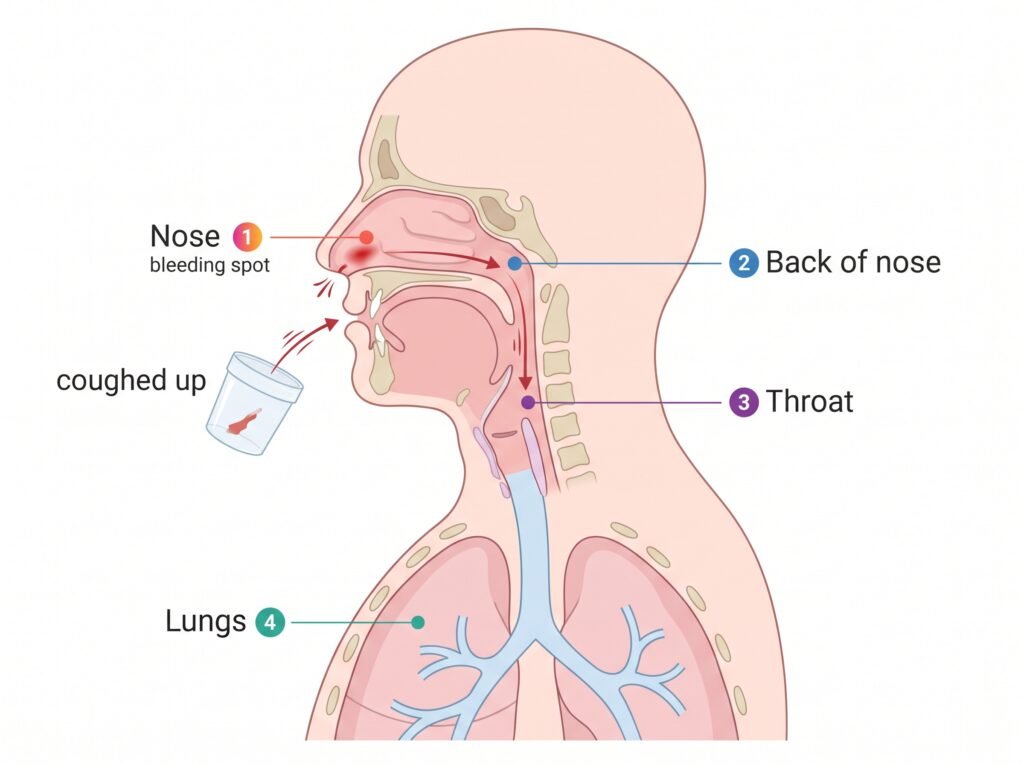
Phlegm (sputum) is the mucus you cough up from your airways. When it contains blood, doctors use the word haemoptysis for blood that truly comes from the lungs or the airways below the voice box. But there is a second, very common category called pseudohaemoptysis, which describes blood that looks as if it came from the lungs but actually came from somewhere else, such as the nose, gums, mouth or throat (3).
This distinction matters because the workup and the urgency are different. In the American Family Physician review of haemoptysis, clues to an upper-airway source include bleeding gums, nosebleeds, little or no cough, and visible fragile blood vessels or ulcers in the nose, tongue or throat. When the source is unclear, the review notes that a nasopharyngoscopy (a camera examination of the nose and back of the nose) can confirm it (3). That camera examination is something we do every day in an ENT clinic.
In plain terms: not every streak of blood in phlegm is a lung problem, and not every one is harmless. The only way to know is to find the source.
The haze, your nose and the blood-streaked phlegm
Think of your nose and throat as the first filter for every breath. In haze, that filter is under constant attack. Fine particles (PM2.5) are small enough to travel deep into the lungs and may even reach the bloodstream, according to doctors quoted by Malay Mail and Business Today (4,5). Long before they get that far, though, they meet the lining of your nose, sinuses and throat.
From my clinical experience as an ENT surgeon, there are several ways that irritated, dry or inflamed upper-airway lining can produce blood-streaked phlegm. I want to be clear that these are clinical explanations, not findings from a Malaysian haze study:
- Dry, cracked nasal lining. Irritated nasal membranes can bleed in tiny amounts. If the blood trickles backwards into the throat, you may cough or spit it up and mistake it for lung blood. We discussed this mechanism in detail in Super El Niño Is Here: Why Your Nose Is Crusting, Bleeding and Burning in the Heat.
- Forceful coughing and throat clearing. A persistent cough repeatedly strains the delicate lining of the throat and voice box area. Small surface vessels can break, leaving thin red threads in otherwise ordinary mucus.
- Sinus and throat infections. Inflamed tissue bleeds more easily. Heavy post-nasal drip from sinusitis can carry flecks of blood down the back of the throat. See our guide on Sinusitis and Sinus: What Is the Difference?.
- Nosebleeds during sleep. A nosebleed at night may drain backwards. You then wake up with a metallic taste and blood-tinged phlegm, without ever seeing blood from the nostril. Our post on nosebleeds during dengue season explains when a nosebleed is a warning sign.
If you are still dealing with a stuffy, crusty nose after the haze, our recovery guide The Haze Is Still Here: Why Your Nose Stays Blocked and Crusty for Weeks covers how to help the lining heal.
The reassuring news is that a small streak of blood in phlegm after a few days of hard coughing, with a clear upper-airway explanation, is common and usually settles. The key phrase is “usually settles”. If it does not, or if it comes with warning features, it needs proper investigation.
When the blood comes from the lungs: the causes that matter
Blood that genuinely comes from the lungs or the airways below the voice box has a longer list of possible causes. According to the American Family Physician review, the most common cause in outpatients is an acute respiratory infection, which accounted for 64% of cases in a UK primary care cohort, followed by asthma (10%), chronic obstructive pulmonary disease (8%) and lung cancer (6%). In hospital cohorts, bronchiectasis, lung cancer, bronchitis and pneumonia lead the list (3).
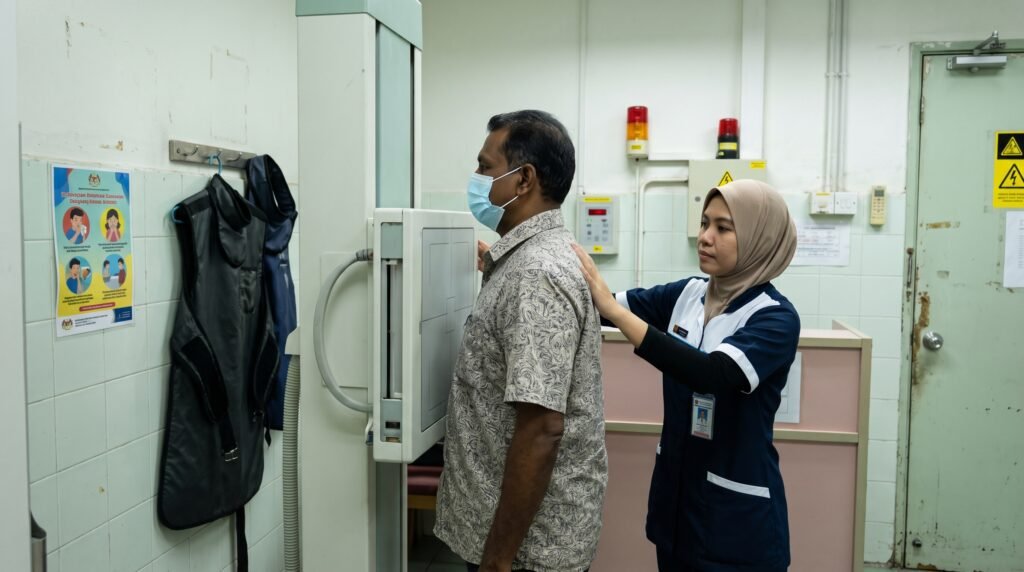
This is consistent with the runner’s story: a fever followed by a prolonged cough is the typical pattern of a chest infection, and a chest X-ray and sputum test are exactly the right first steps (1,3).
Tuberculosis cannot be left out of the conversation in Malaysia
Tuberculosis (TB) is a major cause of haemoptysis in regions where TB is common (3). Malaysia is one of them. In February, the Ministry of Health reported 2,571 TB cases from 1 January to 7 February 2026, 9.8% higher than the same period in 2025, with 10 active clusters. The Ministry listed the warning symptoms as a cough lasting more than two weeks, fever and night sweats, loss of appetite and weight loss, coughing up blood, and close contact with a TB patient (6). Its advice was to seek early examination at the nearest health facility (6).
Haze season does not cause TB, but it fills clinics with coughing patients, and TB can hide among them. A cough that outlasts the haze is not a “haze cough”. For more on the ear, nose and throat side of this infection, see Malaysia’s TB Outbreak: The ENT Symptoms You Must Not Ignore.
Lung cancer and who is at higher risk
Malignancy becomes a stronger consideration in people aged 40 and above with a smoking history, particularly a heavy one (3). Business Today also reported that doctors link long-term exposure to particulate pollution with lung cancer risk, although a single haze episode does not necessarily cause lasting damage and the risk depends on concentration, frequency, duration and existing health (5). Please do not take this as a reason to panic about one hazy fortnight. Take it as a reason not to ignore blood that keeps coming back.
The one ENT cause you should know about: nasopharyngeal carcinoma

Nasopharyngeal carcinoma (NPC), cancer of the back of the nose, is the ENT diagnosis I most want readers to understand when they see blood in their phlegm, because it is a cancer that Malaysia has a particular relationship with. A CodeBlue report published on 1 October 2026 cited National Cancer Institute data showing that NPC is the sixth most common cancer among Malaysian men, that Sarawak has the highest incidence in the country, and that about 76% of men and 73% of women are diagnosed at stage 3 or 4 (7).
The reason is that the tumour hides deep behind the nose. Prof Dr M. Murallitharan of the National Cancer Society of Malaysia told CodeBlue that early symptoms are mild and easily dismissed. The ones he listed include a painless neck lump, nosebleeds, a blocked nose, excess mucus, blood in saliva, one-sided ear blockage, hearing loss and tinnitus (7). The same report gave five-year relative survival of about 64% for stage 1 disease, falling to about 27% for stage 4 (7).
So what does this mean for you? Blood-streaked phlegm or saliva is a recognised early symptom of NPC. Most people with a streak of blood will not have NPC, but blood that keeps recurring without a cold, especially together with a blocked ear on one side or a lump in the neck, deserves a nasoendoscopy. Read more in Why Malaysians Are More Prone to Nasopharyngeal Carcinoma (NPC) and NPC Screening: What Happens at an ENT Visit?.
Red flags: when to stop waiting
Here is the practical part. Please see a doctor promptly, and do not wait for the haze to clear, if any of the following apply:
- Blood in your phlegm on more than one or two occasions, or that returns after it seemed to stop.
- A cough lasting more than two weeks, particularly with fever, night sweats, poor appetite or weight loss (6).
- Blood in the phlegm in someone aged 40 or above, or a current or former smoker (3).
- A painless lump in the neck, a blocked or muffled ear on one side, hearing loss, or ringing in one ear (7).
- A new or lasting hoarse voice, difficulty swallowing, or a feeling of something stuck in the throat. See our guide to the early throat cancer symptoms you shouldn’t ignore.
- Use of blood-thinning medication, since bleeding may be more significant (3).
Go to an emergency department immediately if you are coughing up more than a small streak, if the blood is bright red and continues, or if you have breathlessness, chest pain, dizziness or a racing heart. Large-volume haemoptysis is a medical emergency. The American Family Physician review defines massive haemoptysis as more than about 200 mL in 24 hours, although published cut-offs range from 100 to 600 mL (3). You should never try to measure it at home; if you are worried about the amount, go.
What happens when you see a doctor
The first visit is simpler than most people fear. Based on the standard approach described in the literature, your doctor will ask about the amount and colour of the blood, how long the cough has lasted, fever, weight loss, smoking, medications and TB contact. A chest X-ray is recommended for all patients with haemoptysis and is usually the first test. A CT scan is used when the X-ray is abnormal, when bleeding is heavy, or when risk factors for cancer remain despite a normal X-ray (3).
If the story points to the nose or throat, which is often the case when there is little cough, or blood appears together with nasal symptoms, an ENT examination comes in. In our clinic that means a quick nasoendoscopy: a thin, flexible camera is passed through the nose, usually after a numbing spray, so I can see the nasal lining, the back of the nose and the throat directly. It takes a few minutes and often settles the question on the spot. If something suspicious is seen, a small biopsy can be taken. You can read more about the ENT consultation in GP or ENT: Which One Should You Visit?.
The AFP review also notes that in some people a thorough workup finds no cause. This is called cryptogenic haemoptysis, and in that situation doctors usually observe and follow up with imaging guided by risk factors (3). Having a normal first test is reassuring, but it does not always end the story.
What you can do at home while you wait to be seen
Home care is for comfort and prevention, never a substitute for finding the cause. These steps are reasonable while you arrange an appointment:
- Stay indoors as much as possible and limit prolonged outdoor activity. The Ministry of Health has advised children, pregnant women, older people and those with high-risk conditions to wear masks if symptomatic, avoid outdoor activities and drink enough water (8).
- Wear an N95 respirator if you must go out, as experts quoted by Malay Mail advised on 24 October (4).
- Move your workout indoors until air quality improves, which is exactly the runner’s advice (1). A report on his story states that the Ministry recommends reducing outdoor activity when the API exceeds 100 (9). Note that this is a secondary report of the guideline, so please check the Ministry’s own advisories for the latest position.
- Keep your nasal lining moist with saline spray or gentle saline rinsing. If you rinse, read Is Tap Water Safe for Nasal Rinsing? first.
- Avoid hard throat clearing and forceful nose blowing, which can re-start bleeding.
- Do not take blood-thinning supplements or over-the-counter aspirin for a cough or fever without asking a doctor.
- Do not rely on herbal teas or honey drinks to “treat” blood in phlegm. They may soothe a sore throat, but they do not tell you where the blood came from.
A final thought on prevention. Business Today reported that most healthy people recover from acute haze symptoms within days or weeks, but people with existing heart or lung conditions may recover more slowly and face greater risk (5). Haze exposure is not equal for everyone, and your best protection is to reduce it before symptoms start. For families with children, see Johor’s Schools Are Shut for the Haze.
The bottom line
Blood in phlegm is a symptom, not a diagnosis. The haze can irritate your nose, throat and lungs, and a short-lived streak after a bad cough is often traced to the upper airway. But blood that persists, returns, or comes with fever, weight loss, a cough lasting beyond two weeks, a neck lump or a blocked ear should not be put down to the haze. It needs a chest X-ray, an ENT examination, or both. The Shah Alam runner’s story is a useful reminder, not because it proves anything about the haze, but because he acted: he went to hospital, had the tests, and is following up. That is exactly what I would like every reader to do.
Worried about blood in your phlegm? Talk to Us
If you have noticed blood in your phlegm or saliva, a nose that keeps bleeding or crusting after the haze, a blocked ear on one side, or a neck lump, you do not have to work out the cause alone. As an ENT surgeon based in Kuala Lumpur, I can examine your nose, throat and the back of the nose and arrange the right tests.
Book a consultation with Us on WhatsApp: tap here to message the clinic
Frequently asked questions
Is a small streak of blood in phlegm normal during the haze?
It is common, but it is not something to ignore. A thin streak after a few days of forceful coughing, with a clear nose or throat irritation, often comes from the upper airway and settles. If it recurs, persists beyond a week or two, or comes with fever, weight loss or a cough lasting over two weeks, see a doctor (3,6).
Can haze cause someone to cough up blood?
Haze particles irritate the airways and can aggravate infections, asthma and chronic lung disease (4,5). The reported runner’s case is unconfirmed, and no doctor was quoted linking the haze to his symptoms (1). In practice, doctors look for the underlying cause rather than assuming the haze is responsible.
How do I know if the blood is from my nose or my lungs?
You cannot reliably tell at home. Clues to a nose or throat source include a recent nosebleed, a metallic taste on waking, little cough and bleeding gums (3). Blood from the lungs is usually mixed with frothy mucus after coughing, but this is not dependable. A clinical examination, with or without a nasoendoscopy, settles it.
Should I go to a government clinic or see an ENT specialist?
Either can be a good start. Your doctor will usually order a chest X-ray first (3). If the problem seems to be in the nose, throat or back of the nose, or if the chest is clear, an ENT assessment with nasoendoscopy is the next step.
Could blood in phlegm be nasopharyngeal cancer?
Occasionally. Blood in saliva, a blocked nose, a one-sided blocked ear and a neck lump are recognised symptoms of NPC (7). Most people with a streak of blood will not have it, but because NPC is often found late in Malaysia (7), persistent or recurrent symptoms deserve examination.
When is coughing up blood an emergency?
Go to the nearest emergency department if you are coughing up more than a small streak of blood, if it is bright red and continuing, or if you also feel breathless, have chest pain or feel faint (3).
References
- World of Buzz. “Haze is no joke” — M’sian runner finds blood in phlegm after outdoor training during haze, warns others to exercise indoors. 21 Oct 2026. https://worldofbuzz.com/haze-is-no-joke-msian-runner-finds-blood-in-phlegm-after-outdoor-training-during-haze-warns-others-to-exercise-indoors/
- The Vibes. Haze spreads as 29 areas hit unhealthy air levels, raising health concerns. 20 Oct 2026. https://www.thevibes.com/articles/news/128541/haze-spreads-as-29-areas-hit-unhealthy-air-levels-raising-health-concerns
- Earwood JS, Thompson TD. Hemoptysis: Evaluation and Management. American Family Physician. 2015. https://www.aafp.org/pubs/afp/issues/2015/0215/p243.html (the page notes that a newer 2022 review exists).
- Tan B. Experts say all high-risk groups vulnerable to haze, including those with medical conditions. Malay Mail. 24 Oct 2026. https://www.malaymail.com/news/malaysia/2026/10/24/experts-say-all-high-risk-groups-vulnerable-to-haze-including-those-with-medical-conditions/240185
- Business Today. Beyond the haze: the hidden health damage that could last for years. 23 Oct 2026. https://www.businesstoday.com.my/2026/10/23/beyond-the-haze-the-hidden-health-damage-that-could-last-for-years/
- Malay Mail. MOH: 2,571 TB cases reported so far this year, with 10 active clusters detected nationwide. 11 Feb 2026. https://www.malaymail.com/news/malaysia/2026/02/11/moh-2571-tb-cases-reported-so-far-this-year-with-10-active-clusters-detected-nationwide/208793
- CodeBlue. Sarawakian Bidayuh suffer highest rates of nasopharyngeal cancer worldwide: experts. 1 Oct 2026. https://codeblue.galencentre.org/2026/10/sarawakian-bidayuh-suffer-highest-rates-of-nasopharyngeal-cancer-worldwide-experts/
- Malay Mail. Haze: Health Ministry prepares for possible spike in asthma, respiratory infections. 26 Aug 2026. https://www.malaymail.com/news/malaysia/2026/08/26/haze-health-ministry-prepares-for-possible-spike-in-asthma-respiratory-infections/232755
- Head Topics (republishing IndependentSG). Malaysian man warns against outdoor exercise amid haze. 24 Oct 2026. https://sg.headtopics.com/news/malaysian-man-warns-against-outdoor-exercise-amid-haze-89135931
No responses yet